AI Capable
Without knowledge there cannot be success. Making an organization "AI Capable" is more than rolling out tools. It's strategic education and commitment to transformation.
Why You Can't Outsource Understanding AI
The MIT report that made headlines in August 2025 came with a stat that should have rattled every boardroom in the country: roughly 95% of corporate AI initiatives are showing no measurable ROI. The headlines mostly stopped there. The story, though, doesn't.
Dig into the same kind of research and you find a more uncomfortable picture. Around four out of five executives say they're confident their companies will meet or exceed their AI transformation goals. The same percentage say they're confident in their change management approach. Then you walk down the hall and survey the people actually doing the work, and the answers don't even live on the same planet.
That gap isn't a measurement problem. It's an education problem. And it sits in exactly one place: the C-suite.
This is not your father's technology
We say that a lot, because it bears repeating. The temptation, if you've been running businesses through twenty or thirty years of technology waves, is to file AI under "another IT initiative." Hand it to the CIO. Pick a vendor. Approve a budget. Walk into the next earnings call and use the word "transformation" three times.
It doesn't work that way this time. Not because the technology is harder — in some ways it's easier to start with than anything that came before it — but because, for the first time in a long time, the technology fundamentally reshapes how your people do their work, what their judgment is worth, where the bottlenecks in your business actually are, and what your business even looks like a few years from now. You don't lead through that from a one-pager.
People didn't become factory foremen without understanding the basics of the machinery. They didn't have to repair every machine on the floor, but they knew how the line worked, what it could and couldn't do, where the failure points were. We're saying the same thing about AI for senior leaders today. It is not unreasonable — it's essential — for the people setting direction to understand what the tools are, what they're good at, what they're terrible at, and what's possible when you point them at a real business problem.
The "I rolled out the tool" trap
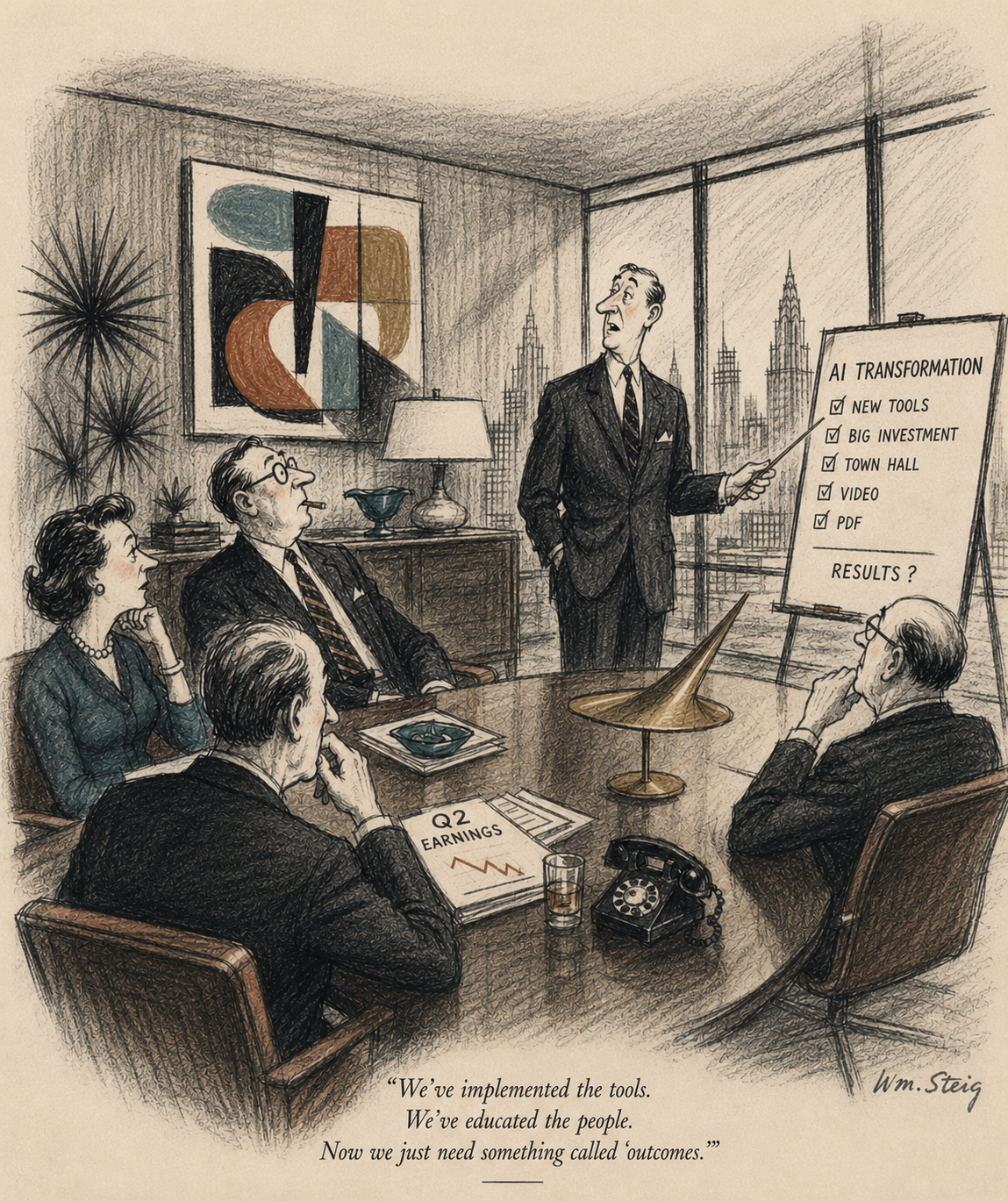
Here is what we keep seeing. Company buys a license for ChatGPT, Copilot, Gemini, or Claude — pick your favorite. Sends a 30-minute video to the workforce. Maybe shares some self-serve PDFs. Calls it a day.
Six months later: where's my productivity gain? Where's the transformation? Why is my Copilot bill up and my output flat?
A fool with a tool is still a fool. Peter has been saying that on the podcast for so long we're considering printing the t-shirts. And the truth is harsher than the t-shirt: a powerful tool in the hands of an untrained organization doesn't just fail to help. It amplifies whatever was already broken. Faster. At scale.
Rolling out tools is not a strategy. It's a step. The 95% who got nothing measurable out of their AI investment? A lot of them mistook the step for the journey. They were expecting outcomes that lived five stops down the road while only buying a ticket for the first stop.
Why this has to start at the top
There's a real argument — and we make it often — that AI fluency needs to be omnipresent in an organization, at every level of seniority. But that's an outcome. It doesn't happen without senior leadership getting it first. Here's why.
You cannot tell a business unit head to "magic up" an AI plan when you yourself can't tell a copilot from an agent, retrieval from fine-tuning, or a hallucination from a legitimate output. We've sat in rooms where a CEO has asked twelve divisional leaders to bake AI into their long-term strategies — none of whom had been given any training, any framework, any signal about what tools, what investment, or what guardrails were even on the table. They turned in pretty slides. They were going to "slather AI like peanut butter over every process." None of it was real.
You cannot lead change you don't understand. Your people watch what you do, not what you announce. When senior leaders openly use AI — and openly talk about how they use it, where it fails, what they've learned — it dissolves the stigma that has otherwise good employees secretly using personal ChatGPT accounts on company work because they don't trust what's been officially deployed. When senior leaders avoid using AI, or quietly use it while publicly hedging, that signal travels too. Shadow AI grows in the gap.
You cannot govern what you don't understand. The board is going to start asking for a regular AI report the same way it now expects one from the CISO. Whoever owns that report on the executive team has to understand the technology well enough to know what they don't know — and which questions they should be asking outside experts to answer.
You cannot outsource judgment. You can, and should, bring in people who live in this every day. We're some of those people. But there is a category of decision that cannot be delegated: what your business strategy is, which problems are worth solving with AI, what kind of organization you are willing to become. The senior executive who hands the entire AI agenda to "Tom in IT" and goes back to the spreadsheets has just opted out of running their company.
What "deep" actually means
When we talk about foundational education for senior leaders, we're not talking about coding. We're not asking a CEO to fine-tune a model. We're not handing anybody a Python textbook.
We're talking about awareness. Comprehension. Enough fluency that when you look at a problem or a process in your business, your first instinct shifts from "how would I solve this with the tools I've used for twenty-five years" to "is this a problem AI is actually good for, and if so, what kind, and what does it cost me to get it wrong?" That shift — even for people like us who live in this — took time. It's a different way of thinking about the work. Closer to learning a foreign language than learning a new application.
That doesn't happen in an hour. It doesn't happen in a webinar. It doesn't happen with a curated reading list. It happens through structured engagement over time — the kind that takes a senior leader through what these models actually do, where they actually break, how they should actually be deployed, what changes in the organization when they are, and what doesn't.
Deploying AI is not handing your people new software. It's transforming the people in your organization, and the only way that transformation lands is if the people at the top have been transformed first. That's not a slogan. We've watched it play out, in both directions, in enough companies now to know the pattern is reliable.
The bottom line
If you are a senior leader and you can't yet have a substantive conversation about how AI fits into your business — not a vendor demo conversation, not a buzzword conversation, but a real one — that's the gap. Close it before you sign another procurement order. Close it before you mandate another company-wide rollout. Close it before you walk into your next board meeting.
Your business strategy is your AI strategy. You can't write either of them in someone else's handwriting.