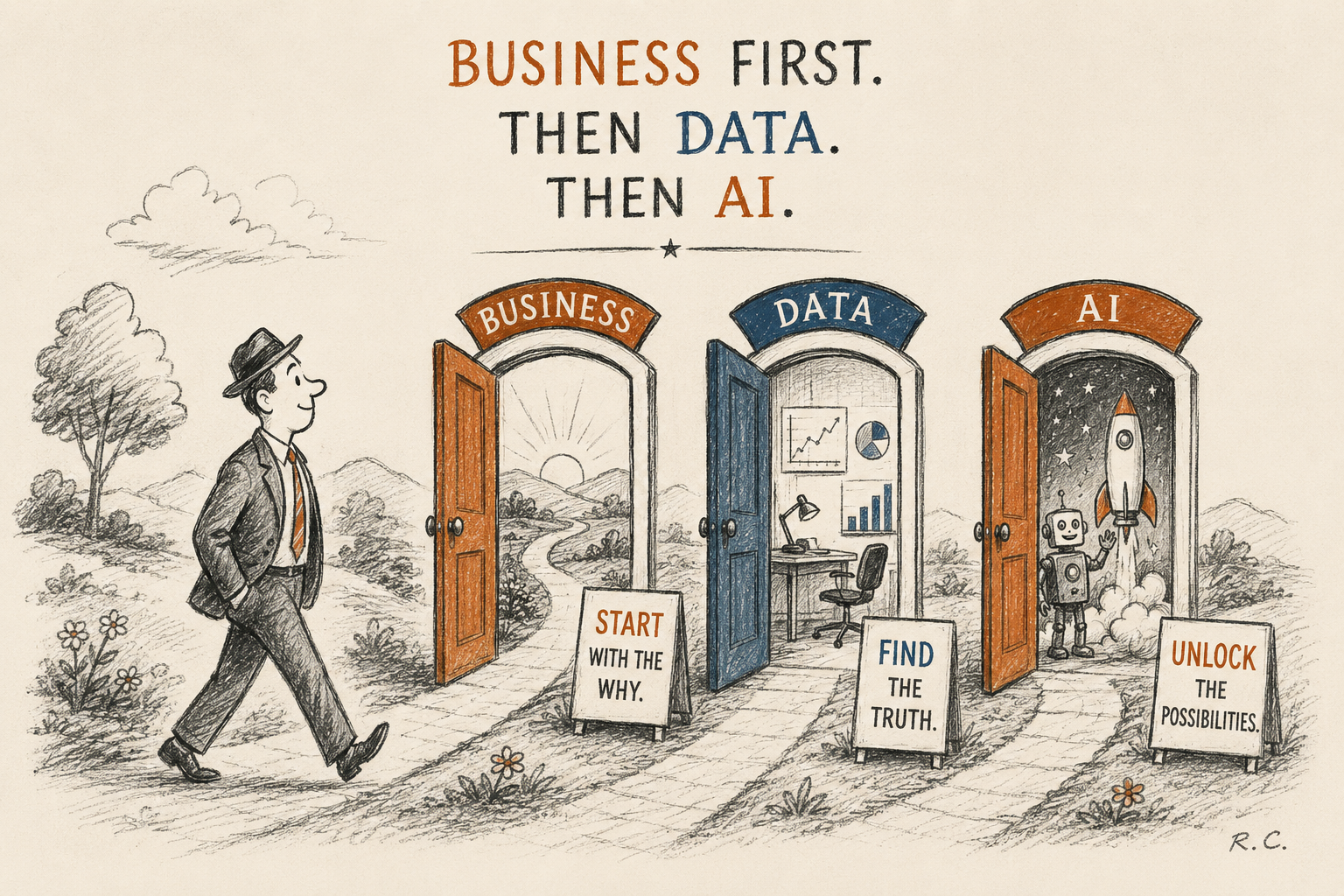
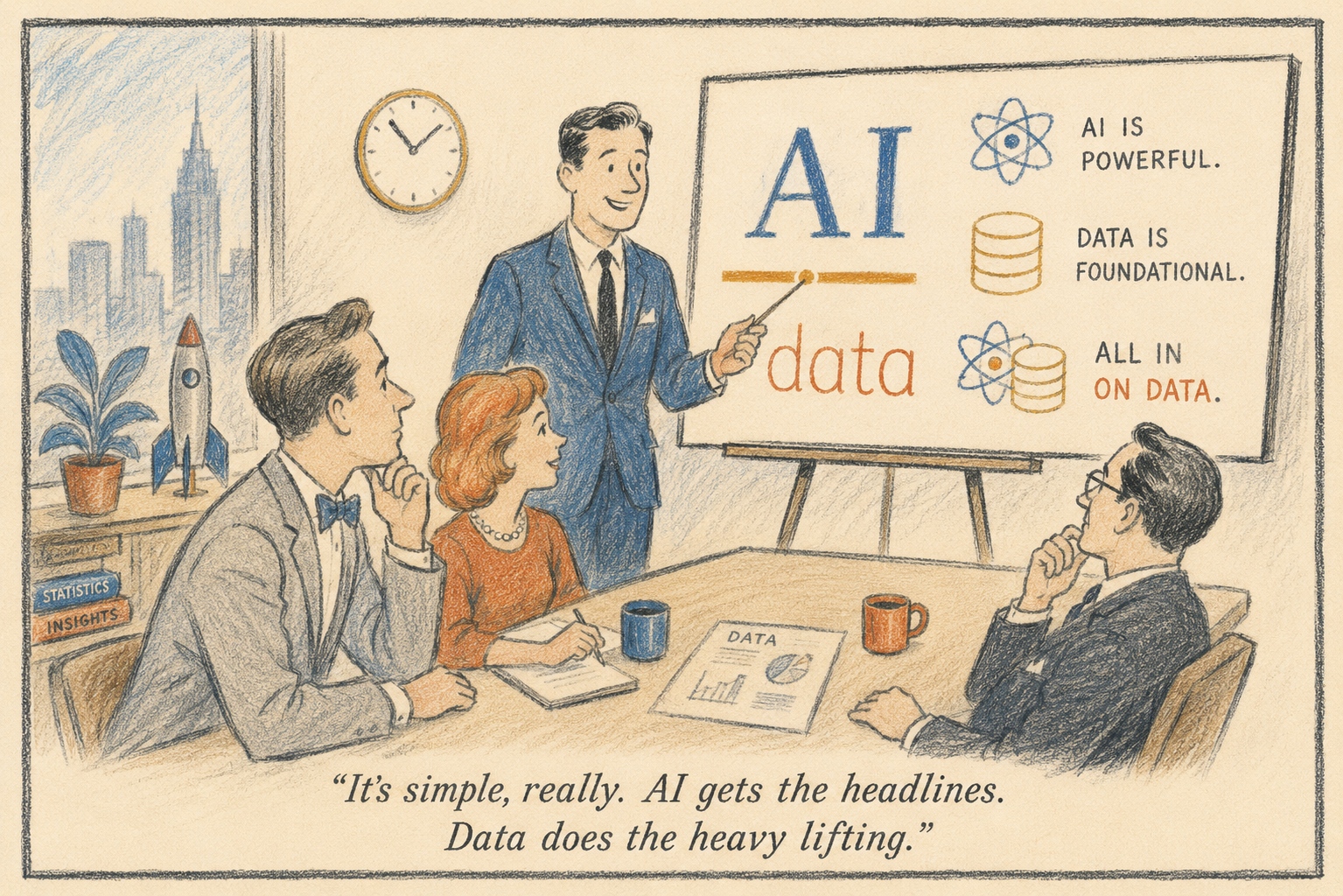
Business first. Then data. Then AI.
In that order. Every time. No exceptions.
It sounds obvious. It almost never happens. The default in our industry is to lead with the technology — pick a model, pick a platform, pick an agentic framework — and then retrofit a business case around it. That's how companies end up with thirty proofs of concept and no profit-and-loss impact to show for any of them.
We work the other way. Slower at the start. Faster everywhere after.
A real engagement begins with a conversation that has nothing to do with AI. What does your business do? Where is it going in three years? What's getting in the way? What are you measured on, what is your board measured on, what keeps your operating committee up at night? Only after we understand all of that do we ask the second question — and now, where does data and AI actually help? Sometimes the answer is "everywhere." Sometimes it's "in two specific places, and the rest can wait." Sometimes it's "you have a data problem, not an AI problem, and pretending otherwise will cost you a year." We've delivered all three answers. None of them have ever lost us a client.
From there, we work across six things. They aren't a checklist. They're the load-bearing walls of any data and AI program that's going to last more than a budget cycle.
Strategic alignment
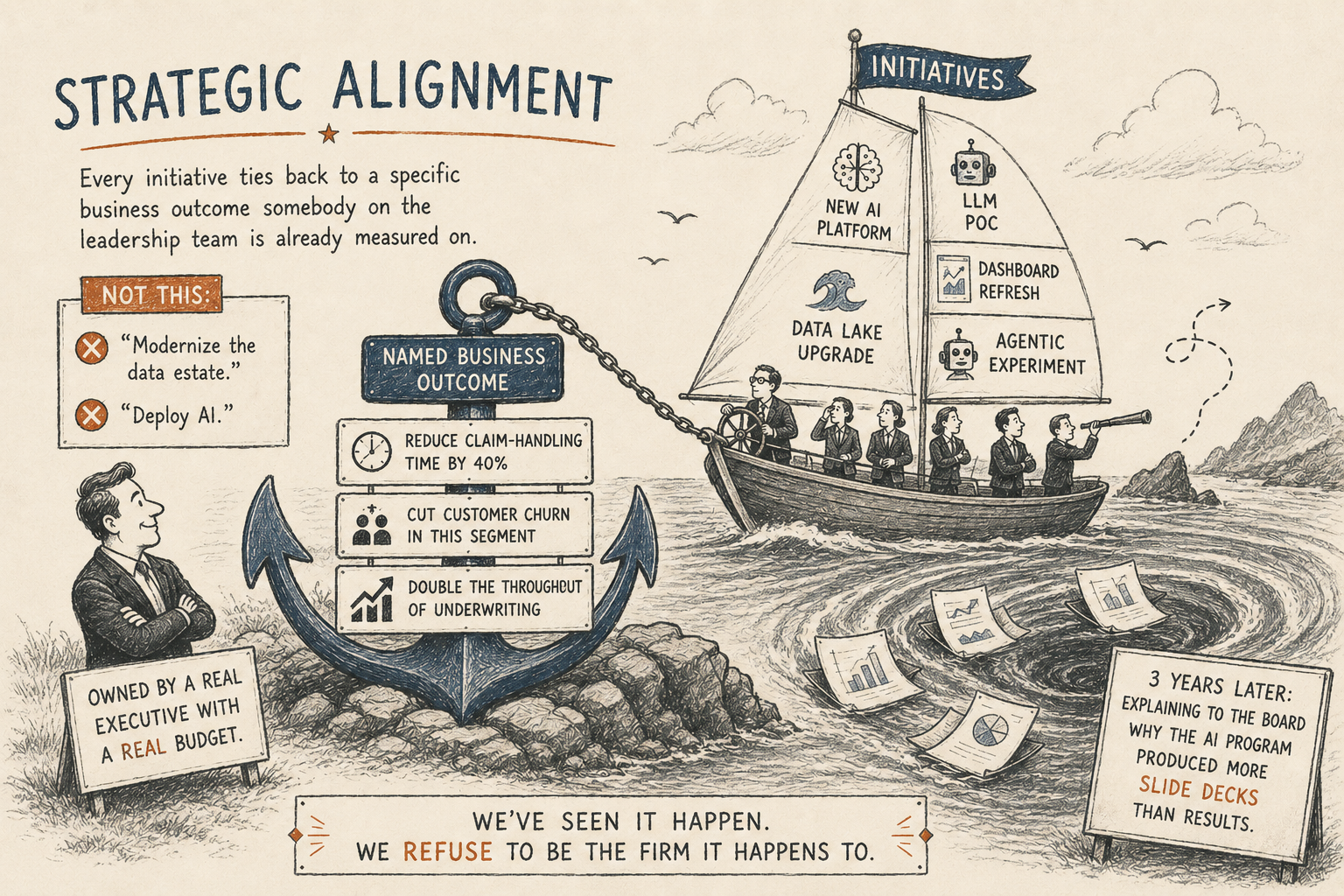
Every initiative ties back to a specific business outcome somebody on the leadership team is already measured on. Not "modernize the data estate." Not "deploy AI." A named outcome — reduce claim-handling time by 40%, cut customer churn in this segment, double the throughput of underwriting — owned by a real executive with a real budget. Without that anchor, the work drifts, and three years later you're explaining to the board why the AI program produced more slide decks than results. We've seen it happen. We refuse to be the firm it happens to.
Data and AI governance
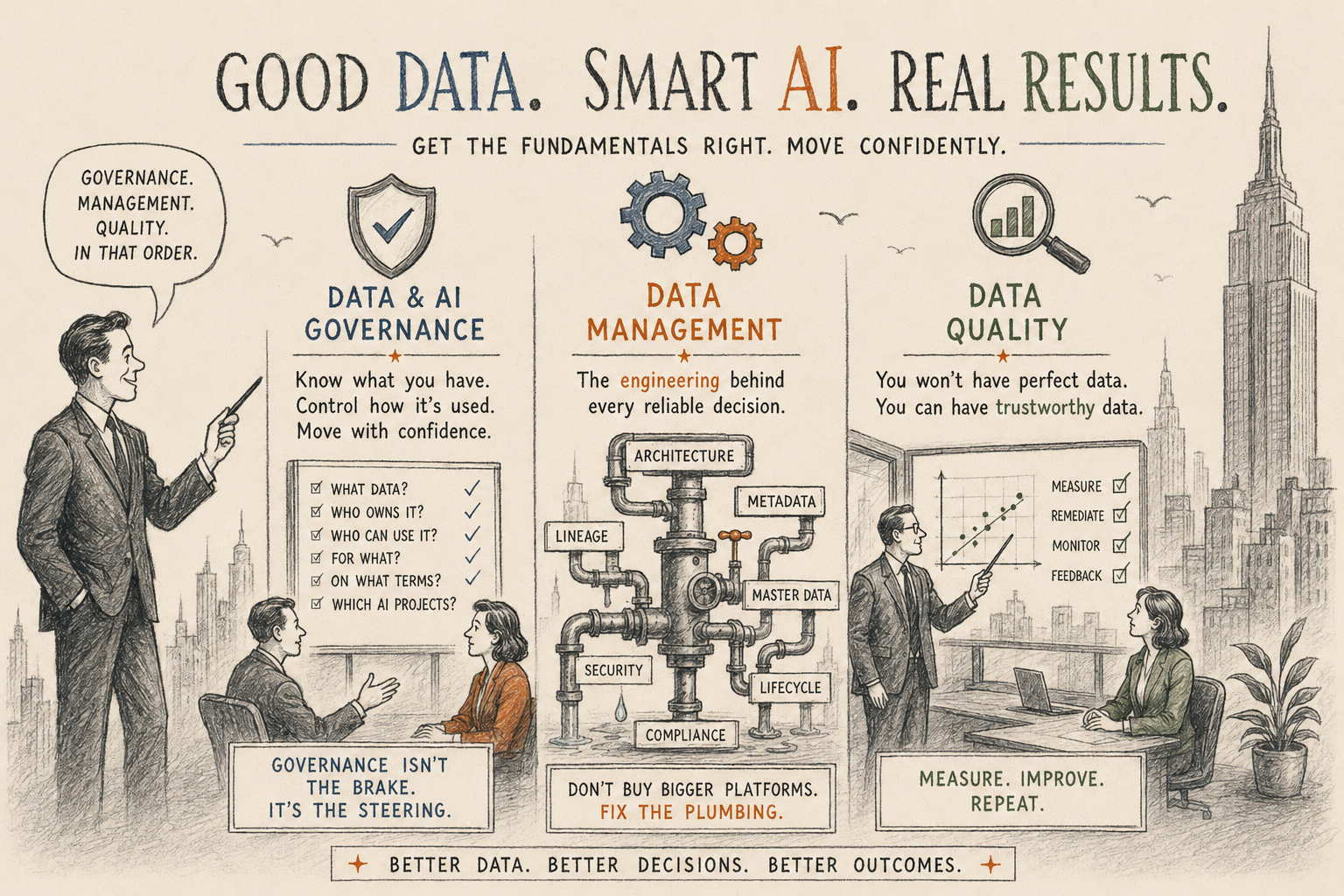
Not the bureaucratic version. The practical one. Do you know what data you have? Do you know who owns each piece of it, who's allowed to use it for what, and on what terms? Can you list — today, in a meeting, without phoning a friend — every AI project running inside your company? If the answer to any of those is no, you're carrying risk you haven't priced. Governance, done right, isn't what slows you down. It's what lets you move fast without breaking things you can't afford to break.
Data management
The actual engineering. Architecture, master and reference data, metadata, lineage, lifecycle, security, privacy, compliance. The unglamorous work that decides whether your data is an asset or a liability. We've walked into companies who'd spent nine figures on an AI platform while still emailing CSVs around as the primary data-sharing mechanism. The platform was fine. The plumbing was the problem. We fix the plumbing.
Data quality
You will not have perfect data. Nobody does. The question is whether you know how bad it is, where it's worst, who depends on it, and whether the models and decisions downstream can survive the imperfections. We help build the measurement, the remediation, and — more importantly — the feedback loops that keep quality from quietly rotting again the moment the consultants leave.
AI and analytics
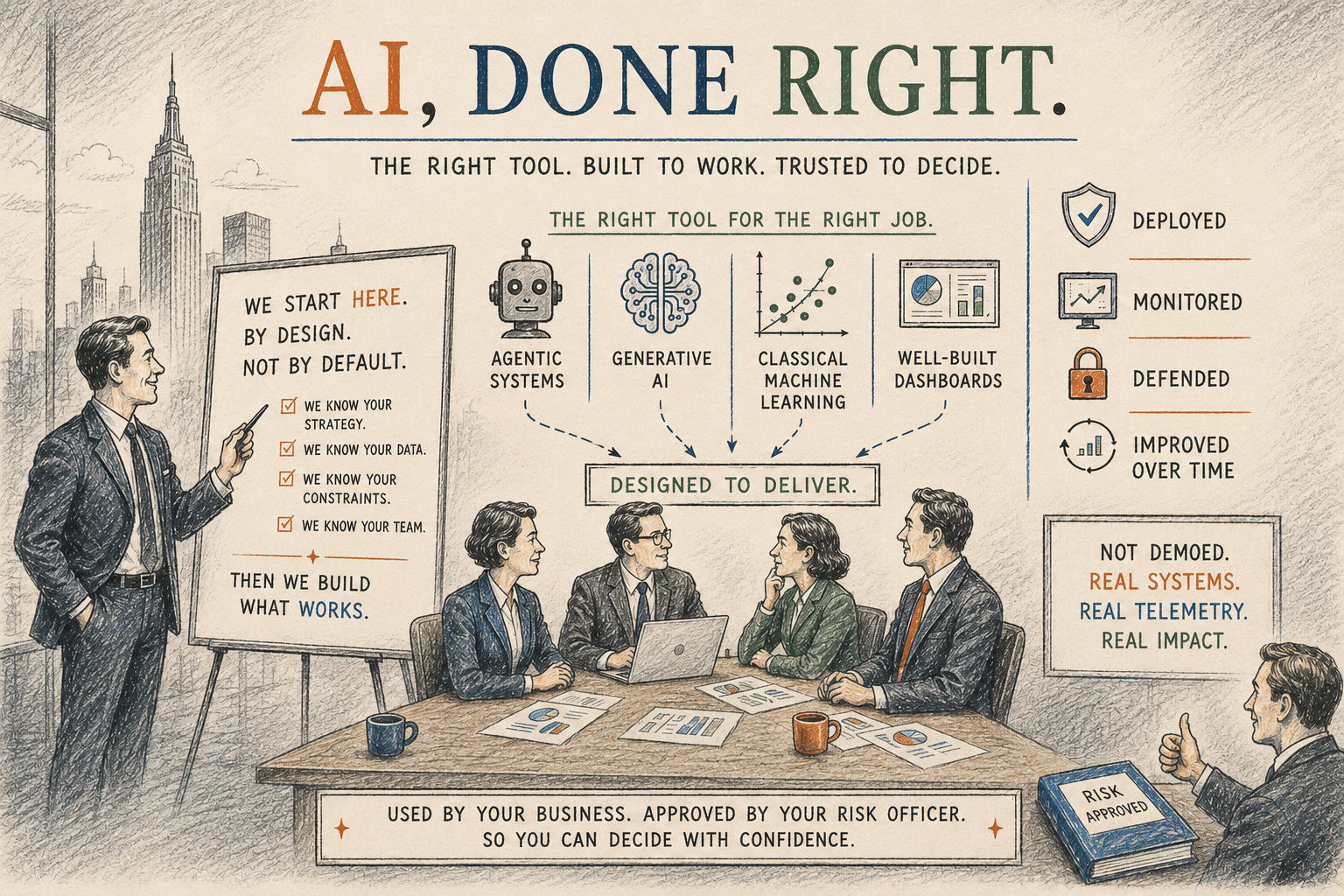
This is where most firms start. We start here fifth on purpose. By the time we get to it, we already know your strategy, your data, your constraints, and your team. Now we pick the right tool — agentic systems, generative AI, classical machine learning, sometimes just a well-built dashboard — and design it to be deployed, monitored, defended, and improved over time. Not demoed. Real systems, with real telemetry, that people in your business actually use to make decisions and that your risk officer can sign off on without losing sleep.
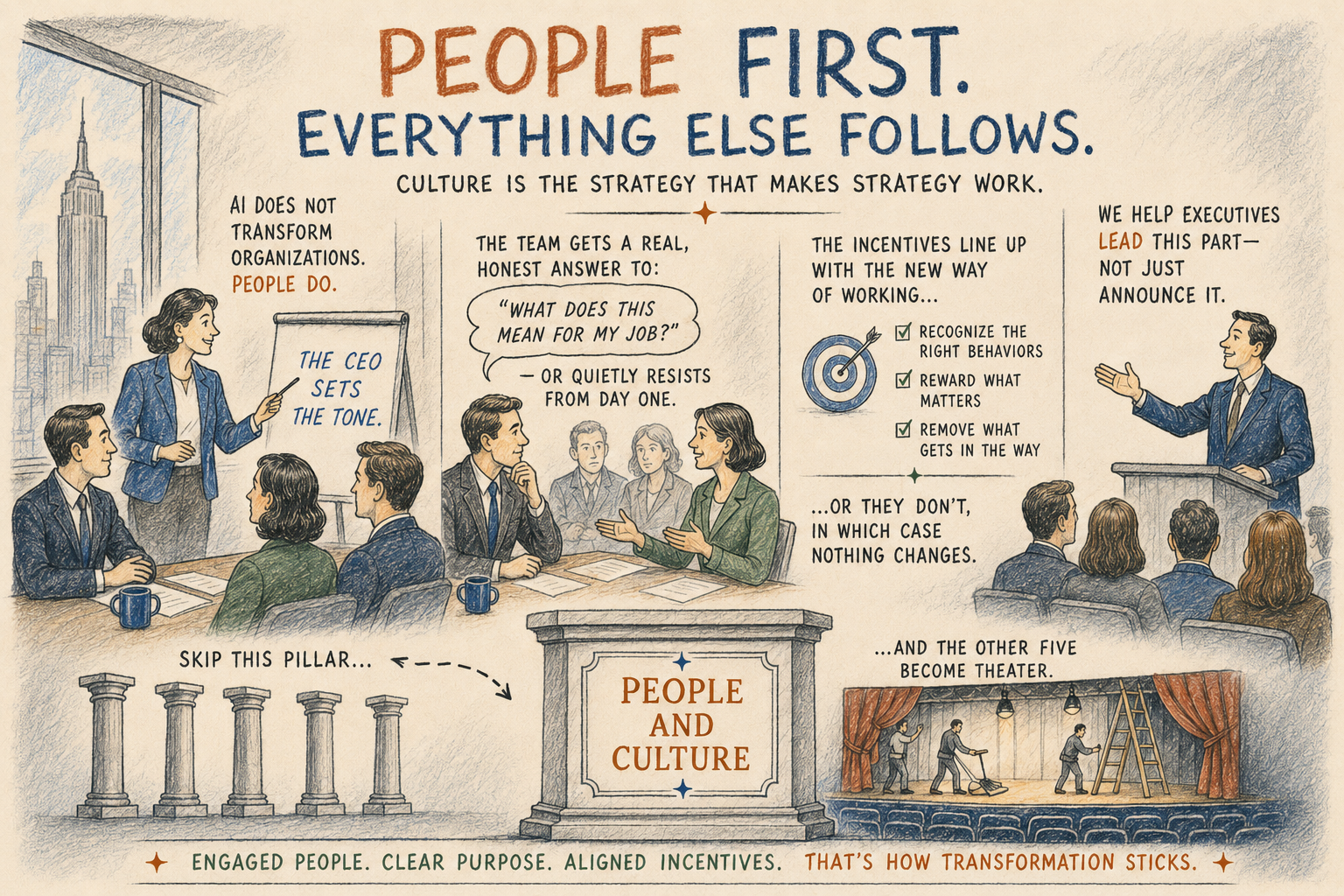
People and culture
The pillar that quietly decides everything. AI does not transform organizations. People do. The CEO sets the tone or the program drifts. The team gets a real, honest answer to "what does this mean for my job?" or quietly resists from day one. The incentives line up with the new way of working or they don't, in which case nothing changes. We help executives lead this part — not just announce it. Skip this pillar and the other five become theater.
How we move
We don't write hundred-page strategy documents nobody reads. We don't sell two-year transformation programs that try to land everything at once. Both are how the industry has historically protected itself from accountability, and neither survives contact with how fast AI is now moving.
We work in shorter cycles. Pick a real business problem. Build something useful and small. Ship it. Learn what it teaches you about your data, your people, and your assumptions. Adjust. Go again. Fail fast, fail cheap, get smarter every quarter. The companies winning with AI right now didn't plan their way there. They worked their way there — deliberately, with discipline, and with someone honest enough to tell them when a turn was wrong.
That's the work. That's what we do.