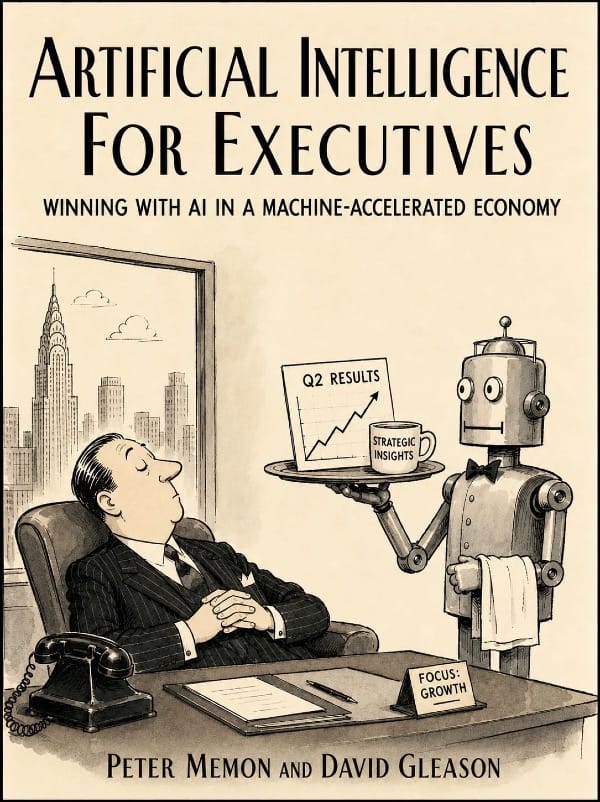
The Genesis of AI Transformation
Writing a book on AI is like trying to catch a phantom—the landscape changes daily. Welcome to the machine-accelerated economy where disruption happens overnight.
 Follow
Introduction
While the idea of writing a book is appealing in theory, the reality often sets in when one actually begins the arduous process of putting the proverbial pen to paper. It seems like this insurmountable wall that you have to try and climb. Once you actually sit down and start the process, and see actual progress, that wall slowly starts to crumble. Slowly, painfully, and eventually before you realize it that impediment is gone and you now see light on the horizon. Writing a book on AI is not a trivial pursuit - at least one that tries to capture the essence of its broad impact on work and society. Everything is moving at an incredible rate of speed. Change happens daily. And not just small changes but profound shifts in the capabilities. Just this morning we woke up to an announcement by Anthropic on their financial services offering. Having worked in finance for decades, and attempting to do something like this six years ago using AI, I know the complexity and the power of what was delivered. It would not be hyperbole to say it is a game changer that will radically alter many finance jobs. That’s the essence of AI. Rapid and significant change almost daily. This is not your parents innovation.
We had the idea of putting a book together for over a year but it always took a back seat to our other endeavors - such as building a company - but timing and a series of decisions on how to go about it presented itself. Over the past decade we have accumulated a vast amount of content. Substack articles, eBooks, podcasts, meeting transcriptions, an AI graduate class, presentations, white papers and other content. This information was the digital equivalent of Peter and David’s thinking. Our digital twins. It was how we engage, write, speak and convey our thoughts. We had all the content for a book but how, given our very limited amount of available time coupled with the rapidly changing domain, do you write a relevant book ‘quickly’. And we use that term loosely since quick is subjective. Suffice to say that this has been a labor of love and pure hard work.
Both of us have received numerous e-mails suggesting we should consider writing and publishing a book. There are a few large companies - names you would know - that ghost write books for busy business people that want to increase their level of visibility. In fact much of what’s out in the wild is probably ghost written. We are not fans of ghost writing since it is not our words. We both felt that there was no way that they could fully capture what is in our heads in a way that would illustrate the complexity and potential of AI so we took a different approach. We are both very good writers that have written a large volume of content that was consumed by others. We are comfortable putting down our thoughts in a cogent fashion and feel comfortable writing a book but time, or the lack of, prevented us from doing so.
We think it is necessary to be transparent about how this book was written. As we were saying previously we have a massive amount of content that could be used to write a book and organizing it would have taken a fairly large amount of time. Our process, quite honestly, was to use AI extensively in the writing process. Partly we wanted to test the hypothesis that this was possible and also, since we run a fully AI enabled consultancy, we wanted to ‘eat our own dogfood’. We preach that AI is a force multiplier. In many ways this is far more honest than having a ghostwriter put our names on a book we didn’t write in a voice that’s not ours. This book is based on our content. It’s our voice. So the process, once we settled on the right model to use, was fairly straightforward. Let’s be clear that this was not a trivial process. Easier for sure, but far from easy. When all is said and done this book will have taken many hundreds of hours to complete and that doesn’t include the thousands of hours of content that was used in its creation.
Eventually we settled on using Anthropic’s Claude to help write this book. We tested all the other models but ultimately Claude produced excellent results and the user interface was conducive to organizing the content together and writing. First we used Claude to generate a table of contents based on our large corpus of content. From there we created a complex prompt and input files that guided how to create the book chapter by chapter. We also created a robust prompt that would ‘interview’ us after the initial draft was created. This interactive interview process was typically long, asking many questions per chapter and extremely thorough. A chapter would often take hours and span over several days. Our responses were either typed into Claude or, in some cases, we used an application called Superwhisperer to transcribe our voices and then copy and pasted that into Claude. Often walking and thinking and talking are highly productive and we both found this to help our writing process enormously. Maybe this sounds a bit odd but removing the constraints of sitting at a desk and typing all day allowed both of us to think very differently and then have a model summarize our words. We have all had those moments when a brilliant idea comes to you and then it is gone but Superwhisperer allowed us to capture it and use those ideas. This approach was extraordinarily powerful.
After we had a draft of this book, which took approximately two months of consistent, daily, writing, the hard work really began. Editing and re-editing. Editing a book, for anyone that has not done it before, is really difficult. We are not professional editors but we first wrote and rewrote until it articulated clearly what we wanted to communicate. We both can say that Claude did an impressive job putting together draft chapters based on our content and interview responses.
For those really curious, the prompt that we used had Claude interview both of us as if Claude was acting like a premier business writer such as Peter Drucker, W. Edwards Deming and others. Claude, most impressively, wound up being an excellent, highly detailed oriented, interviewer. Arguably the questions were sometimes, and often, brutal in their difficulty asking us to clarify our thinking.
The editing process took months but what ultimately came out, we believe, is our words, our content and our thinking, in our voice, on this incredibly complex and exciting subject that we believe wholeheartedly will have profound implications on business and society.
It was by no means an easy process using AI to compose this book but we both can say that it certainly sped the process up significantly and ultimately gave us, we think, a better result.
The greatest gift an author can expect is that someone gains knowledge from reading their words. It is our hope that you walk away from this book with a deeper understanding of the implications of this fascinating technology.
Peter Memon and David Gleason
May 2026