The CIO Should Not Run Your AI Rollout
If Your CIO Is Running Your AI Rollout, You've Already Failed. How would you expect to be running a company in 2026 and not understand how AI works?
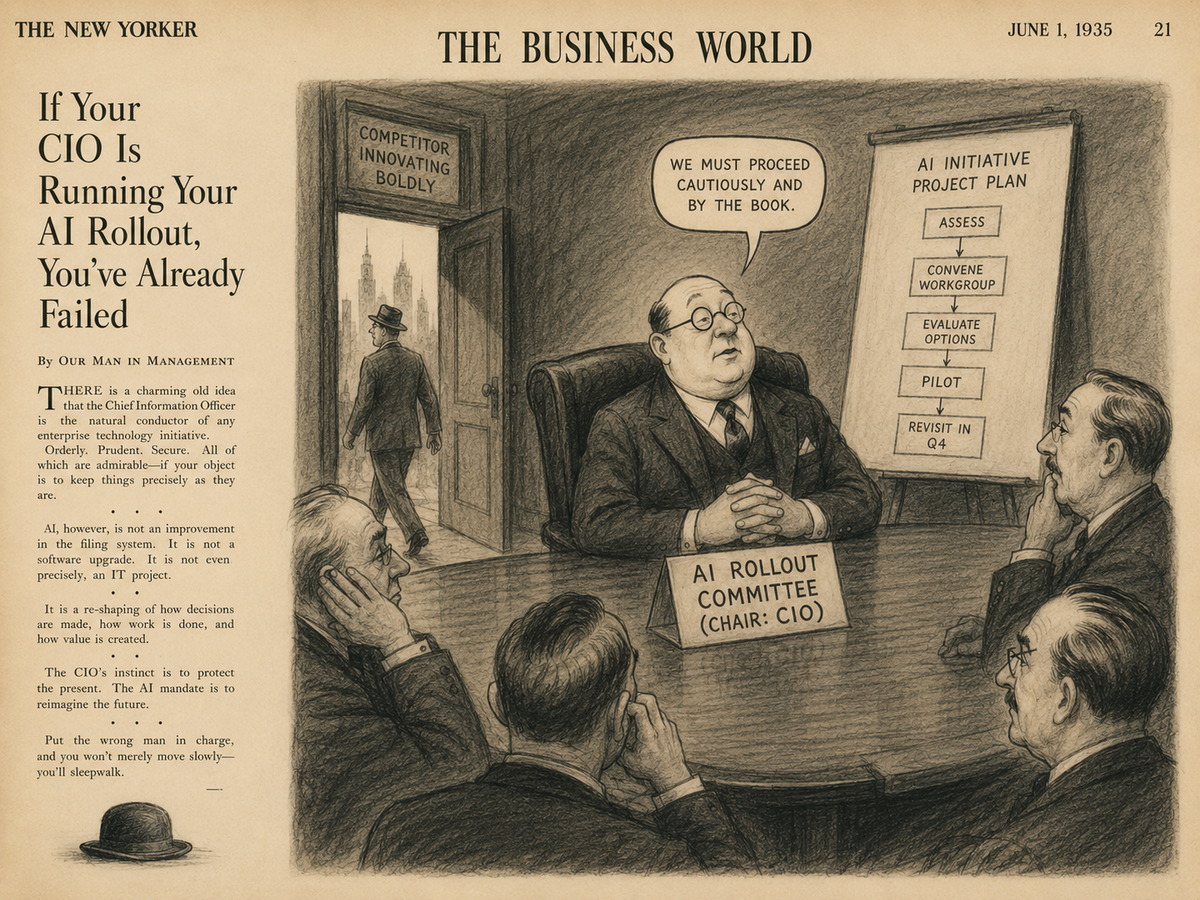
If Your CIO Is Running Your AI Rollout, You've Already Failed
Here's a question we've been asking every senior leader we meet, and we keep getting the same uncomfortable silence: how would you expect to be running a company in 2026 and not understand how AI works?
It's not a rhetorical jab. It's a real question. And the silence is the problem.
Right now, somewhere between 80 and 95 percent of corporate AI initiatives are coming up empty. MIT's State of AI in Business report put the failure number at 95 percent. That's not an "early-days" number. That's a generational malpractice number. And we've now seen enough of these rollouts up close to know that almost none of them failed because the technology wasn't ready. They failed because the company wasn't.
Specifically, the people at the top weren't ready. And they're still not.
This is the conversation no one wants to have. So let's have it.
The Slathering Problem
We've watched company after company roll out ChatGPT, Copilot, Gemini, or Claude to thousands of employees. They throw a 30-minute online training session at people, drop a link to some self-serve materials, and call it done. Then they sit back, wait three months, and wonder where the productivity miracle went.
Imagine a factory owner who buys a thousand industrial robots, drops them on the loading dock, hands the operators a quick-start PDF, and says, "good luck, see you at the productivity review." No one would do that. And yet that is exactly what hundreds of companies are doing with AI right now and calling it a "transformation strategy."
We've talked to leadership teams who, in the same breath, will tell us they've slathered AI like peanut butter across every process in the company — and then ask us, with a straight face, where the ROI is. The ROI is buried under the peanut butter. You can't see it because no one was actually trained to use the knife.
The Executive Hypocrisy Nobody's Calling Out
Here's the part that should make every board member sit up. A recent industry survey found that 79 percent of executives said they were confident their companies would meet or exceed their AI transformation goals. Seventy-eight percent said they were confident in their change management approach. Almost four out of five leaders — survey says — got this.
We can guarantee they don't. We know what they're saying and what they're actually doing, and the two are not in the same zip code.
The same survey found that a majority of those same executives won't admit they personally use AI. They're using it in private — drafting emails, summarizing reports, prepping for meetings — and they're hiding it. Then they walk into the all-hands and tell their workforce that AI is the future and everyone needs to embrace it.
You cannot lead people through a transformation you are too embarrassed to admit you're already participating in. The workforce sees through it. The line-of-business employees surveyed in that same report did not match their leaders' optimism. Not even close. They are watching their leaders perform confidence on stage while quietly winging it backstage, and they have noticed.
If you want to know why your AI rollout isn't working, start there.
The Top Is the Wrong Place to Skip
The default playbook for the last three years has been to push AI down through IT or, worse, through legal and compliance. We are going to be blunt: if your CIO is responsible for your AI rollout, you have already failed. You may not know it yet, but you have. If your first stop is the lawyers, you are trying to regulate something nobody in the room actually understands. We have sat in meetings at major companies where the AI initiative had been "in legal review" for three years. Three years. The technology you were trying to regulate barely existed three years ago.
This is not a knock on IT, legal, or compliance. They all belong at the table. None of them should be at the head of it.
AI is not your father's technology. It is not another ERP rollout. It is not a new email client. It is the most transformative tool of our lifetime, for better or for worse, and it touches every function in your business. Pretending otherwise is how you get to the 95 percent club.
Education must start with the senior leadership team, and it has to go well beyond a polite lunch-and-learn. We are not talking about a vendor demo with sandwiches. We are not talking about a one-hour online course. We are talking about real, deliberate, foundational education for the people who set the strategy and sign the checks.
Why? Every CEO understands their balance sheet. They are not the CFO, but they know how it works. Every CEO understands their go-to-market. They are not the chief revenue officer, but they understand sales. AI deserves the same level of fluency from the top. You can't outsource this. You can't hand it off to someone and say "Tom's got it now, moving on." Not at this stage. Not with a technology this consequential.
Understand How These Models Actually Work
Here's where we get specific about what foundational education actually means. Senior leaders don't need to train a model from scratch. They don't need to write Python. But they do need to understand a few foundational things, and these things are not optional.
First, large language models are probabilistic, not deterministic. They predict the most likely next token based on the patterns in their training data. They are not databases. They are not search engines. They are not oracles. They generate plausible-sounding text. Sometimes that text is right. Sometimes it is confidently and beautifully wrong. The most insidious thing about these models is that they sound exactly the same whether they are right or wrong. That single insight changes how you think about deployment, validation, and risk.
Second, models have knowledge cutoffs. They do not know what happened yesterday unless you tell them, or unless they have tools to look it up. Once you understand that, you stop being shocked when a model gives you a stale answer, and you start thinking about how to ground the model in your own data through approaches like retrieval-augmented generation.
Third, models reflect the data they were trained on. If most of the world's writing supported a flat earth in 1490, that is what your model would have told you. The popular answer is not always the right answer. The most important ideas are often the low-probability ones the model will quietly downrank in favor of consensus.
When senior leaders grasp these three things, they stop treating AI as either a magic oracle or a useless toy. They start treating it as what it actually is: an incredibly powerful, sometimes flawed, often surprising collaborator that needs direction, oversight, and judgment.
Prompting Is the New Literacy
We'll admit it. When "prompt engineering" first became a job title, we both rolled our eyes. It sounded pompous. Writing a few questions and calling it engineering? Come on.
We were wrong.
A good prompt is the difference between getting a usable answer and getting confident garbage. One of us spent an hour last week writing a single prompt that saved fifty hours of research. The same task with a lazy three-word prompt would have produced something that sounded great and was full of holes. Worse, the lazy-prompt version would have been impossible to spot as wrong unless you were already an expert on the topic — which is exactly the moment when you would not need the model in the first place.
Prompt engineering is a skill, not a job. We don't hire typists anymore — we expect everyone to type. The same is becoming true of prompting. And it starts at the top. If your CEO can't construct a serious prompt, your CEO cannot credibly walk the floor and tell anyone else to use these tools well. They will be standing on stage demanding AI fluency they themselves do not possess, and the workforce will see it.
A serious prompt has context, constraints, examples, and a clear specification of the output format. It often takes longer to write than the answer takes to read. That feels wrong to people until they have done it once and gotten back something genuinely useful — and then they never go back.
The Knowledge Asymmetry Trap
There is one more reason senior leaders need to go first, and it is the one we worry about most. A dangerous knowledge asymmetry is forming inside almost every company we work with.
Younger workers are AI-native. They use these tools constantly, often with their employer's tools and often without — recent surveys show 89 percent of Gen Z workers use AI frequently at work, and many of them are using personal accounts on unsanctioned tools because the corporate version is locked down or inferior. But they do not yet have the business judgment or domain depth to wield the tools well.
Senior workers have decades of judgment and deep institutional knowledge. They know where the bodies are buried, where the real risks live, and what good output actually looks like in their domain. But they are uncomfortable with the tools and often quietly hostile to them.
The people who know how to swing the hammer don't know what to build. The people who know what to build don't know how to swing the hammer. That is a recipe for disaster. The only people who can close that gap are senior leaders willing to put in the work themselves and then create the conditions for the rest of the organization to follow.
And let's be honest about what happens if they don't. We have seen CEOs publicly push out long-tenured, high-performing executives for being insufficiently enthusiastic about AI — while those same CEOs could not, if pressed, explain how a transformer architecture differs from a search engine. That is not leadership. That is theater. And it will be remembered.
Where to Start
If you take one thing from this post, take this. Do not roll out AI broadly across your workforce before you have genuinely educated your leadership team. Two or three days of focused, deliberate foundational education for your top thirty or forty people is the highest-leverage investment you can make this year. Full stop.
Cover how the models actually work. Cover what prompting is and why it matters. Cover where AI fits and where it does not. Cover what your data needs to look like to make any of it useful, because your data strategy and your AI strategy are inseparable. Cover the risk surface honestly — hallucinations, automation bias, cognitive offloading, model collapse, data leakage — without retreating into the "we'll wait for legal" cop-out.
Then translate all of that into a real business strategy. Because your business strategy is your AI strategy. They are not two documents. They are one.
Here's the harsh part. If you skip this step, none of the rest of it will save you. Not the consultants. Not the tools. Not the rebranded chief AI officer. Not the dashboard. You will end up in the 95 percent, you will blame the technology, and you will be wrong. AI did not fail. The company failed to take it seriously enough to learn it.
This is not your father's technology. It is the most transformative tool of our time. The companies that treat it that way — starting with the people at the top — will define the next decade. The companies that keep slathering will get exactly what they have paid for, which is nothing.
Start at the top. Or don't bother starting at all.