You Can't Stream Your Way to an AI-Capable Organization
Your team finished the AI training, the dashboard turned green, and everyone agreed the company was now "AI-ready." That's a real first step — but the shift that actually separates the winners from the spectators can't be downloaded, streamed, or checked off a list.
"A bad system will beat a good person every time." - W. Edwards Deming
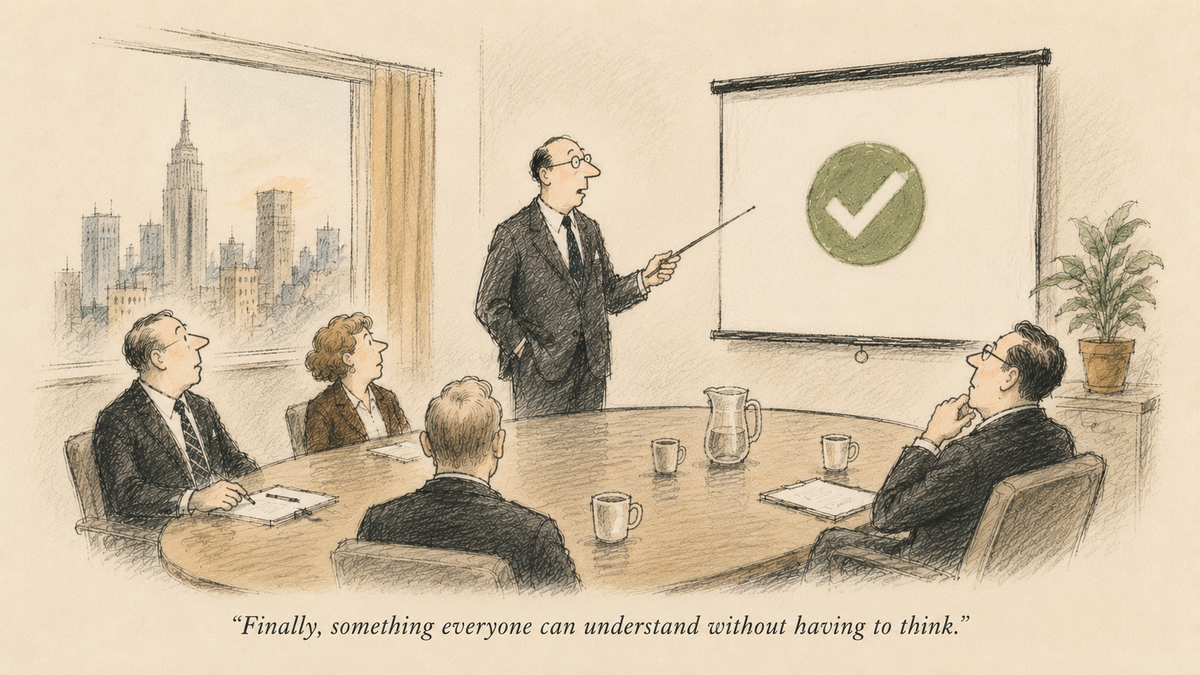
There is a particular kind of optimism that takes hold in a leadership team right after they approve the AI budget. Someone buys a stack of licenses. Someone else commissions a library of training videos — tidy fifteen-minute modules with progress bars and a quiz at the end. A dashboard somewhere lights up green as completion rates climb. And everyone agrees, with great relief, that the organization is now "upskilling."
That's a real and worthwhile step. It's also not the finish line.
We say that with genuine respect for the people who set it up, because the instinct is exactly right. You cannot deploy AI across a company without changing how the people in it think and work, and a strong training library is a sensible place to begin — it builds shared vocabulary, it gets everyone past the blank-page intimidation, and it's the most efficient way to put basic fluency in a lot of hands quickly. The thing to know is that it's necessary but not sufficient. The most important thing AI asks of an organization is not a skill you can absorb passively from a screen. It is a change in how people approach problems — and that particular shift needs more than a video watched at 1.5x speed between meetings. The videos open the door. They don't walk anyone through it.
AI is built on data, and the organizations that win the next decade will be the ones who took their foundations seriously while everyone else chased the shiny thing. But there is a second foundation that gets even less attention than data, and it is the one made of people. Getting it right requires something the market would rather not sell you, because it doesn't scale neatly and it can't be licensed by the seat: in-person education, in depth, starting at the top, with the hard conversations left in.
The thing videos can't teach
Recorded training is excellent at one job: transferring procedure. If you need five hundred people to know which button to click, a video is a fine and efficient way to do it. The trouble is that "which button to click" is the least valuable thing anyone needs to learn about AI, and it's the part that changes every other Tuesday anyway.
The valuable thing — the thing that actually determines whether your AI investment turns into a business outcome or an expensive autocomplete with a confident voice — is judgment. Knowing what a tool is genuinely good at and where it's on shakier ground. Knowing which problems are worth pointing it at and which are a waste of everyone's afternoon. Knowing when an output is ready to rely on and when it needs to be pushed back on. None of that is procedural. All of it is contextual, and context is exactly what a generic video module strips away.
Judgment is built through friction. This isn't a new idea — it's one of the oldest truths about how expertise forms, and it stuck with us the first time we encountered it years ago. We get sharper through being asked a question we can't quite answer, watching a peer reason through a problem differently than we would have, and working through a real decision with real stakes alongside other people. That happens in a room. It happens when a thoughtful senior manager says "I'm not sure I buy it" out loud and the group works the question together. You cannot manufacture that kind of friction asynchronously, and the mild discomfort of it is not a flaw to be smoothed away. The discomfort is where the learning lives — and it's also, in our experience, where the room starts to enjoy itself.
Start at the top, and mean it
Most AI education programs are aimed downward — at the analysts and the individual contributors, the people assumed to be doing the "actual work." Leadership attends a one-hour overview, nods approvingly, and delegates the rest. This gets the hierarchy of the problem exactly backwards.
The decisions that make or break an AI effort are not made at the keyboard. They are made in the room where someone decides which initiatives get funded, how success will be measured, and whether the organization is willing to change a process it has run the same way for fifteen years. If the people in that room don't understand — really understand, not buzzword-deep — what these systems can and can't do, no amount of training underneath them will compensate. You will get a beautifully upskilled workforce executing a strategy that was set by people who were guessing.
So the education has to start with senior leadership, and the good news is that it's more approachable than most executives fear. We believe a working, non-technical understanding of what these models are and roughly how they work is essential for business leaders — not so they can build anything, but so they can do the two things only leadership can do: predict where AI will genuinely add value, and figure out how to integrate it into a complex organization with real people, real processes, and real constraints. You can't make those calls well from the outside. A little grounding in how the technology behaves turns AI from a black box you have to take on faith into a capability you can reason about, point in the right direction, and hold to a standard.
That grounding is friendlier than the jargon suggests. Leaders don't need to write code or follow the math. They need an intuitive sense of a few things: that these systems learn patterns from data and are only ever as good as the data and the question behind them; that they're remarkable at some tasks and genuinely shaky at others; and that the clarity you bring to a request shapes the quality of what comes back. Understand that much and you can spot the opportunities others miss — and gently test a claim that sounds a little too good — without ever touching a keyboard.
Those questions are specific, and they are learnable. Can you draw a straight line from this AI investment to the business outcome it serves? Is this actually an AI problem, or a data problem wearing AI clothing because that's what gets the budget approved? Where might this system be on shaky ground, and who's positioned to catch it? A leader who walks out of a room able to ask those three questions with confidence is worth more to an AI program than a hundred completed video modules.
The hard part isn't the tool. It's unlearning.
Here is the uncomfortable thing we've watched play out in organization after organization, and it is the reason this work has to be done live.
The most experienced people in your company are often the slowest to get value from AI — not because they're less capable, but because they're more capable. Over a long career, a senior manager builds a dense library of heuristics: shortcuts, rules of thumb, "the way we handle this," instincts that let them make good decisions fast without consciously reasoning through them. That library is the basis of their expertise. It is also, quietly, the thing standing between them and a genuinely different way of working.
AI doesn't reward the person who already knows the answer and reaches for it. It rewards the person willing to reformulate the question — to approach a problem they've solved a thousand times as if they were seeing it fresh, to explore three framings instead of defaulting to the one that has always worked. That is not a skill. It is closer to the opposite of a skill. It asks senior people to set aside, at least temporarily, the very heuristics they've spent decades building, and to be a beginner again in a domain where they are used to being the expert in the room.
You cannot watch your way into that. Telling an accomplished executive "think differently about problem-solving" in a recorded module is like handing someone a pamphlet about humility. The shift happens through experience — through sitting with a problem alongside a peer, trying an approach, watching it fail, watching someone at your own level try something you'd never have considered, and feeling the small productive shock of realizing your instinct wasn't the only one available. That feeling is the entire point, and it is profoundly social. It does not survive being recorded.
Why peers, not just instructors
There's a reason we keep saying "alongside a peer" rather than "from an expert." When a junior trainer tells a thirty-year veteran how to do their job, the veteran's heuristics — correctly, most of the time — win the argument. But when a fellow senior leader, someone who carries the same scars and the same earned skepticism, says "I was sure this was a waste of time, and then I tried it on the thing we both hate doing, and here's what happened" — that lands. The credibility transfers because the experience is shared.
This is why the format matters as much as the content. People change how they work by watching people like them work differently. Peer-to-peer learning, structured discussion among equals, leaders teaching leaders — these aren't soft enrichment activities to schedule if there's time left over. For the population that holds the most institutional knowledge and the most resistance, they are the mechanism. Flatten the room. Let the hard questions get asked out loud. Let the skeptics be skeptical in front of each other, because watching a respected peer come around is the most persuasive thing in any organization.
In practice, the sessions that work don't look like training at all. They look like a group of senior people bringing a real problem they actually own — a decision on the calendar, a process everyone quietly resents, a report that takes three days to produce — and working it through together, out loud, with the tool open in front of them. The point is not to leave with a finished answer. The point is to watch each other reason, to hear someone frame the problem in a way you wouldn't have, and to feel, in a low-stakes setting, what it's like to be wrong-footed by a peer's approach before it happens in front of a client or a board. A good facilitator doesn't lecture; they keep the friction productive and refuse to let the room retreat to the comfortable shortcut. That is slow, and it is occasionally awkward, and it is worth more than any module library precisely because no two rooms produce the same conversation.
What this is really about
None of this is an argument against technology, and it is emphatically not an argument that AI replaces the people doing this learning. The opposite. The entire reason to invest this much in human judgment is that AI is an amplifier, not a magic wand — it amplifies clarity into compounding advantage and confusion into expensive, automated confusion. The goal is augmented intelligence: using these tools to extend what your best people can do, not to thin out the ranks. A workforce that has genuinely changed how it thinks is the moat. The model isn't. The model is a commodity that gets cheaper and more capable while you read this sentence.
We understand why the video library is appealing. It's measurable, it's cheap per head, and it produces a satisfying green dashboard you can show the board. In-person education is none of those things. It's expensive in the currency leaders guard most jealously, which is senior time. It's hard to schedule. It refuses to scale the way a budget line wants it to. And it is, in our experience, the difference between an organization that becomes genuinely AI-capable and one that has simply spent money to feel modern.
The companies that wait for the gun-to-the-head moment — that treat this as a training-completion problem to be checked off rather than a change in how their people think — are the ones future business students will read about in chapters with unkind titles. Inertia is comfortable precisely because the quarter still looks fine. It also kills.
So put the senior people in the room. Make it in person. Make it deep. Let them ask the questions they're slightly embarrassed not to know the answers to, and let them argue about real decisions with real stakes. Let them learn from each other, not just from a screen. It is slower and harder and more expensive than pressing play — and it is the only version of this that actually works.
These are the conversations no one else wants to have with you, because they're inconvenient and they don't fit in a fifteen-minute module. They're also the ones that decide whether your AI strategy — which is to say, your business strategy — is built on a foundation or on a dashboard full of completion rates. We'd rather have the inconvenient version. We suspect, if you've read this far, so would you.