Chapter 1: What is AI, Really?
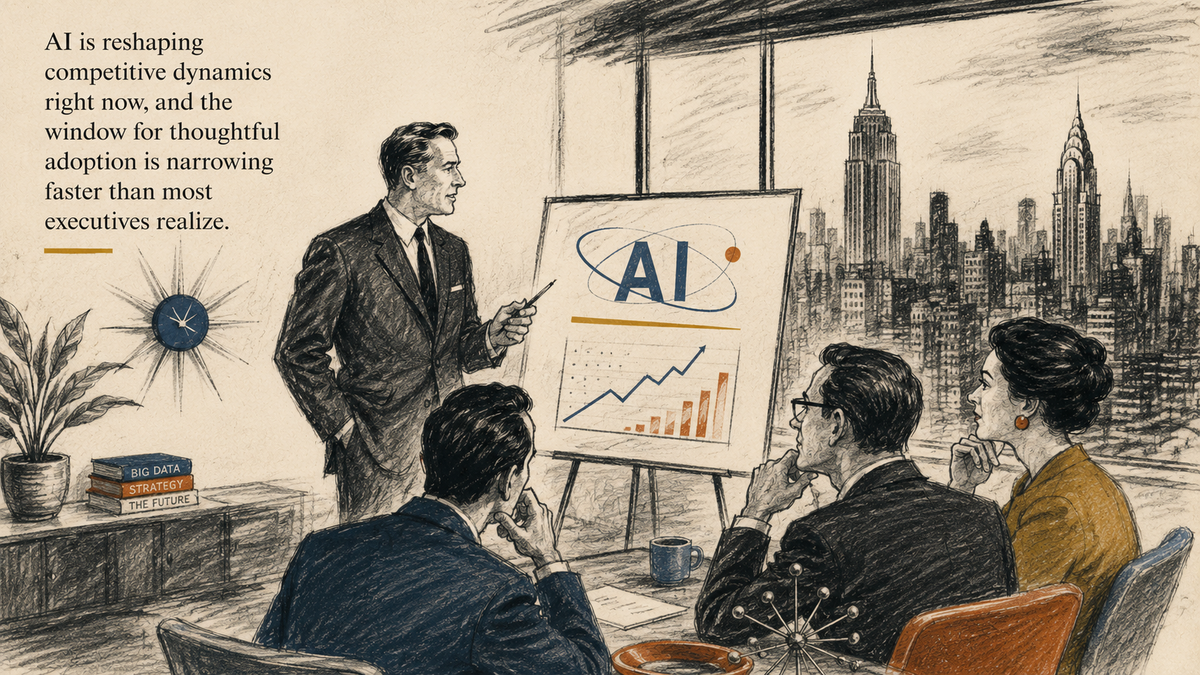
AI is reshaping competitive dynamics right now, and the window for thoughtful adoption is narrowing faster than most executives realize.
"There are risks and costs to action. But they are far less than the long-range risks of comfortable inaction." - John F. Kennedy
Moment of Truth
The conference room falls silent as your chief technology officer wraps up her presentation on artificial intelligence initiatives. Board members exchange glances. Someone clears their throat. Then comes the inevitable question that every executive dreads: "So what exactly is AI, and why should we care about it now?"
If you've found yourself in this moment—nodding knowingly while secretly wondering whether AI is revolutionary technology or expensive snake oil—you're in excellent company. But here's the uncomfortable truth: while you've been waiting for clarity, your competitors have been building competitive moats that may soon become unbridgeable.
AI is reshaping competitive dynamics right now, and the window for thoughtful adoption is narrowing faster than most executives realize.
The WeWork Moment
In January 2019, WeWork was valued at $47 billion and preparing for what many expected to be one of the largest IPOs in history. The co-working company had raised $12.8 billion in financing, mostly from SoftBank's Vision Fund, and was expanding globally at breakneck speed. WeWork's leadership believed they had revolutionized commercial real estate and created a new category of "space as a service."
But when WeWork filed its IPO documentation in September 2019, investors discovered a company burning through cash at an unsustainable rate, with fundamental business model flaws and questionable corporate governance. The IPO was cancelled, CEO Adam Neumann was forced to resign, and the company's valuation collapsed by more than 80%.
Four years later, in November 2023, WeWork filed for bankruptcy, listing liabilities of $18.6 billion against assets of $15 billion. The company that once promised to transform how people work couldn't adapt to changing market conditions or fix its core economics. WeWork's story illustrates how quickly market leaders can collapse when their fundamental assumptions prove wrong.
The timeline is horrifying. From $47 billion valuation to bankruptcy in just four years. WeWork fell victim to what we might call "disruption delusion"—believing that rapid growth and venture capital could substitute for sustainable business fundamentals.
AI operates on an even more compressed timeline. The technology advances weekly, not annually. Companies building AI capabilities today aren't just implementing software; they're developing organizational muscles for continuous adaptation. The gap between early adopters and laggards isn't just technological—it's cultural, strategic, and increasingly unbridgeable.
Consider the broader pattern: organizations that assumed they could observe digital transformation from the sidelines found themselves scrambling to catch up when the world changed overnight in 2020. The same compressed timeline applies to AI adoption, but with one crucial difference: AI adoption is happening during normal business operations, not crisis conditions. This means the organizations that build AI capabilities now will enter the next disruption with amplified advantages.
Moving Past the AI Influencers
At its core, artificial intelligence is the capability of machines to perform tasks that typically require human intelligence—but that clinical definition tells you almost nothing useful about running a business.
Here's a more practical framework: AI is a collection of technologies that can understand complex information, reason about problems, and generate novel solutions in ways that feel remarkably human-like. When you ask a modern AI system to analyze a contract, develop a marketing strategy, or debug software code, it doesn't follow pre-programmed rules like traditional automation. Instead, it draws upon patterns learned from vast amounts of data to create contextually appropriate responses.
The distinction matters enormously. Traditional business automation replaced human tasks with rigid processes—if this, then that. AI augments human capabilities with flexible intelligence that can handle situations it has never specifically encountered before. The difference isn't just efficiency—it's the emergence of artificial capability that rivals human performance.
But here's where many executives get seduced by vendor promises: AI isn't magic, and it's not a "cure-all" despite what the charlatans claim. Modern AI systems are performing sophisticated statistical analysis to predict what responses are most likely to be appropriate. They excel when they can draw upon patterns in their training data, which means they work best for tasks with substantial precedent. They struggle with entirely novel situations, highly specialized domains with limited data, or contexts requiring deep understanding of specific organizational relationships and culture.
The Spectrum of AI: From Task Automation to Reasoning Systems
To make intelligent decisions about AI implementation, you need to understand the spectrum of capabilities available today. AI isn't a single technology—it's a continuum ranging from narrow task automation to sophisticated reasoning systems that can work through complex problems step by step.
At the foundation level, you have AI systems that excel at pattern recognition and classification. These might analyze invoices to extract payment terms, categorize customer service inquiries, or flag unusual transactions for review. While powerful, these applications essentially perform very sophisticated pattern matching—recognizing situations similar to those in their training data.
Moving up the capability spectrum, you encounter generative AI systems that can create original content. These systems can draft marketing materials, write software code, generate product descriptions, or create training documentation. The key insight is that they're not just retrieving stored information—they're synthesizing knowledge to produce novel outputs tailored to specific contexts.
At the current frontier are reasoning models that demonstrate what researchers call "chain of thought" capabilities. When you present these systems with complex business problems, they don't just generate immediate responses. Instead, they work through problems systematically, showing their reasoning, considering multiple approaches, and even correcting their own mistakes when they identify flaws in their logic.
The level of AI capability you deploy determines both what problems you can solve and how much human oversight you need. Pattern recognition systems require humans to design the patterns and interpret the results. Reasoning systems can tackle open-ended problems but still need humans to validate their assumptions and conclusions.
On the horizon—potentially within the next few years—lies Artificial General Intelligence (AGI), where AI systems would have human-like cognitive abilities across all domains. While AGI remains aspirational rather than practical, the trajectory toward more general intelligence is clear and accelerating. This creates a strategic challenge: you need AI capabilities now, but you also need to prepare for much more capable systems arriving sooner than most experts predicted even two years ago.
What's Real, What's Hype, and the Emerging Agent Revolution
The AI landscape moves so rapidly that distinguishing genuine breakthroughs from marketing hyperbole has become a critical business skill. Let's examine what's actually working in production environments versus what remains experimental.
What's Real and Deployable Today:
Modern AI systems can genuinely understand and generate human language with sophistication that passes professional quality tests. They can analyze complex documents, extract insights from unstructured data, write coherent long-form content, and engage in nuanced conversations about specialized topics. The quality threshold has reached the point where AI-generated content is often indistinguishable from expert human work.
Code generation represents another area where AI has achieved practical utility. Systems can write functional software applications, debug existing programs, and architect entire solutions based on natural language descriptions. While the code requires human review and testing, the productivity gains are substantial enough that major technology companies report measurable improvements in developer efficiency.
What Remains Aspirational:
Despite remarkable capabilities, current AI systems aren't actually "thinking" in human terms. They're performing statistical analysis to predict appropriate responses, which explains both their impressive capabilities and their peculiar limitations. Understanding this distinction helps set realistic expectations for AI implementation.
Current AI systems also lack persistent memory and learning from individual interactions. Each conversation or task is essentially independent, limiting their ability to build relationships or continuously improve from feedback the way humans do.
The promise of fully autonomous AI agents that handle complete business processes from start to finish remains largely experimental. While AI can automate many individual tasks, orchestrating these capabilities into reliable, production-ready business workflows still requires significant human guidance.
The Agent Revolution on the Immediate Horizon
The most significant near-term development is the emergence of agentic AI—systems that can pursue goals autonomously, use tools dynamically, and coordinate with other AI systems. Unlike current AI that responds to prompts, agentic systems can break down complex objectives into subtasks, execute them independently, and adapt their approach based on results.
Early agentic applications are moving from research into production. Companies are testing AI agents for data processing workflows, customer service orchestration, and software development project management. These systems represent a qualitative shift from AI as a sophisticated tool to AI as an autonomous workforce component.
AI Demands Leadership Attention
AI is fundamentally different. It's what systems theorists call a "pervasive force multiplier" that amplifies virtually every aspect of knowledge work.
AI is more like electricity or literacy—a foundational capability that enhances everything else. When every knowledge worker can access AI capabilities, the fundamental economics of intellectual work shifts. Problems that previously required teams of specialists can be tackled by individuals with AI augmentation. Analysis that took weeks can be completed in hours.
A professional services firm discovered this when they initially approached AI as a research efficiency tool. They quickly realized that AI's ability to analyze client information was revealing strategic insights that informed everything from proposal development to service delivery optimization. What started as a narrow efficiency project evolved into a firm-wide intelligence capability that changed how they competed for and delivered client engagements.
The force multiplier effect also explains why AI adoption timelines are compressing. Organizations that develop AI capabilities gain compounding advantages over competitors still evaluating options. Each AI implementation builds organizational knowledge that accelerates subsequent implementations. Meanwhile, organizations waiting for certainty fall further behind competitors accumulating AI experience.
Highly Skilled Workers Are Most Impacted
Conventional wisdom suggests that automation primarily affects lower-skilled workers—and historically, that's been accurate. Factory automation replaced manual laborers. Earlier business automation replaced clerical workers. This pattern led many executives to assume AI would follow similar trajectories.
Research on generative AI reveals a dramatically different impact pattern. Studies indicate that highly skilled knowledge workers may be most affected by AI capabilities—not necessarily through job displacement, but through fundamental changes in how their work gets done.
Consider the "vibe coding" phenomenon emerging in software development. Traditionally, programming required mastering complex syntax, understanding intricate system architectures, and debugging abstract technical problems. AI-powered development tools now allow people to describe what they want in natural language and receive functional code in response. This doesn't eliminate the need for skilled developers—it changes what skills matter most.
The same pattern appears across knowledge work domains. Financial analysts can process vastly more market data but need stronger skills in interpreting results and communicating insights. Marketing professionals can generate hundreds of content variations but need deeper strategic thinking about brand positioning and customer psychology. Legal professionals can research cases and draft documents at unprecedented speed but need enhanced judgment about strategy and client counseling.
This shift has profound implications for organizational development. The employees most valuable in an AI-augmented environment are those who can effectively collaborate with AI systems while providing uniquely human capabilities: contextual understanding, relationship building, strategic thinking, and creative problem-solving.
"If you truly want to be unique, and you and I have been honest from the very beginning when we first started doing this... you really have to be a key differentiator. You have to make yourself different. If you really fully want a competitive advantage and have a lot of value, get a lot of values out of these tools, you have to understand how to maximize their capabilities and use your own information and your own data." {Peter Memon, "Call Me Data" Podcast, 2024}
Organizations that invest in developing AI collaboration skills among their workforce will have significant advantages over those that treat AI as just another software tool.
Beyond Demo Magic
The gap between AI demonstrations and production implementations is where many organizations stumble. Demo environments showcase AI capabilities under ideal conditions—clean data, well-defined problems, forgiving success criteria. Production environments are messier, more complex, and far less forgiving.
Consider a common scenario: document analysis. In vendor demonstrations, AI systems flawlessly extract information from pristine, well-formatted documents. In production, organizations discover their documents span decades of different formats, scanning qualities, and organizational conventions. The AI that seemed magical in the demo suddenly requires extensive data preparation, custom training, and ongoing maintenance.
Successful AI implementation requires "infrastructure thinking"—understanding that AI capabilities are only as good as the data, processes, and organizational systems supporting them. This means before deploying sophisticated AI applications, organizations often need to invest in data quality, process standardization, and change management.
The lesson isn't that AI implementation is impossibly complex. It's that successful AI adoption requires honest assessment of organizational readiness and willingness to invest in foundational capabilities that enable AI success.
Real-World AI Transformation
Financial Services: From Coding Tool to Strategic Advantage
Regulated financial services companies initially approached AI cautiously, focusing on internal applications like software development assistance. The number one use case became AI-powered coding copilots—viewed as safe because they didn't directly impact customers.
What these organizations discovered was that AI coding assistance didn't just improve developer productivity—it changed what kinds of problems they could tackle. Development teams could rapidly prototype new analytical tools, experiment with different data processing approaches, and deliver solutions that would have required months of traditional development.
Manufacturing: Customer Service Becomes Business Intelligence
Manufacturing companies are discovering that AI systems initially deployed for customer service cost reduction capture insights about product quality, installation challenges, and market trends valuable across multiple departments. Customer service interactions become sources of real-time market intelligence that inform product development, quality control, and strategic planning.
The customer service AI evolved into a company-wide intelligence capability that connected customer feedback to operational decisions. What started as a cost reduction initiative became a strategic advantage that influenced everything from manufacturing processes to new product development.
The Agentic Future: From Tools to Autonomous Workforce
The next phase of AI evolution represents a fundamental shift from AI as sophisticated tools to AI as autonomous workforce components. Agentic AI systems can pursue goals independently, coordinate with other systems, and adapt their approaches based on results.
Unlike current AI that responds to specific prompts, agents can break down complex objectives into subtasks, execute them across multiple systems, and adjust their strategies based on feedback. This capability enables AI to handle complete business processes rather than individual tasks.
Early agentic applications are already moving into production environments. Organizations are testing AI agents for:
- Data pipeline orchestration: Agents that monitor data flows, identify quality issues, and automatically implement corrections while alerting human supervisors to significant problems.
- Customer service workflows: Agents that can research customer histories, identify optimal solutions, execute remediation steps across multiple systems, and escalate only exceptional cases requiring human judgment.
- Software development project management: Agents that can analyze project requirements, delegate tasks to specialized AI systems, monitor progress, and coordinate deliverables while keeping human stakeholders informed.
Waiting Is the Riskiest Strategy
The fundamental challenge facing business leaders isn't technical uncertainty—it's the compressed timeline for building organizational AI capabilities. Unlike previous technology cycles where fast followers could catch up by copying successful approaches, AI adoption requires developing organizational muscles for continuous learning and adaptation.
Organizations building AI capabilities today aren't just implementing specific solutions—they're developing the ability to quickly understand, evaluate, and integrate new AI capabilities as they emerge. This "AI resilience" becomes increasingly valuable as the technology continues evolving.
Consider the competitive dynamics emerging across industries. AI-native startups are challenging established companies by building operations around AI capabilities from the ground up. These organizations don't have legacy systems to integrate or existing workflows to modify—they can optimize everything for AI-augmented operations.
Meanwhile, established organizations face the challenge of integrating AI capabilities with existing systems, processes, and cultures. This integration complexity creates significant advantages for early adopters who begin building experience and organizational capabilities immediately.
The risk of inaction isn't just missing efficiency gains—it's falling behind competitors who are developing fundamentally different operational capabilities. As one expert observed, "Companies that are actively learning this technology and figuring it out may soon have an insurmountable lead."
Cultural Transformation Imperative
Successful AI adoption requires more than technical implementation—it demands cultural transformation that embraces continuous learning, experimentation, and adaptation. This cultural shift may be the most challenging aspect of AI adoption, particularly for organizations with established hierarchies and risk-averse cultures.
The pace of AI advancement means that specific AI skills become obsolete quickly, but the ability to quickly learn and adapt to new AI capabilities becomes increasingly valuable. Organizations need to foster cultures that reward intelligent experimentation, learning from failures, and continuous skill development.
This cultural transformation touches every aspect of organizational operation:
- Decision-making processes need to accommodate AI-generated insights while maintaining human judgment for strategic choices.
- Workflow design must balance AI automation with human creativity and relationship management.
- Performance measurement should capture both efficiency gains and innovation outcomes from AI adoption.
- Talent development needs to emphasize AI collaboration skills alongside traditional domain expertise.
The organizations that successfully navigate this cultural transformation will gain compounding advantages over competitors still treating AI as just another software implementation.
Architect Your AI Future or React to Others'
The question facing every business leader isn't whether AI will transform your industry—that transformation is already underway. The question is whether you'll actively shape how AI enhances your organization's capabilities or simply react to competitive pressures created by others' AI implementations.
The window for thoughtful AI adoption is narrowing, but it hasn't closed. Organizations that begin building AI capabilities now can still establish competitive advantages and avoid the "WeWork moment" of recognizing transformation too late.
This requires moving beyond passive observation to active engagement. It means investing in foundational capabilities like data quality and organizational AI literacy. It means experimenting with AI applications relevant to your business while building the cultural capabilities needed for ongoing adaptation.
Most importantly, it means recognizing that AI adoption is not a discrete project with a clear beginning and end—it's an ongoing adaptation to continuously evolving capabilities. The competitive advantage goes to organizations that become proficient at quickly understanding, evaluating, and integrating new AI capabilities as they emerge.
The choice, and the advantage, belongs to leaders who move from understanding to action.