Chapter 2: Generative AI and Reasoning Models
Step into the new frontier where machines don't just predict the next word—they actively show their work. Learn when to deploy Large Language Models versus Large Reasoning Models.
"The future belongs to organizations that understand the difference between generating content and generating insight."
Embracing the use of artificial intelligence is a journey. Most organizations start around the periphery and first use it embedded in existing applications. It's still not unusual for an organization to ban the use of commercial models for perceived security risks. These tools facilitate creating content rapidly, iterating over ideas, generating graphics, designs and even full marketing plans usually in hours. But even more striking is the ability to attempt to solve complex problems giving the appearance of actual thinking. Iterating over potentially thousands of solutions and eventually arriving at, what the model thinks, is the correct one. Solving complex physics and math problems are now the norm. Augmenting the diagnostic process of a doctor and getting results that are better than the doctor alone all point in a direction of great potential power. And we are just at the beginning of this journey.
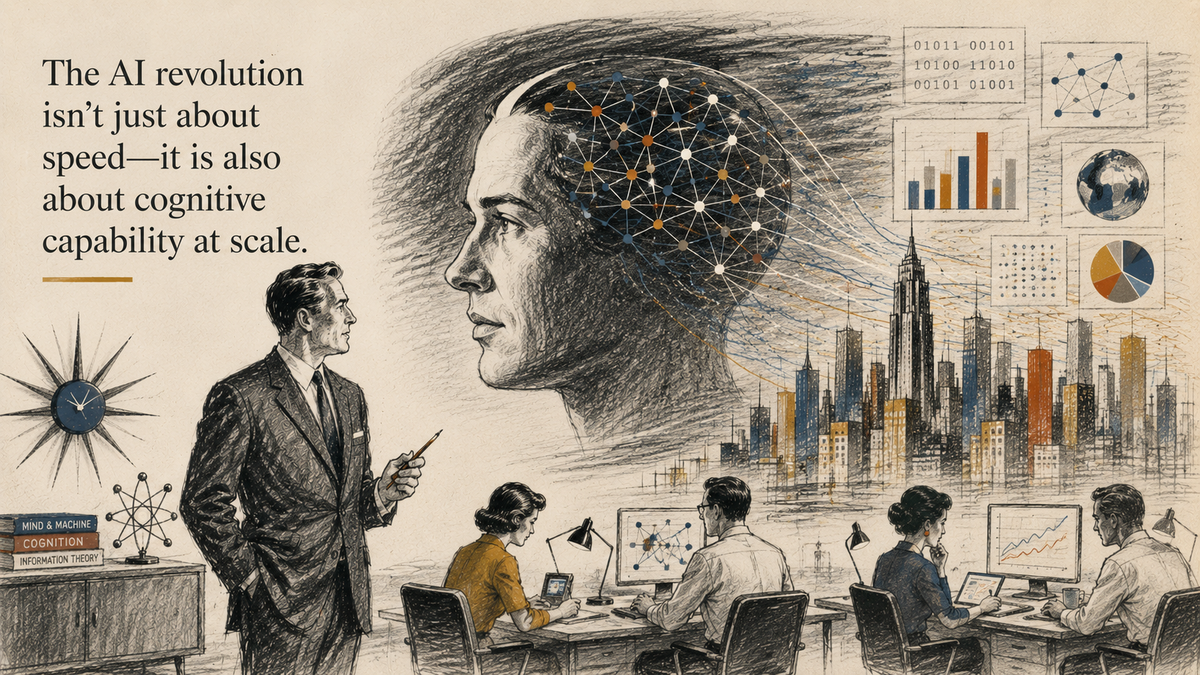
The AI revolution isn’t just about speed—it is also about cognitive capability at scale.
Welcome to the new frontier of artificial intelligence, where machines don't just predict the next word or generate pretty pictures, but actually reason through problems, show their work, and arrive at insights that can transform your business. Generative AI stands poised to revolutionize the landscape of content creation, offering unprecedented capabilities for generating material across domains. Reasoning models are dramatically enhancing our analytical capabilities. The interaction between generative AI for creation and reasoning models for analysis represents a powerful paradigm shift.
Beyond Content Creation
Generative AI models are fundamentally altering how we conceive, produce, and disseminate information and experiences. Their ability to learn from vast datasets and extrapolate novel outputs at scale promises to unlock tremendous efficiency, creativity, and personalization in content development. The creation of text, images, designs and movies will never be the same. What was previously the domain of experts with decades of experience is now in the hands of anyone.
The era of the democratization of creativity is upon us.
When most executives think of generative AI, they picture ChatGPT writing emails or DALL-E creating images. While these applications are impressive, they represent merely the opening act of a much larger transformation. Generative AI has already begun reshaping entire business functions in ways that would have seemed like science fiction just two years ago.
The true power of generative AI is its ability to explore vast possibility spaces and create genuinely novel solutions. Unlike traditional automation, which follows predetermined rules, generative AI operates in the realm of emergence—creating outputs that genuinely surprise..
The technology underlying this revolution centers on Large Language Models (LLMs), sophisticated neural networks trained on vast amounts of text, images, video, and other data. These models learn patterns and relationships across billions, and sometimes over a trillion, parameters, enabling them to generate coherent, contextually appropriate content across multiple domains. Understanding what they can and cannot do is crucial for business leaders who want to harness their power effectively.
The Architecture of Creation
At their core, LLMs work by predicting the next most likely token—essentially pieces of words—based on everything that came before. This might sound simplistic, but when scaled to models with hundreds of billions of parameters, trained on essentially the entire written corpus of knowledge, this seemingly straightforward mechanism produces remarkably sophisticated outputs.
Think of an LLM as having developed an incredibly nuanced understanding of how concepts, ideas, and information relate to each other. When you ask it to compose marketing copy for a new product, it's not just stringing together generic phrases. It's drawing on patterns learned from millions of successful marketing campaigns, understanding the psychological triggers that drive consumer behavior, and crafting language that resonates with specific audiences.
But here's what's crucial for business leaders to understand: these models are not actually "thinking" in the human sense. They're performing extraordinarily sophisticated pattern matching and statistical prediction. This distinction matters because it helps explain both their remarkable capabilities and their important limitations.
Real-World Business Transformation
The impact of generative AI extends far beyond content creation into core business processes. At Unilever, AI-generated product formulations are now outperforming human-designed alternatives in consumer preference tests. The models analyze ingredient interactions, consumer preferences, sustainability requirements, and manufacturing constraints simultaneously—a cognitive load that would overwhelm human product developers.
Financial services firms are using generative AI to create personalized investment strategies. Rather than offering standardized portfolios, AI can generate unique investment approaches tailored to individual client circumstances, risk tolerance, and life goals.
Perhaps most remarkably, we're seeing generative AI excel in areas requiring genuine creativity and strategic thinking. Boston Consulting Group reports that their AI-assisted consultants are generating 40% more innovative solutions to client problems, with higher client satisfaction scores. AI isn't replacing human creativity—it's amplifying it by rapidly exploring alternatives that humans might never consider.
The Video Revolution
The latest frontier in generative AI is video creation, and the implications for business communication are staggering. Models can now generate cinematic-quality videos from simple text descriptions, complete with complex camera movements, realistic lighting, and emotionally compelling narratives.
For businesses, this represents a complete transformation of content economics. A small startup can now produce marketing videos that rival major studio productions, without cameras, actors, or production crews. Training videos, product demonstrations, and corporate communications can be generated on-demand, customized for specific audiences, and updated in real-time as business needs evolve.
The implications go far deeper than cost savings. When video content can be generated instantly, businesses can experiment with thousands of creative approaches, test them with target audiences, and iterate rapidly. Moreover it can generate hyper-personalized videos specifically targeted at you that maybe have a voice or a language that draws you in. This transforms marketing from a craft requiring significant upfront investment to a data-driven optimization process. If you have ever seen the movie Minority Report with Tom Cruise walking through a mall while it was targeting him with content - that’s not too far away.
When AI Shows Its Work
If generative AI represents the creative revolution, reasoning models represent the analytical breakthrough that will fundamentally change how businesses solve complex problems. These models, sometimes called Large Reasoning Models (LRMs), don't just generate outputs—they think through problems step by step, evaluate alternatives, and arrive at conclusions through logical processes that mirror human reasoning.
To understand why this matters for business, we need to grasp the fundamental difference between how traditional Large Language Models and Large Reasoning Models operate. This distinction will determine which tool you use for which business challenge.
Understanding the LLM Limitation
Traditional LLMs, for all their impressive capabilities, are fundamentally prediction engines. They excel at predicting what word or phrase should come next based on statistical patterns learned from vast amounts of text. When you ask an LLM "What should our pricing strategy be for the European market?", it doesn't actually analyze your specific situation. Instead, it generates a response that sounds like what typically follows such questions in its training data.
This approach works remarkably well for many tasks. LLMs can write compelling marketing copy, summarize documents, answer factual questions, and even generate code because these tasks rely heavily on pattern recognition and established conventions. If you need a press release announcing a new product launch, an LLM can produce excellent results because press releases follow predictable structures and language patterns.
The critical limitation that every executive must understand is that LLMs don't actually reason through problems. They can't break down a complex business challenge into its component parts, evaluate different approaches systematically, or explain why one solution is superior to another. They generate responses that appear thoughtful, but underneath they're performing sophisticated pattern matching, not genuine analysis.
The Reasoning Model Breakthrough
Reasoning models represent a fundamental architectural advancement. When you present a reasoning model with that same pricing strategy question, it doesn't just generate a plausible-sounding answer. Instead, it breaks the problem down systematically: analyzing market conditions, evaluating competitor positioning, considering regulatory environments, assessing customer price sensitivity, and constructing a logical argument for why specific pricing approaches would succeed or fail in your context.
Consider a practical comparison. If you asked both types of models to solve this business problem: "Our manufacturing costs have increased by 15% while customer acquisition costs have risen by 23%. We're entering three new geographic markets next quarter. How should we adjust our pricing strategy?"
A traditional LLM might generate a response like: "Consider implementing a tiered pricing strategy that accounts for increased costs while maintaining competitive positioning. You should analyze regional market conditions and adjust pricing accordingly for each new geographic market."
A reasoning model would approach this completely differently. It would first clarify what information it needs: "To develop an optimal pricing strategy, I need to consider several interconnected factors. Let me work through this systematically." It would then analyze the cost structure implications, model the impact on profit margins, evaluate how price increases might affect customer acquisition in each new market, consider competitive responses, and construct a specific recommendation with clear reasoning for each component. Many of the commercially available reasoning models will ask you a series of questions before it starts its analysis to further clarify what it is trying to solve for.
The reasoning model might conclude: "Given the 15% cost increase, maintaining current margins requires a 9-12% price increase. However, the elevated customer acquisition costs suggest market sensitivity that makes price increases risky. I recommend implementing market-specific pricing. For example it may suggest premium pricing in Market A where competitive analysis shows low price sensitivity, value-based pricing in Market B where cost-conscious customers dominate, and penetration pricing in Market C to establish market presence quickly. This approach balances margin protection with growth objectives while accounting for regional market dynamics." This is a very different response that you might get from a traditional LLM.
When to Use Which Model
Understanding when to deploy LLMs versus reasoning models is crucial for maximizing business value. LLMs excel at tasks requiring creativity, content generation, and pattern-based responses. Use them for marketing content, customer communications, document summarization, and creative brainstorming. They're fast, cost-effective, and excellent at tasks that benefit from established patterns and conventions.
Reasoning models are your choice for complex analysis, strategic planning, problem-solving, and any situation where you need to understand the "why" behind recommendations. Use them for financial analysis, operational optimization, strategic decision support, and complex troubleshooting. They're slower and more expensive than traditional LLMs, but they provide the analytical rigor that business-critical decisions require.
The key insight for executives is that these are complementary technologies, not competing ones. A complete AI strategy incorporates both, deploying each where its unique capabilities create maximum value. Keep in mind that as of the time of this writing while the LRMs are quite powerful depending on the level of complexity at some point they will collapse and not converge on a solution. Somewhat counterintuitively while an LRM might use significantly more tokens and compute power than an LLM they won’t arrive at a solution as the problems become more complex. Also LLMs might outperform LRMs at low complexity and the reverse is true for higher complexity problems but it is safe to say that beyond a certain level of complexity both LLMs and LRMs collapse. There are some generalized guidelines but always test with your data and your problems.
The Executive's Decision Framework: LLM or LRM?
To help business leaders make these decisions systematically, consider this framework based on the nature of your business challenge:
Choose LLMs when your task involves:
- Content creation that follows established patterns (marketing copy, emails, reports)
- Creative brainstorming where volume of ideas matters more than analytical rigor
- Customer communications requiring personalization at scale
- Document summarization or information extraction
- Speed is critical and "good enough" quality is acceptable
- Cost efficiency is a primary concern
Choose Reasoning Models when your task requires:
- Complex problem-solving with multiple interdependent variables
- Strategic analysis where you need to understand the logic behind recommendations
- Financial modeling or operational optimization
- Decision support for high-stakes business choices
- Regulatory or compliance scenarios where reasoning must be auditable
- Novel problems that don't have established solution patterns
Use Both in Sequence when you need:
- Creative solutions that must also be analytically sound (LLM generates options, LRM evaluates them)
- Strategic communications that require both compelling messaging and logical foundation
- Innovation processes that benefit from both divergent and convergent thinking
- Complex projects where speed and rigor are both essential
This framework helps executives move beyond the "AI is magic" mindset to strategic deployment of the right AI capability for each business challenge. The organizations that master this decision-making process will extract significantly more value from their AI investments than those that treat all AI as interchangeable. But as is typically the case with new technologies as you use it more you will identify the class of problems that work best on which model. Also every foundation model is different and they have different capabilities so when we use them we will often test with multiple to see which performs better.
Chain-of-Thought Reasoning
The breakthrough that enabled reasoning models is called chain-of-thought processing. Just as humans solve complex problems by breaking them into smaller steps, reasoning models explicitly work through problems sequentially, showing their reasoning at each stage.
Consider a practical example from supply chain optimization (composite scenario based on multiple retail implementations we've observed, with details altered for confidentiality). When a major retailer's operations team faced a complex inventory optimization challenge involving hundreds of stores, thousands of products, seasonal demand patterns, and supply chain constraints, traditional optimization software provided solutions but no insight into the reasoning behind them. When they applied a reasoning model to the same problem, it not only suggested optimal inventory distributions but explained its logic: "Given the upcoming holiday season, I'm prioritizing high-margin items in metropolitan stores while maintaining safety stock in suburban locations where delivery times are longer. The model considers both historical sales patterns and real-time social media sentiment indicating elevated demand for luxury accessories."
This explanatory capability transforms AI from a black box that provides answers to a transparent reasoning partner that builds understanding and confidence in its recommendations.
Testing Thousands of Paths
What makes reasoning models particularly powerful is their ability to explore vast solution spaces systematically. While a human problem-solver might consider three or four approaches to a complex challenge, a reasoning model can evaluate thousands of potential paths, testing each for logical consistency and practical viability.
The authors have tested these models on graduate-level mathematical problems, describing watching a reasoning model work through complex proofs: "It will generate a hundred different ways to try to solve the problem, then break down each approach, evaluate the most promising paths, and construct a solution. You can literally watch it ask itself questions, reject approaches that don't work, and refine its thinking in real-time."
This capability has immediate applications in business strategy, operations research, financial modeling, and any domain requiring complex problem-solving. Management consultancies now use reasoning models to analyze market entry strategies, with the AI evaluating hundreds of variables simultaneously—competitive dynamics, regulatory environments, customer segments, operational requirements—and constructing comprehensive strategic recommendations with full explanatory logic.
Beyond Human Cognitive Limitations
Humans excel at intuitive reasoning and creative problem-solving, but we're constrained by cognitive limitations. We can only hold a limited number of variables in our working memory, we're subject to cognitive biases, and we often settle for "good enough" solutions rather than exploring all possibilities.
Reasoning models transcend these limitations while maintaining logical rigor. They can simultaneously consider dozens of interrelated variables, systematically evaluate all possible approaches, and construct solutions that account for complex interdependencies that would overwhelm human analysis.
At major consumer goods companies (composite example based on multiple supply chain implementations we've observed, with details altered for confidentiality), reasoning models are now designing supply chain strategies that simultaneously optimize for cost, sustainability, resilience, and customer service across global operations. The solutions they generate consistently outperform human-designed strategies, not because they're "smarter" than humans, but because they can exhaustively explore solution spaces that are simply too complex for human cognition.
Integration, Not Replacement
The power of generative AI and reasoning models lies not in replacing human intelligence but in augmenting it in ways that create exponential value. The most successful implementations combine AI's computational power with human creativity, intuition, and contextual understanding.
Transforming Marketing and Customer Engagement
Marketing represents perhaps the most immediate opportunity for AI transformation. Generative AI can now create personalized content at scale, generating unique marketing messages, product descriptions, and creative assets tailored to individual customer preferences and behaviors.
But the real breakthrough comes when generative AI is combined with reasoning models. Consider how Spotify uses this combination: generative AI creates personalized playlists and recommends new music, while reasoning models analyze user behavior patterns to understand why certain recommendations succeed or fail. The result is a continuously improving system that becomes more accurate and engaging over time.
For B2B companies, this combination is transforming sales processes. AI can generate personalized proposals, case studies, and presentations for each prospect, while reasoning models analyze the customer's business challenges and recommend optimal solution configurations. Sales teams report closing rates improving by 35-40% when supported by these AI capabilities.
Revolutionizing Research and Development
In R&D-intensive industries, the combination of generative and reasoning AI is accelerating innovation cycles dramatically. Pharmaceutical companies are using generative AI to propose novel drug compounds while reasoning models evaluate their likely efficacy, safety profiles, and development pathways.
3M's materials science division now uses AI to generate thousands of potential new material formulations daily, with reasoning models evaluating each for specific application requirements. What previously required months of laboratory experimentation can now be simulated and optimized computationally, with only the most promising candidates advancing to physical testing.
Enhancing Strategic Decision-Making
Perhaps most significantly, reasoning models are transforming strategic decision-making by enabling leaders to explore complex scenarios systematically. When Maersk's leadership team needed to optimize their global shipping network in response to geopolitical tensions and climate regulations, reasoning models evaluated thousands of potential configurations, considering factors ranging from fuel costs and carbon emissions to political risk and customer service requirements.
The AI didn't make the final decisions—that remained with human leadership—but it provided comprehensive analysis and clear reasoning that enabled much more informed decision-making. The result was a network optimization that improved efficiency by 22% while reducing carbon emissions by 15%.
The Deep Research Revolution
One of the most exciting developments in reasoning models is their application to research and knowledge discovery. OpenAI's Deep Research capability represents a glimpse into how AI will transform how businesses understand their markets, competitors, and opportunities.
Deep Research goes beyond simple web searching to conduct genuine research investigations. It can analyze thousands of sources, identify patterns and trends, synthesize insights across disparate domains, and generate comprehensive research reports that would require teams of analysts weeks to produce.
For business applications, this capability is revolutionary. Market research that previously required extensive outsourcing to consulting firms can now be conducted internally within hours. Competitive intelligence, industry analysis, and trend identification become continuous capabilities rather than expensive, intermittent exercises.
Transforming Market Intelligence
When a mid-sized software company needed to understand the competitive landscape for their new cybersecurity product, traditional market research would have required hiring external consultants for a six-figure engagement taking 8-12 weeks. Instead, they used Deep Research to analyze their market comprehensively in under 48 hours.
The AI examined thousands of competitor websites, patent filings, financial reports, industry publications, and customer reviews. It identified emerging competitive threats, analyzed pricing strategies, evaluated product positioning, and synthesized insights about market trends and customer preferences. The resulting report was more comprehensive and current than traditional consulting outputs, at a fraction of the cost and time.
Transforming Business R&D
The combination of generative AI and reasoning models is revolutionizing how businesses approach research and development, creating opportunities for innovation acceleration that seemed impossible just two years ago. For R&D-intensive industries, understanding these capabilities isn't just about operational efficiency—it's about fundamentally reimagining what's possible in innovation timelines and breakthrough discovery.
The New R&D Paradigm
Traditional R&D operates through cycles of hypothesis formation, experimental design, testing, and analysis that can span months or years. Generative AI and reasoning models don't replace this process, but they compress and enhance each stage dramatically. Consider how this transformation is playing out across different phases of business R&D:
Hypothesis Generation and Literature Review: Reasoning models can analyze thousands of research papers, patents, and technical documents to identify unexplored connections and generate novel hypotheses. At pharmaceutical companies (based on implementations we've observed, with details altered for confidentiality), reasoning models are identifying potential drug interactions and therapeutic pathways that human researchers, limited by cognitive capacity, would never have connected across disparate research domains.
Experimental Design Optimization: Rather than running expensive physical experiments for every variable combination, generative AI can simulate thousands of experimental conditions, with reasoning models evaluating which combinations are most likely to yield meaningful results. This dramatically reduces the time and cost of moving from hypothesis to validated results.
Data Analysis and Pattern Recognition: When experiments generate complex datasets, reasoning models excel at identifying subtle patterns and correlations that might escape human analysis. They can simultaneously consider dozens of variables and their interactions, uncovering insights that drive breakthrough discoveries.
Real-World Business R&D Transformation
The materials science division at a major manufacturing company (composite example based on multiple implementations we've observed, with details altered for confidentiality) exemplifies this transformation. Their traditional R&D process for developing new adhesive formulations typically required 18-24 months from initial concept to prototype validation. By integrating generative AI for molecular design with reasoning models for performance prediction, they've compressed this timeline to 4-6 months while actually improving the success rate of their formulations.
The AI doesn't just speed up existing processes—it explores chemical spaces that human researchers would never systematically investigate. The reasoning models evaluate each generated formulation against multiple performance criteria simultaneously, considering factors like adhesion strength, temperature resistance, environmental impact, and manufacturing feasibility. The result is formulations that often outperform human-designed alternatives while meeting constraints that would overwhelm traditional design approaches.
Accelerating Innovation Cycles
Perhaps most significantly, AI-enhanced R&D enables continuous innovation rather than discrete project cycles. At automotive companies implementing these approaches (composite example based on multiple industry implementations), AI systems continuously generate and evaluate new material combinations for vehicle components, with reasoning models assessing how each innovation impacts safety, weight, cost, and manufacturing complexity simultaneously.
This continuous innovation model means that R&D becomes an ongoing optimization process rather than a series of isolated projects. Companies can explore thousands of innovation paths in parallel, with AI identifying the most promising directions for human researchers to pursue. The result is faster time-to-market for innovations and higher success rates for R&D investments.
Why Change Takes Time While Technology Accelerates
Understanding the timeline compression possible with generative AI and reasoning models is only half the equation for business leaders. The other half - often the more challenging half - is understanding why organizational transformation takes time even when the technology delivers immediate results.
The force multiplier effect of these AI capabilities becomes apparent once employees are properly trained and comfortable using these tools effectively. At the 3M materials science division mentioned earlier, the 18-month to 4-6 month timeline compression didn't happen overnight. It took nearly eight months of training, experimentation, and workflow redesign before teams achieved those dramatic improvements. During that transition period, productivity actually decreased temporarily as researchers learned new approaches and organizations adapted their processes.
This human adaptation challenge explains why executives naturally want to proceed cautiously with AI implementation. The technology promises dramatic improvements, but the path to realizing those improvements runs through a period of organizational learning that can feel disruptive and uncertain. This is precisely why proof of concepts become essential for executive confidence and organizational buy-in.
The Strategic Role of Proof of Concepts
Proof of concepts serve multiple crucial functions in AI transformation beyond simply testing technology. They provide executives with concrete evidence that the promised improvements are achievable within their specific organizational context. More importantly, they create controlled environments for human learning and adaptation without risking core business operations.
Consider how a manufacturing company approached reasoning models for supply chain optimization (composite example based on multiple implementations we've observed). Rather than attempting to transform their entire global supply chain immediately, they selected a single product line serving three regional markets. The proof of concept ran for twelve weeks, during which the reasoning model optimized inventory levels, distribution routes, and supplier allocation while the human team learned to interpret AI recommendations, validate outputs, and integrate insights into their decision-making processes.
The technical results were impressive: fifteen percent reduction in inventory costs and twelve percent improvement in delivery times. But the organizational learning was equally valuable. The team developed frameworks for evaluating AI recommendations, established workflows for human-AI collaboration, and built confidence in the technology's reliability. When they expanded the approach across additional product lines, implementation proceeded much faster because the human systems had already adapted.
Building Organizational AI Readiness
The most successful AI transformations recognize that technology adoption and human adaptation must proceed in parallel, with neither getting too far ahead of the other. Organizations need time to develop what we might call "AI fluency" - not just technical skills, but judgment about when and how to apply these tools effectively.
This fluency development explains why the timeline compression benefits of AI often follow an S-curve pattern. Initial implementation proceeds slowly as teams learn and adapt. Then, as organizational competency builds, improvements accelerate dramatically. Finally, the rate of improvement levels off as teams optimize their human-AI collaborative processes.
Executive leadership during this transition period becomes crucial. Teams need permission to experiment, fail, and learn without facing criticism for temporary productivity decreases. They need clear guidance about which processes are appropriate for AI enhancement and which should remain purely human-driven. Most importantly, they need sustained support for the learning investment required to unlock AI's transformative potential.
Overcoming Executive Risk Aversion
Here lies perhaps the most challenging aspect of AI transformation is that many executives will struggle to move beyond their natural risk aversion to embrace these changes. The fundamental issue isn't technical or strategic - it's psychological and cultural. Leaders who have built successful careers by controlling variables and minimizing uncertainty face a technology that requires embracing experimentation and accepting temporary disruption of proven processes.
The uncomfortable truth is that for many executives, intellectual understanding of AI's potential won't overcome deeply ingrained resistance to disrupting successful operations. They don't like what they don't understand or can't control completely. This represents a fundamental shift in executive thinking that goes beyond traditional technology adoption.
The most successful AI transformations we've observed happen when organizations make AI adoption a leadership imperative at the highest levels, with clear accountability and compensation tied to transformation progress. This isn't simply about technology strategy - it's about cultural transformation that must begin with the board and CEO setting clear expectations that AI experimentation and learning are no longer optional for leadership roles.
Companies that successfully navigate this transition treat AI fluency as a core leadership competency, not a technical specialization. They build AI goals into executive performance metrics and hold leaders accountable for developing organizational AI capabilities. Without this level of commitment from the top, AI initiatives typically stall in the proof-of-concept phase, regardless of their technical promise.
This creates a stark reality for boards and CEOs: AI transformation requires leadership courage that many executives find uncomfortable. The organizations that acknowledge this challenge directly and address it through governance, accountability, and cultural change will separate themselves from competitors who remain trapped by risk aversion disguised as prudent management.
Why Inaction Has Become the Greatest Risk
The fundamental risk equation for AI has reversed completely, though many executives haven't recognized this shift yet. The traditional executive mindset treats new technology adoption as risky experimentation that should be approached cautiously to avoid disrupting proven operations. This mindset made sense when technological advantages developed slowly and competitive gaps closed gradually.
AI represents a complete inversion of this risk framework. The risk of action - implementing AI capabilities with their attendant learning curves and temporary disruptions - has become dramatically smaller than the risk of inaction. Organizations that delay AI adoption aren't preserving stability; they're allowing competitors to establish advantages that become increasingly insurmountable with each passing quarter.
Consider the mathematics of competitive divergence. When your competitor's marketing team can create personalized campaigns in hours rather than weeks, they're not just twelve times faster - they can test twelve times more approaches, learn from twelve times more experiments, and optimize twelve times more frequently. This isn't a linear advantage; it's an exponential learning acceleration that compounds over time.
When your competitor's R&D teams can explore thousands of innovation paths simultaneously while your teams pursue individual projects sequentially, they're not just finding solutions faster - they're systematically exploring solution spaces that your organization will never even discover. The competitive gap doesn't just widen; it becomes qualitatively different, moving beyond speed to entirely different capabilities.
The harsh reality is that organizations clinging to risk-averse approaches are making the riskiest bet of all: that their competitors will also choose to move slowly, that AI capabilities will plateau, and that established market positions will protect them from disruption. Every month of delay in building organizational AI fluency increases the likelihood that these bets will prove catastrophically wrong.
The Compounding Disadvantage of Delay
The competitive mathematics of AI adoption create what economists call "increasing returns to scale" - early movers don't just get temporary advantages, they establish self-reinforcing cycles that make catching up progressively more difficult. Each successful AI implementation generates data that improves future AI performance. Each process optimization creates capacity for additional optimization. Each competency developed enables faster development of related competencies.
Meanwhile, organizations that delay AI adoption don't maintain steady positions - they fall increasingly behind as the gap between AI-enhanced and traditional capabilities widens. The comfortable notion that they can "fast follow" once the technology matures ignores the reality that by the time AI approaches maturity, the competitive landscape will have been fundamentally restructured by organizations that developed AI fluency early.
This isn't speculation about future possibilities - it's already happening. Companies like Unilever, Maersk, and 3M aren't just using AI tools; they're developing organizational capabilities that compound their advantages quarterly. Their teams think differently about problems, approach challenges with different assumptions, and generate solutions that competitors using traditional methods simply cannot match.
For executives still viewing AI adoption as optional experimentation, the question has become existential: Will your organization be among those that develop AI fluency quickly enough to remain competitive, or will you discover too late that cautious risk management has become the path to irrelevance?
Practical Implementation
Understanding the transformative potential of generative AI and reasoning models is only the beginning. The real challenge for business leaders is implementing these capabilities effectively within their organizations.
Identifying High-Impact Applications
The key to successful AI implementation is identifying applications where the technology's unique capabilities align with significant business challenges. Generative AI excels at creative tasks, content personalization, and exploring large possibility spaces. Reasoning models excel at complex analysis, strategic planning, and problems requiring systematic evaluation of multiple factors.
Start by inventorying your organization's most time-consuming creative and analytical tasks. Marketing content creation, financial analysis, strategic planning, operational optimization, and customer service are typically high-impact starting points.
Building AI-Ready Infrastructure
Successful AI implementation requires robust data infrastructure and clear governance frameworks. Generative AI and reasoning models require access to relevant, high-quality data to deliver value. This often requires breaking down data silos and establishing unified data platforms.
Equally important is establishing clear guidelines for AI use, particularly around data privacy, decision-making authority, and quality control. The most successful organizations establish AI governance frameworks before deploying systems widely.
Developing AI Literacy
Perhaps most critically, successful AI transformation requires developing AI literacy across your organization. This goes beyond basic training on how to use ChatGPT to deeper understanding of AI capabilities, limitations, and appropriate applications.
Teams need to understand when to use generative AI versus reasoning models, how to craft effective prompts, how to evaluate AI outputs critically, and how to integrate AI capabilities into existing workflows effectively.
The Competitive Imperative
The businesses that master generative AI and reasoning models first will establish significant competitive advantages that will be difficult for followers to overcome. These technologies enable entirely new business models, dramatically improve operational efficiency, and accelerate innovation cycles.
Consider the implications: if your competitors can generate personalized marketing content at scale while you're still using traditional processes, how do you compete? If they can solve complex operational problems in hours while your solutions take weeks, how do you maintain market position?
The window for competitive AI adoption is rapidly closing. Early movers are already establishing AI-driven competitive advantages, and the gap between leaders and laggards is widening quickly.
The Network Effect of AI Capability
AI capabilities exhibit network effects—they become more valuable as more people in your organization use them effectively. Each person who develops AI literacy contributes to collective organizational capability. Teams that collaborate using AI tools become more effective than the sum of their individual contributions.
This suggests that broad AI adoption, rather than concentrated expertise in specialized teams, will drive competitive advantage. Organizations that democratize AI access while maintaining appropriate governance will outperform those that restrict AI to technical specialists.
The Convergence of Capabilities
The future of business AI lies in the convergence of generative and reasoning capabilities. We're already seeing systems that combine creative generation with analytical reasoning, producing outputs that are both innovative and rigorously evaluated.
This convergence will enable entirely new approaches to business challenges. Strategic planning processes that generate multiple scenarios while simultaneously evaluating their feasibility and implications. Product development cycles that create innovative designs while optimizing for manufacturing, cost, and market appeal. Customer service systems that craft personalized responses while reasoning through complex problem-solving.
The organizations that understand and prepare for this convergence will be positioned to thrive in an AI-powered future. Those that view AI as merely another software tool will find themselves increasingly disadvantaged.
The Path Forward
Generative AI and reasoning models represent more than technological advancement—they represent a fundamental shift in how businesses can operate, innovate, and compete. The creative and analytical capabilities these systems provide will reshape every aspect of business operations, from customer engagement and product development to strategic planning and operational optimization.
The question facing business leaders is not whether to adopt these technologies, but how quickly and effectively they can integrate them into their operations. The window for competitive advantage is open now, but it won't remain open indefinitely.
The businesses that embrace this new frontier, invest in AI literacy across their organizations, and reimagine their processes around AI-augmented capabilities will define the future of their industries. Those that wait for the technology to mature or for clear industry standards to emerge will find themselves competing against opponents with fundamentally superior capabilities.
The new frontier is here. Will you be among the pioneers who claim it, or will you be among the settlers who arrive after the best opportunities have been taken?