Chapter 17: Identifying the Right Problems and Failing Forward
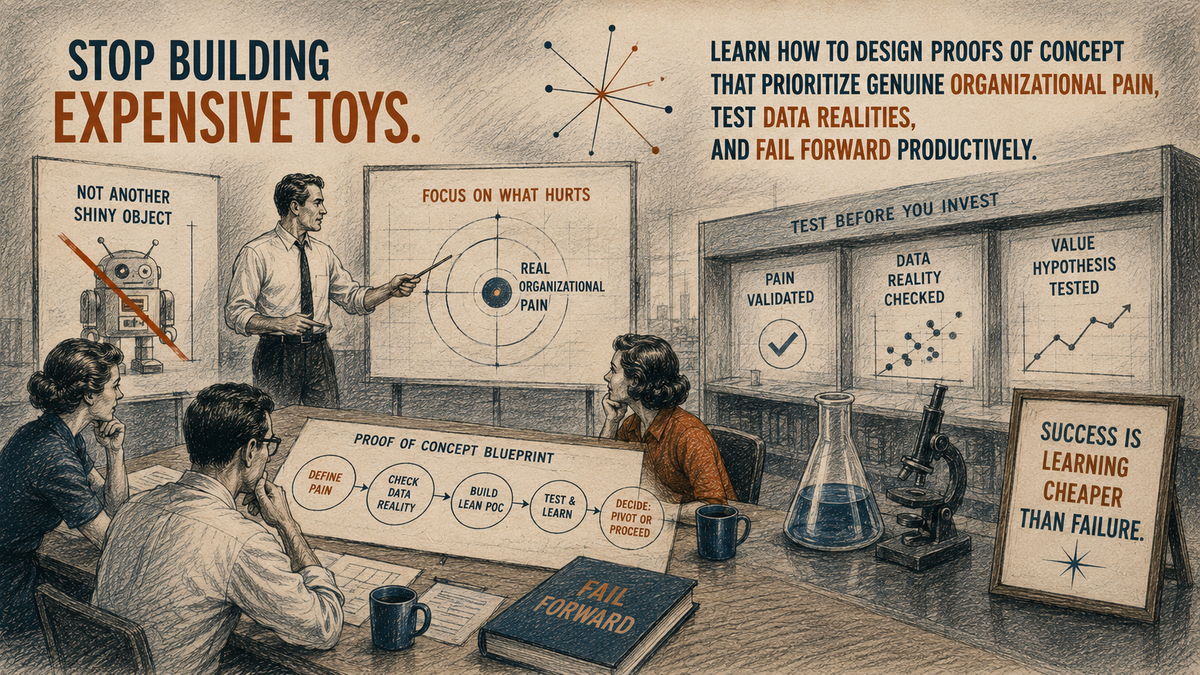
Stop building expensive toys. Learn how to design Proofs of Concept that prioritize genuine organizational pain, test data realities, and fail forward productively.
"The most important thing in communication is hearing what isn't said." - Peter Drucker
In the grand theater of AI transformation, nothing is more critical than your opening act. You've absorbed the fundamentals, grasped the strategic imperatives, and rallied your leadership team around the AI transformation vision. Now comes the moment of truth: translating all that understanding into action. This is where the rubber meets the road, where theoretical knowledge transforms into tangible business value, and where many organizations stumble despite their best intentions.
The challenge isn't a lack of enthusiasm or resources. Most executives we encounter are genuinely excited about AI's potential and willing to invest significantly in the transformation. The challenge lies in a more fundamental question: How do you start smart? How do you identify the right problems to solve, design Proofs of Concept that actually teach you something valuable, and set yourself up for success rather than expensive disappointment?
This chapter will equip you with a systematic approach to launching AI initiatives that deliver real insight, whether they succeed spectacularly or fail forward productively. We'll explore the art and science of selecting problems that matter, designing POCs that illuminate rather than obscure, and building a foundation for sustainable AI success.
POC Paradox
Before diving into methodology, we need to address a fundamental misconception that plagues many AI initiatives. Too many organizations treat Proofs of Concept as elaborate demonstrations rather than learning experiments. They invest months building sophisticated prototypes designed to impress stakeholders rather than genuinely test hypotheses about feasibility, value, and implementation challenges.
This approach transforms POCs from invaluable learning tools into expensive toys that generate impressive demos but little actionable insight. Sarah Chen, Chief Technology Officer at a Fortune 500 manufacturing company, learned this lesson the hard way. Her team spent six months building a sophisticated AI system for predictive maintenance that could analyze thousands of sensor readings and predict equipment failures with remarkable accuracy. The demonstration was spectacular, complete with real-time dashboards and compelling visualizations.
Yet when they attempted to move beyond the POC, they discovered a cascade of problems. The training data came from their newest, most instrumented facility, but seventy percent of their equipment lacked the sensors necessary for the AI to function. The model required constant retraining as equipment configurations changed, but they had no process for capturing those changes systematically. Most critically, the maintenance teams didn't trust the AI's recommendations and continued following their established procedures, rendering the technology irrelevant regardless of its technical sophistication.
"We built a beautiful solution to a problem we didn't fully understand," Chen reflected. "The POC taught us that our AI worked perfectly, but it failed to teach us whether our organization was ready for that AI."
This experience illustrates the fundamental purpose of POCs in AI transformation. They're not marketing tools or technology showcases. They're learning instruments designed to convert unknowns into knowns, to surface hidden assumptions, and to test not just technical feasibility but organizational readiness. The most successful POCs often reveal unexpected barriers and illuminate alternative approaches that prove more valuable than the original concept.
Aligning Problems with Possibilities
Effective AI implementation begins with a rigorous framework for problem selection that balances business impact, technical feasibility, and organizational readiness. This framework has evolved from observing hundreds of AI initiatives across industries, distilling the patterns that separate successful transformations from expensive experiments.
Pain Point Principle
The first criterion for selecting AI problems is simple yet frequently overlooked: genuine pain. The problem you're solving must cause enough organizational discomfort that people are genuinely motivated to adopt a new solution. This might seem obvious, but many AI initiatives target problems that are intellectually interesting but practically insignificant.
Consider the difference between two AI projects at a global consulting firm. The first used natural language processing to automatically categorize client emails, potentially saving assistants fifteen minutes per day. The second used AI to analyze historical project data and suggest optimal team compositions for new engagements, potentially improving project success rates by twelve percent while reducing staffing conflicts.
Both projects were technically feasible and demonstrated clear ROI on paper. Yet the email categorization project languished despite successful implementation. Assistants found workarounds that were faster than correcting the AI's occasional mistakes, and the time savings, while real, didn't transform their daily experience meaningfully.
The team composition project, conversely, gained rapid adoption. Project managers were struggling with increasingly complex staffing decisions as the firm grew, often leading to conflicts between departments competing for the same skilled resources. The AI didn't need to be perfect; it needed to be better than the informal, inconsistent process they were using. The pain was real, the solution was obviously better, and adoption followed naturally.
The lesson is clear: target problems that keep people awake at night, not problems that might theoretically improve efficiency. If the people closest to the problem aren't enthusiastic about solving it, your AI solution will struggle regardless of its technical merits.
Data Reality Check
The second criterion involves an honest assessment of your data landscape. AI initiatives live or die on data quality, availability, and accessibility. Yet many organizations leap into AI projects without thoroughly understanding their data foundations, leading to expensive discoveries late in the process.
This data reality check requires asking uncomfortable questions about your organization's data maturity. Do you know what data you have? Can you access it systematically? Is it clean enough for AI consumption? More importantly, do you understand the story your data tells and the biases it might contain?
Marcus Rodriguez, who led digital transformation at a major retail chain, encountered this challenge when his team proposed using AI to optimize inventory management. The concept was compelling: analyze sales patterns, weather data, local events, and supplier reliability to predict demand more accurately than traditional forecasting methods.
The POC initially appeared promising. Using two years of historical data from their flagship store, the AI system predicted demand with impressive accuracy. However, when they attempted to scale beyond the initial store, they discovered their data landscape was far more complex than anticipated.
Different regions used different point-of-sale systems with incompatible data formats. Some stores had years of detailed transaction history while others had only aggregate sales figures. Promotional pricing was tracked inconsistently, and seasonal variations differed significantly between geographic regions. What appeared to be a straightforward data problem revealed itself as a complex organizational challenge requiring significant infrastructure investment.
"We thought we were testing an AI solution," Rodriguez reflected. "What we actually learned was that we needed to solve our data problems before we could solve our business problems with AI."
This experience led to a more systematic approach to data assessment before launching AI initiatives. They developed a data readiness rubric that evaluated not just data quality but also organizational processes for data collection, cleaning, and governance. This preliminary work proved invaluable for subsequent AI projects, dramatically improving their success rate.
Organizational Readiness Factor
The third criterion examines your organization's capacity for change. Even the most technically successful AI implementation will fail if your organization isn't prepared to integrate new processes, trust new insights, and adapt established workflows.
This organizational readiness assessment requires understanding the human systems surrounding your target problem. Who would use the AI solution? What are their current processes? What incentives drive their behavior? How do they currently make decisions, and what would need to change for them to incorporate AI insights?
Dr. Jennifer Walsh, Chief Medical Officer at a regional hospital system, learned this lesson while implementing AI for medical diagnosis support. The technology was remarkable, analyzing medical images with accuracy that matched or exceeded human specialists. The POC results were extraordinary, identifying conditions that human radiologists had missed and providing detailed explanations for its diagnoses.
Yet when they moved to production, adoption was disappointingly low. Radiologists were legally responsible for diagnoses and worried about liability if they followed AI recommendations that proved incorrect. The AI's explanations, while technically accurate, didn't align with how radiologists typically reasoned through complex cases. Most critically, using the AI added extra steps to already efficient workflows without providing clear value to the radiologists themselves.
"The AI was technically perfect," Walsh explained. "But we had designed it for the problem we wanted to solve rather than the problem our radiologists actually faced."
This insight led to a redesigned approach that focused on AI as a second opinion tool rather than a primary diagnostic system. The new implementation highlighted cases where AI and human assessment differed, prompting additional review rather than attempting to replace human judgment. This approach proved much more successful because it enhanced rather than threatened the radiologists' professional expertise.
Art of Smart Problem Selection
With these criteria in mind, let's explore a systematic approach to identifying problems that are both suitable for AI and strategically valuable for your organization. This approach has emerged from studying successful AI implementations across industries and represents a practical methodology for problem selection.
Goldilocks Principle
The most successful AI initiatives target problems that are neither too simple nor too complex, but just right. Problems that are too simple don't justify the complexity and cost of AI solutions. Problems that are too complex often fail because they attempt to solve too many challenges simultaneously, making it difficult to isolate what's working and what isn't.
The sweet spot lies in problems that are complex enough to benefit from AI's pattern recognition capabilities but bounded enough to be solved systematically. These problems typically involve processing large amounts of data, identifying subtle patterns, or making predictions based on multiple variables.
Consider the approach taken by Elena Vasquez, head of operations at a logistics company. Rather than attempting to optimize their entire supply chain with AI, they focused on a specific challenge: predicting which shipments were likely to be delayed based on weather patterns, traffic conditions, and historical carrier performance.
This problem was complex enough to benefit from AI's analytical capabilities but focused enough to be solved systematically. The data was readily available, the business impact was clear, and the solution could be implemented without disrupting existing operations. Success here provided both immediate value and a foundation for more ambitious AI projects.
Adjacent Possible Strategy
Another effective approach involves identifying problems that are adjacent to your organization's existing capabilities. These problems leverage your current strengths while introducing AI in a way that feels natural rather than disruptive.
A global manufacturing company exemplified this approach when they applied AI to enhance their existing quality control processes. Rather than replacing human inspectors with AI, they used computer vision to flag potential defects for human review. This approach built on their existing quality expertise while introducing AI capabilities gradually.
The key insight was that the AI didn't need to be perfect; it needed to be better than random chance at identifying items that deserved additional human attention. This reduced the pressure on the AI system while providing immediate value to quality control teams.
Measurable Impact Imperative
Finally, successful AI problems must have clear, measurable outcomes that align with business objectives. Vague goals like "improving efficiency" or "enhancing customer experience" make it impossible to evaluate success or failure meaningfully.
Effective problem selection requires identifying specific, quantifiable outcomes that matter to your organization. These might include reducing processing time by a specific percentage, improving prediction accuracy by a measurable amount, or decreasing error rates to a defined level.
James Mitchell, who led AI initiatives at a financial services firm, insisted on what he called "elevator pitch metrics" for every AI project. If you couldn't explain the expected business impact in a thirty-second elevator ride, the problem wasn't well-defined enough to warrant investment.
This approach led to more focused project scoping and clearer success criteria. More importantly, it forced teams to think deeply about why they were pursuing AI solutions rather than assuming AI was inherently valuable.
Designing POCs That Teach
With the right problem identified, the next challenge involves designing POCs that generate actionable insights rather than impressive demonstrations. This requires shifting from a proving mindset to a learning mindset, where the goal is understanding rather than validation.
Hypothesis-Driven Approach
Effective POCs begin with explicit hypotheses about what you expect to learn and what would constitute success or failure. These hypotheses should address not just technical feasibility but also business viability, organizational readiness, and implementation challenges.
For example, rather than simply testing whether AI can analyze customer service calls, a well-designed POC might test specific hypotheses such as: "AI can identify customer frustration signals with sufficient accuracy to trigger supervisor intervention," or "Customer service representatives will trust and act on AI-generated insights when they're presented with clear explanations."
This hypothesis-driven approach ensures that POCs address real uncertainties rather than confirming what you already know. It also provides clear criteria for evaluating results and deciding whether to proceed with full implementation.
Minimum Viable Learning Framework
Successful POCs focus on generating maximum learning with minimum investment. This requires identifying the smallest experiment that can test your most critical assumptions about feasibility, value, and implementation.
Dr. Patricia Kim, who leads AI research at a pharmaceutical company, applies what she calls the "minimum viable learning" framework to AI initiatives. Rather than building complete systems, her team designs focused experiments that test specific hypotheses about AI's potential application to drug discovery.
For instance, when exploring AI's potential for identifying promising drug compounds, they didn't attempt to build a complete discovery system. Instead, they tested whether AI could identify patterns in existing successful compounds that human researchers had missed. This focused experiment required minimal data preparation and could be completed in weeks rather than months.
The results were revealing. While the AI identified interesting patterns, the most valuable insight was that their existing data wasn't structured in ways that made AI analysis straightforward. This discovery led to a more systematic approach to data collection that proved valuable for subsequent AI initiatives.
Failure Forward Philosophy
Perhaps most importantly, effective POCs are designed to fail forward productively. This means structuring experiments so that negative results provide valuable insights rather than simply confirming that an approach doesn't work.
This philosophy requires explicitly identifying what you'll learn from different possible outcomes. If the AI performs better than expected, what does that tell you about scaling potential? If it performs worse than expected, what does that reveal about data quality, problem complexity, or organizational readiness?
Michael Thompson, who led AI initiatives at a consulting firm, exemplified this approach when testing AI for proposal writing. Rather than simply measuring whether AI could generate acceptable proposals, they designed the POC to understand what types of proposals AI handled well, what types it struggled with, and what that implied about optimal human-AI collaboration.
The results showed that AI excelled at generating standard sections but struggled with client-specific customization. This "failure" provided valuable insights about how to structure human-AI workflows that played to each participant's strengths.
Common Pitfalls and How to Avoid Them
Even with the best intentions and systematic approaches, AI POCs can stumble in predictable ways. Understanding these common pitfalls and developing strategies to avoid them can significantly improve your chances of success.
Vanity Project Trap
Perhaps the most insidious and costly pitfall is what we might diplomatically call "executive showcase syndrome" - the tendency for ambitious managers to pursue high-visibility AI projects that enhance their personal brand rather than solve genuine business problems. These vanity projects are characterized by impressive demonstrations, sophisticated technology, and very little lasting value.
The psychology driving these initiatives is both human and predictable. Executives understand that AI projects carry significant wow factor and can differentiate them in competitive organizational environments. The challenge is that these managers often operate with compressed timelines driven by career advancement rather than business value creation. They champion flashy initiatives, gain recognition and promotion, then move on before the inevitable cleanup phase begins.
This pattern is particularly endemic in certain organizational cultures - typically those that are highly competitive, male-dominated, and focused on individual achievement over collective success. Financial services firms exemplify this dynamic, where aggressive personalities and short-term thinking often dominate strategic decision-making. The problem compounds when organizations inadvertently reward show over substance, creating feedback loops that perpetuate wasteful spending on impressive but ultimately meaningless AI demonstrations.
The most damaging aspect of vanity projects isn't the immediate financial cost, though that can be substantial. It's the organizational learning opportunity lost. When POCs are designed to impress rather than educate, they consume resources while teaching nothing about actual AI implementation challenges. Teams spend months building sophisticated prototypes that look remarkable in executive presentations but provide no insight into data quality requirements, organizational readiness, or production viability.
Consider the stark contrast between vanity-driven POCs and substantive learning experiments. Vanity projects typically feature cutting-edge technology applied to problems that sound important but cause little actual organizational pain. They're designed to generate boardroom excitement rather than operational improvement. Substantive POCs, conversely, target genuine business problems with clear success criteria and explicit learning objectives, even if the solutions appear less technologically impressive.
The antidote to vanity projects requires both structural and cultural interventions. Organizations need lightweight but meaningful approval processes that force proponents to articulate clear business problems, success metrics, and learning objectives before resources are allocated. More importantly, they need to reward executives for delivering sustainable business value rather than generating temporary excitement.
Perfectionism Trap
One of the most common mistakes involves pursuing perfection rather than adequacy. Teams often spend months refining AI systems to achieve marginal improvements rather than testing whether the current performance level provides business value.
This perfectionism trap reflects a fundamental misunderstanding of AI's role in business processes. AI doesn't need to be perfect; it needs to be better than the current alternative. A customer service AI that resolves sixty percent of inquiries successfully might be tremendously valuable if it allows human agents to focus on complex issues that require empathy and creative problem-solving.
The key is establishing clear thresholds for business value and testing whether AI can meet those thresholds rather than pursuing theoretical optimization. This requires ongoing dialogue between technical teams and business stakeholders to ensure everyone understands what constitutes success.
Data Perfection Fallacy
Another common pitfall involves waiting for perfect data before beginning AI experiments. Organizations often spend months cleaning and organizing data before testing whether AI can provide value, only to discover that their understanding of data requirements was incomplete.
A more effective approach involves beginning with available data and using initial AI experiments to understand what data quality is actually required. This iterative approach often reveals that AI can provide value with imperfect data while simultaneously identifying the most important data quality improvements.
Rebecca Johnson, who led AI initiatives at a healthcare organization, discovered this when her team delayed an AI project for months while cleaning patient data. When they finally began testing with imperfect data, they found that the AI provided valuable insights despite data quality issues. More importantly, the AI's performance helped them prioritize which data quality improvements would have the greatest impact.
Technology-First Mistake
Perhaps the most dangerous pitfall involves falling in love with specific AI technologies rather than focusing on business problems. This technology-first approach leads to solutions in search of problems rather than problems in search of solutions.
This mistake manifests in various ways: choosing AI approaches because they're cutting-edge rather than appropriate, pursuing problems that showcase AI capabilities rather than address business needs, or continuing with technical approaches that aren't working because of sunk cost investments.
The antidote is maintaining relentless focus on business outcomes rather than technical achievements. Every AI initiative should be evaluated based on its contribution to organizational objectives, not its technical sophistication or innovation.
Fail Fast Imperative
Effective POCs embrace the principle of failing fast - completing learning experiments quickly and efficiently rather than pursuing extended development cycles. This approach recognizes that POCs should be lean learning instruments, not production systems. A well-designed POC should typically complete its learning objectives within eight weeks with clearly defined goals and outcomes.
The fail fast philosophy serves multiple organizational purposes. It prevents teams from becoming emotionally invested in approaches that may not work, reduces the sunk cost fallacy that keeps failing projects alive, and accelerates the overall learning cycle. More importantly, it forces teams to focus on the most critical unknowns rather than pursuing perfection across all dimensions.
However, failing fast requires careful balance. The goal isn't to rush through experiments carelessly but to design focused tests that can provide maximum learning with minimum investment. This might mean testing AI capabilities with representative rather than comprehensive data sets, or building functional prototypes rather than polished applications.
Organizational Controls and Governance
Large organizations require lightweight but meaningful governance structures to prevent vanity projects while enabling legitimate innovation. These controls should focus on ensuring that AI initiatives have clear business justification, measurable success criteria, and explicit learning objectives.
Approval Framework
An effective AI governance framework begins with a streamlined approval process that requires project proponents to articulate several key elements before resources are allocated. This includes identifying the specific business problem being addressed, defining success metrics that align with organizational objectives, and explaining what will be learned regardless of technical outcomes.
The approval process should also require stakeholder validation - confirming that the people closest to the business problem are genuinely motivated to adopt solutions and that they've been consulted in problem definition. This simple requirement can prevent many technically sophisticated projects that address problems nobody actually cares about solving.
Budget allocation for POCs should be tied to learning outcomes rather than technical achievements. Organizations might consider funding POCs from special innovation budgets that reward successful translation to production systems rather than impressive demonstrations. This creates natural incentives for substance over show while still enabling experimental approaches.
Role of Institutional Memory
One of the most promising developments in AI governance involves using artificial intelligence systems themselves to provide institutional memory and pattern recognition for decision-making. Organizations generate massive amounts of internal documentation - emails, Slack messages, meeting notes, project retrospectives - that contain valuable insights about what works and what doesn't.
AI systems could potentially analyze these digital footprints to identify patterns associated with successful versus unsuccessful initiatives. They might detect when proposed projects exhibit characteristics similar to past vanity projects, or when communication patterns suggest insufficient stakeholder consultation or unrealistic timelines.
This represents a fascinating evolution in organizational governance - using AI to help organizations understand their own decision-making patterns and blind spots. Such systems would function as evaluation tools rather than decision-makers, providing additional data to inform human judgment rather than replacing it.
However, this approach raises complex questions about behavioral adaptation. If employees know their communications are being analyzed for certain patterns, they will naturally modify their behavior - potentially creating organizational theater where real decision-making becomes even more opaque. The long-term implications of AI-assisted organizational self-awareness remain largely unexplored territory.
Building a Portfolio of Learning
As your organization gains experience with AI POCs, the goal shifts from individual project success to building a portfolio of learning that accelerates future initiatives. This portfolio approach recognizes that AI transformation is a journey rather than a destination, requiring systematic capability building over time.
Capability Staircase
Effective AI programs build capabilities systematically, with each project contributing to organizational AI maturity. This might involve progressing from simple automation to complex prediction, from single-function AI to integrated AI systems, or from departmental AI to enterprise-wide AI platforms.
The key is ensuring that each POC contributes to this capability progression rather than operating in isolation. This requires capturing and sharing lessons learned, building reusable data and technical infrastructure, and developing organizational expertise that transfers across projects.
Culture of Experimentation
Perhaps most importantly, successful AI POCs contribute to building a culture of experimentation that embraces both success and failure as learning opportunities. This culture recognizes that AI transformation requires ongoing adaptation and that the most valuable insights often come from unexpected directions.
This cultural transformation is often more challenging than technical implementation but ultimately more valuable. Organizations that develop strong experimentation cultures can adapt quickly to new AI capabilities and identify opportunities that more rigid organizations miss.
However, building this culture requires confronting organizational realities about ego-driven decision-making, short-term thinking, and resistance to genuine learning. Some organizations may need to address fundamental cultural patterns before they can implement effective AI transformation strategies. The most successful AI transformations often begin with honest organizational self-assessment about readiness for change, willingness to learn from failure, and commitment to substance over show.
Organizational Self-Awareness
Looking toward the future, we may be approaching a new era of organizational governance enabled by AI systems that can analyze patterns in corporate behavior and decision-making. This evolution could fundamentally change how organizations understand themselves and make strategic choices about technology adoption.
Imagine AI systems that could analyze years of internal communications, project documentation, and outcome data to identify patterns associated with successful versus unsuccessful initiatives. Such systems might detect early warning signs of vanity projects, identify organizational blind spots, or surface insights about cultural tendencies that enable or inhibit effective change management.
This concept represents both tremendous opportunity and significant risk. On one hand, organizations desperately need better institutional memory and self-awareness to avoid repeating expensive mistakes. Many of the AI implementation failures we observe today stem from predictable organizational patterns that could theoretically be detected and addressed proactively.
On the other hand, human psychology and organizational dynamics are extraordinarily complex. People adapt their behavior when they know they're being monitored, potentially creating cat-and-mouse games between human creativity and AI detection systems. The risk exists that such governance tools could become either overly risk-averse, stifling legitimate innovation, or overly permissive, failing to prevent the very problems they're designed to address.
The behavioral implications remain largely unexplored. We have no research base for understanding how executives will modify their communication patterns, decision-making processes, or project justification approaches when they know AI systems are analyzing organizational behavior. The unintended consequences could be as significant as the intended benefits.
Nevertheless, the potential for AI-assisted organizational self-awareness represents a fascinating frontier that could transform how companies approach not just AI transformation but strategic decision-making more broadly. Organizations willing to experiment carefully with these approaches may develop significant advantages in institutional learning and adaptive capacity.
From POCs to Production
The ultimate goal of smart AI POCs isn't generating impressive demonstrations or confirming theoretical possibilities. It's building the foundation for sustainable AI transformation that creates lasting business value. This requires thinking beyond individual projects to the broader organizational capabilities needed for AI success.
Successful POCs illuminate not just what's possible with AI but what's required for success: data infrastructure, technical expertise, organizational change management, and cultural adaptation. They reveal hidden assumptions, surface unexpected barriers, and identify alternative approaches that prove more valuable than original concepts.
Most importantly, they build organizational confidence and competence for the larger AI transformation journey ahead. Each well-designed POC contributes to your organization's AI maturity, creating a compound effect that accelerates future initiatives.
The path from POC to production is rarely straightforward, but organizations that start smart with carefully selected problems and thoughtfully designed learning experiments position themselves for sustainable AI success. They build the foundation for AI transformation that creates lasting competitive advantage rather than temporary technological showcase.
As you embark on your AI journey, remember that the goal isn't to prove that AI works in your organization. The goal is to discover how AI can work most effectively for your specific challenges, constraints, and opportunities. That discovery process, guided by the frameworks and principles outlined in this chapter, will serve you well as you navigate the complex but rewarding path of AI transformation.
The organizations that emerge as AI leaders won't necessarily be those with the most sophisticated technology or the largest AI budgets. They'll be the organizations that learned fastest, adapted most effectively, and built the strongest foundation for ongoing AI innovation. Your POC strategy is where that foundation begins.