Chapter 16: New Skill Sets for an AI-Driven World
Survive the phantom menace of organizational dysfunction by mastering the arcane arts of prompt engineering, vibe coding, and AI-aware critical thinking.
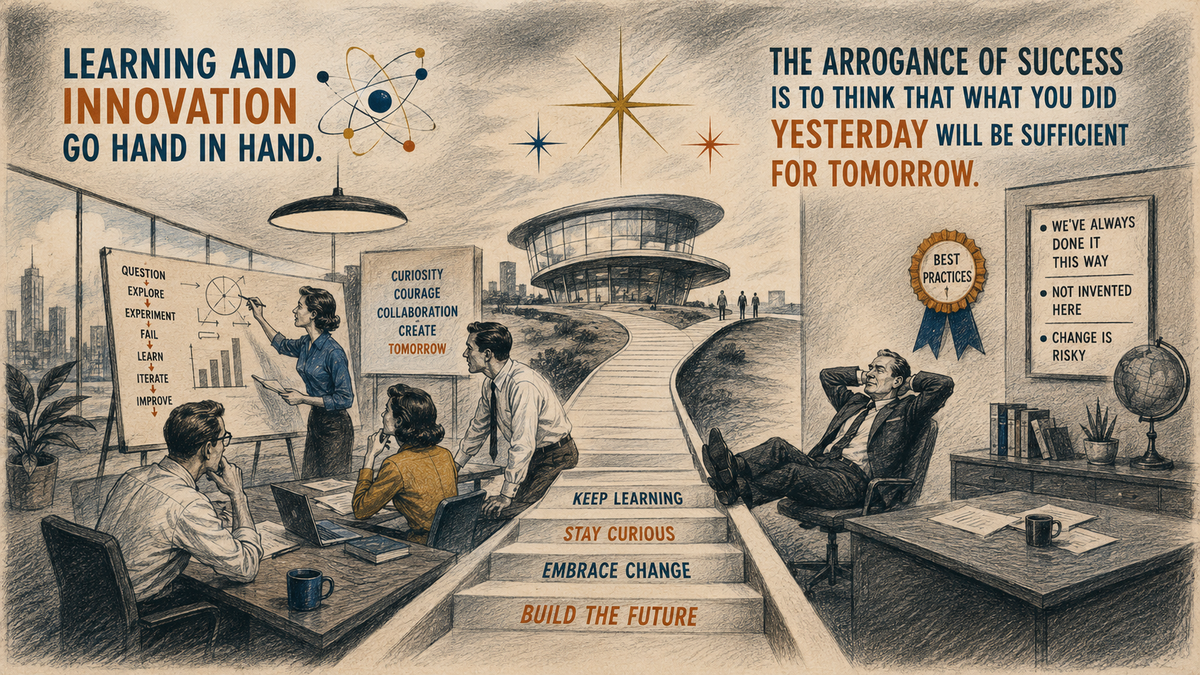
"Learning and innovation go hand in hand. The arrogance of success is to think that what you did yesterday will be sufficient for tomorrow." — William Pollard
The executive walked into her Monday morning leadership meeting carrying something that would have seemed absurd just two years earlier: a printout of a conversation. Not meeting notes, not a research report, but literally a back-and-forth dialogue she'd had with an AI system over the weekend. In thirty minutes of carefully crafted questions and iterative refinement, she had produced a comprehensive market analysis that previously would have required weeks from her strategy team.
"I want everyone to see this," she announced, setting the pages on the conference table. "Not because of what it says about our market position, but because of what it reveals about the skills we need to develop if we're going to compete in this new landscape."
This scene, playing out in boardrooms across industries, represents a fundamental shift in how we think about professional competency. The most valuable employees in an AI-driven world won't necessarily be those who can perform traditional tasks faster or better. They'll be those who can most effectively collaborate with artificial intelligence to achieve outcomes that neither human nor machine could accomplish alone.
This collaboration requires entirely new skill sets—skills that didn't exist in business schools even five years ago. At the forefront are prompt engineering, the emerging discipline of "vibe coding," and an evolved form of critical thinking that can navigate the intersection of human judgment and machine capability. These aren't technical novelties for the IT department to master; they're core competencies that will determine competitive advantage across every function of your organization.
But here's the uncomfortable truth: fewer than 20% of organizations will successfully integrate AI deeply enough to realize transformational benefits. The rest will dabble, experiment, and ultimately fail to capture AI's true potential. The difference isn't about technology budgets or technical talent—it's about organizational readiness and leadership commitment to fundamental change.
Art and Science of Prompt Engineering
When AI-powered tools first emerged, many executives dismissed prompt engineering as a frivolous concept. Why would serious companies need specialists to "write prompts"? The notion seemed absurd—until those same executives began to understand how these models actually work internally.
The transformation from skepticism to strategic investment follows a predictable pattern. Initially, organizations treat AI interactions like search queries: short, casual questions yielding disappointing results. Then someone discovers that AI systems respond dramatically better to detailed, contextual instructions. The difference between asking "Write a marketing email" and crafting a comprehensive prompt specifying audience, purpose, tone, constraints, and desired outcomes isn't incremental—it's transformational.
Consider the evolution in equity research, where AI's impact has been particularly profound. A traditional equity analyst might spend days gathering data, analyzing financial statements, and synthesizing market intelligence into investment recommendations. With properly engineered prompts combined with external data sources and AI agents, that same analyst can produce deeper, more comprehensive analysis in hours rather than days.
The key isn't just speed—it's the enhancement of analytical capability. A well-crafted prompt can direct AI to evaluate companies across dozens of financial metrics, cross-reference market conditions, analyze competitive positioning, and identify emerging risks or opportunities that might escape human analysis. When combined with fine-tuned, domain-specific models, the accuracy and depth of insights can exceed what individual analysts could achieve through traditional methods.
But this transformation requires systematic approach to prompt development. The most successful organizations create "prompt libraries"—collections of well-tested, refined prompts for common business functions. These aren't casual collections of interesting questions; they're carefully engineered instructions that specify context, define parameters, establish constraints, and guide reasoning processes.
Effective prompt engineering follows several key principles:
Context is king. AI systems perform dramatically better when they understand the business context, target audience, and desired outcomes. A prompt that begins "You are a senior financial analyst at a mid-market investment firm analyzing potential acquisitions in the healthcare sector" will yield far superior results than one that simply asks for "financial analysis."
Specificity drives quality. Generic requests produce generic output. Detailed specifications about format, tone, analytical approach, and success criteria guide AI toward relevant, actionable results.
Iterative refinement is essential. The best prompts evolve through testing and refinement. Initial versions establish the foundation; subsequent iterations add nuance, address edge cases, and optimize for specific use cases.
Domain expertise matters. The most effective prompt engineers combine deep understanding of AI capabilities with thorough knowledge of their business domain. They know which questions to ask, which analyses to request, and how to evaluate the quality of AI-generated output.
Organizations that master prompt engineering gain significant competitive advantages. Their employees become force multipliers, capable of producing higher-quality analysis and content with dramatically improved efficiency. But this requires treating prompt engineering as a legitimate skill worthy of training, development, and organizational investment.
Vibe Coding
Software development is experiencing its most fundamental transformation since the introduction of high-level programming languages. The emergence of AI coding assistants has created what developers call "vibe coding"—a collaborative approach where humans provide high-level intent and iterative feedback while AI generates and refines actual code.
Traditional software development required developers to translate business requirements into precise technical specifications, then implement those specifications line by line. This process demanded deep technical expertise in programming languages, frameworks, and system architecture. Vibe coding inverts this relationship: developers focus on problem definition, solution architecture, and quality assessment while AI handles much of the implementation detail.
The shift is profound. Developers who once spent 70% of their time writing code and 30% thinking about architecture now find those percentages reversed. They spend most of their time defining problems clearly, evaluating AI-generated solutions, and integrating components. The AI writes most of the actual code, but humans direct the entire process.
This isn't simply automation of routine tasks. Modern AI coding assistants can generate complex functions, create entire modules, and architect system components based on natural language descriptions. The developer's role becomes more strategic: understanding business requirements deeply enough to guide AI effectively, recognizing high-quality code when they see it, and maintaining system integrity across AI-generated components.
The implications for software engineering teams are staggering. Development velocity increases dramatically, but the nature of required skills shifts significantly. Junior developers can contribute meaningfully to complex projects much earlier in their careers, but they need different competencies: the ability to communicate requirements clearly, evaluate code quality critically, and understand system architecture conceptually rather than implement it manually.
However, vibe coding isn't without challenges. Developers must maintain code quality without writing every line themselves. They need to understand the implications of AI-generated code well enough to spot subtle errors, security vulnerabilities, or performance issues. The risk of introducing technical debt through insufficiently understood AI contributions is real and requires new forms of code review and quality assurance.
Debugging AI-generated code also presents unique challenges. When humans write functions, they understand the logic intimately. When AI generates code, even with human guidance, implementation details may surprise experienced developers. This requires new debugging skills and more sophisticated testing practices.
The most successful development teams treat AI as a junior developer with infinite patience and remarkable technical skills but limited business understanding. They provide clear context, review output critically, and iterate frequently. They establish clear boundaries—understanding which tasks AI handles well and which still require human expertise.
Organizations embracing vibe coding discover that it's not just about individual developer productivity. Entire development methodologies must evolve. Project timelines compress dramatically, but requirement definition becomes more critical. Documentation practices must adapt to code that's generated rather than crafted. Team collaboration patterns shift when AI becomes a collaborative partner rather than just a tool.
Critical Thinking in an AI-Augmented World
The democratization of sophisticated analysis through AI creates an unexpected challenge: the increased importance of human judgment. When any employee can generate impressive-looking reports, compelling presentations, or detailed research through AI assistance, the ability to evaluate quality, identify gaps, and synthesize insights becomes more valuable than ever.
This isn't the critical thinking taught in philosophy courses—abstract logical reasoning applied to theoretical problems. This is applied critical thinking: the ability to assess AI-generated output, identify its limitations, recognize when human oversight is essential, and make sound decisions based on AI-augmented information.
The challenge is real and immediate. AI can produce analysis that appears sophisticated and comprehensive while containing subtle errors, questionable assumptions, or logical gaps that only domain experts can identify. Organizations risk being impressed by their own AI-generated output without actually evaluating its validity or applicability.
This evolution of critical thinking operates on several levels:
Output evaluation requires domain expertise—understanding your field well enough to spot when AI produces plausible-sounding but incorrect information. This includes recognizing when AI fills gaps in data with reasonable-sounding but unverified assumptions, when it misapplies concepts from one context to another, or when it produces technically accurate but strategically irrelevant analysis.
Process evaluation involves understanding AI's strengths and limitations well enough to structure tasks appropriately. AI excels at pattern recognition, information synthesis, and generating variations on themes. It struggles with true creativity, understanding implicit context, and making judgments that require values-based decisions.
Strategic evaluation means recognizing when AI augmentation is appropriate and when human-only approaches are preferable. Some decisions require human judgment not because AI lacks technical capability, but because the consequences of error are too significant or the decision requires accountability that only humans can provide.
The most sophisticated practitioners develop what might be called "AI-aware critical thinking"—the ability to leverage AI's capabilities while compensating for its limitations. They structure problems to play to AI's strengths while maintaining human oversight where it matters most.
Organizations that develop strong AI-aware critical thinking capabilities gain significant competitive advantages. They can process information faster and more comprehensively than competitors while maintaining judgment quality. They avoid the trap of being either too skeptical of AI capabilities or too trusting of AI output.
Reality of Organizational Readiness
Here's the truth that most business books won't tell you: the majority of organizations attempting AI transformation will fail not because of technical limitations, but because of fundamental organizational dysfunction. Data is a mess, management is a mess, internal fighting creates territorial fiefdoms, and strategy is incoherent. No tool, AI or otherwise, can resolve massive internal dysfunction. If anything, AI can make it worse.
The problem isn't the lack of technology budgets or technical talent. The problem is that most organizations are living in a fantasy about their own capabilities and readiness. They have data scattered across systems with no coherent strategy for integration. They have management teams that measure success by quarterly results rather than long-term capability building. They have cultures that resist change until forced by external crisis.
The organizations that succeed in AI transformation share several characteristics:
Forward-thinking management that doesn't always measure by quarterly results and understands the value of investment in technology. They continually review where they are, not just looking at internal financial metrics, but seeking external perspectives on their competitive position and capabilities.
CEO commitment and involvement. There's no way around this. Only the CEO has the political capital to move an organization forward against internal resistance. CEOs who try to delegate AI strategy to IT or innovation teams while remaining uninvolved themselves will watch their initiatives fail.
Systematic approach to capability building. Successful organizations start with proof of concepts, train small numbers of people to become ambassadors, and take close looks at their data capabilities. They begin with small teams and modest budgets, learning lessons deeply before scaling up.
Cultural readiness for change. The people who embrace AI transformation are naturally open to suggestions, recognize they don't know everything, and have willingness to listen to different opinions even when they're controversial or radically different from their own beliefs.
The timeline for competitive advantage is compressed. Organizations that start today can begin seeing impact in less than six months, with broader organizational impact taking years. But there's a significant first-mover advantage, and organizations that grasp AI's impact and start now may gain so much advantage that competitors will find it impossible to catch up.
Corporate Therapy
Before attempting AI transformation, many organizations need what can only be described as corporate therapy—a brutal, honest external evaluation of their culture, processes, and readiness for change. This isn't a standard consulting engagement designed to make everyone feel better. This is an unflinching assessment of organizational dysfunction that identifies the real barriers to change.
The process requires several critical elements:
Independent external evaluation. Internal assessments are compromised by politics, relationships, and career concerns. Organizations need external evaluators with no stake in organizational dynamics who can identify dysfunction without fear of repercussions.
Confidential results. The findings of corporate therapy should not be broadly shared. Results go only to those who need to know—perhaps only the CEO, or in some cases, select board members. Even the board should be included in the evaluation, as they often contribute to organizational dysfunction.
Systematic truth-telling. This requires getting out of offices and speaking directly to employees at all levels. Quiet, private, off-the-record conversations reveal the real organizational dynamics that never appear in formal reports or presentations.
Actionable recommendations. The evaluation should identify specific changes required for AI readiness, including potential leadership changes, structural modifications, and cultural shifts.
Some organizations are so fundamentally broken that they need to fix internal dysfunction before attempting AI transformation. No amount of technology investment can overcome dysfunctional management, territorial fighting, or incoherent strategy. The foundation must be solid before attempting to build upon it.
Building Organizational Capability\
Individual skills in prompt engineering, vibe coding, and critical thinking create value, but organizational capability requires systematic development across teams. This isn't a training problem solved with workshops; it's a capability-building challenge requiring sustained attention and resources.
The most successful organizations follow a deliberate progression:
Start with pilots. Small teams develop expertise intensively and then spread knowledge throughout the organization. These pilots should be chosen for their likelihood of success, not their visibility or political importance.
Establish communities of practice. Employees need forums to share effective prompts, debugging strategies, and evaluation frameworks. These communities create momentum and reduce the learning curve for new practitioners.
Create internal resources. Organizations need prompt libraries, coding best practices, and decision frameworks for when to use AI assistance. These resources should be living documents that evolve with experience and capability.
Focus on hands-on, context-specific training. Generic AI literacy courses provide useful background, but employees need practice with actual tools and problems they encounter in their roles. Marketing teams need marketing-specific training; developers need training with their actual technology stack.
Evolve measurement systems. Traditional productivity metrics may not capture the value of AI-augmented work. Success metrics should focus on outcomes and impact rather than activity levels or tool usage.
Create psychological safety. Employees need permission to experiment with AI approaches that might not work perfectly initially. They need support for developing new workflows and recognition that mastery takes time and practice.
Leadership
The development of AI-augmented capabilities creates both opportunities and obligations for organizational leaders. The opportunity is significant: teams that master AI-augmented work can dramatically outperform those that don't. But the obligation is equally significant: ensuring systematic capability development rather than leaving it to chance.
This requires investment in training, but more importantly, it requires creating organizational cultures that support experimentation and learning. It requires leaders who model these behaviors—executives who gain enough hands-on experience with AI to understand capabilities and limitations, even if they don't become technical experts.
The timeline for capability development is compressed but not instantaneous. Organizations that begin systematic skill development now will have significant advantages over those that delay. These advantages compound: teams that become proficient in AI-augmented work can tackle increasingly sophisticated challenges, creating widening gaps with competitors who lack these capabilities.
Harsh Reality of Success and Failure
Here's the brutal truth: fewer than 20% of organizations will successfully integrate AI deeply enough to realize transformational benefits. The rest will use AI in some capacity—adopting tools, running pilot projects, implementing point solutions—but they won't achieve the systematic transformation that creates sustainable competitive advantage.
The difference isn't about technology budgets, technical talent, or industry dynamics. It's about organizational readiness, leadership commitment, and willingness to confront uncomfortable truths about internal capabilities and dysfunction.
The organizations that succeed will be those that start with honest self-assessment, invest systematically in capability building, and maintain long-term commitment to transformation even when results aren't immediately obvious. They'll be led by executives who understand that AI strategy is business strategy, not a technical initiative to be delegated to IT departments.
The organizations that fail will be those that pursue vanity projects, resist honest evaluation of their readiness, and expect technology to solve problems that are fundamentally about culture, process, and leadership.
Skills That Matter
The specific skills outlined in this chapter—prompt engineering, vibe coding, and AI-aware critical thinking—represent the beginning of human-AI collaboration capabilities. As AI systems become more sophisticated, the techniques will evolve, but the underlying principles will remain fundamental: clear communication with AI systems, effective collaboration between human and machine intelligence, and sophisticated evaluation of AI-augmented output.
The most valuable professionals will be those who embrace continuous learning. They'll stay current with AI capabilities not from fascination with technology, but from understanding that these capabilities directly impact their ability to create value. They'll develop comfort with AI-augmented work patterns while maintaining confidence in their uniquely human contributions.
The future belongs not to those who can compete with AI, but to those who can collaborate with it most effectively. That collaboration starts with developing the skills outlined in this chapter, but it requires organizational commitment to systematic capability building and honest assessment of readiness for change.
The choice is clear, but the timeline is compressed. The skills that seemed exotic a year ago are becoming competitive necessities today. Tomorrow, they'll be baseline expectations for professional competence. The question isn't whether to develop these capabilities, but how quickly you can build them throughout your organization—and whether your organization is ready for the transformation they require.
The future of work is human-AI collaboration. The future belongs to the organizations that master it first.