Chapter 15: The Evolving Role of IT
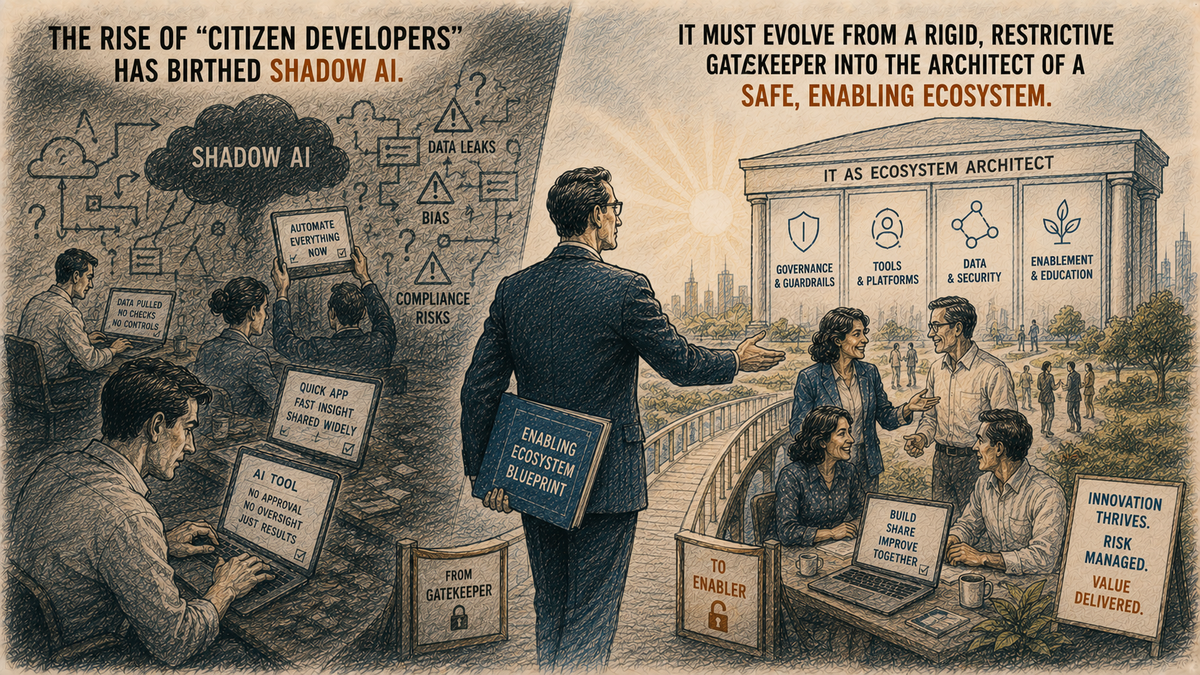
The rise of "Citizen Developers" has birthed Shadow AI. IT must evolve from a rigid, restrictive gatekeeper into the architect of a safe, enabling ecosystem.
"The greatest enemy of knowledge is not ignorance, it is the illusion of knowledge." — W. Edwards Deming
The conference room fell silent as Sarah, the Chief Information Officer of a mid-sized manufacturing company, watched her CEO's face redden with frustration. "Why," he demanded, "does it take six months to get a simple dashboard built when my nephew can create something similar in Power BI over a weekend?" The uncomfortable truth hanging in the air was one that IT departments across the globe are grappling with: the traditional model of IT as the sole arbiter of technology solutions is not just obsolete—it's actively hindering business transformation in the age of AI.
This scene, playing out in boardrooms everywhere, represents more than just generational friction or technological growing pains. It signals a fundamental shift in how organizations must approach technology governance, development, and enablement. The rise of AI-powered tools has democratized capabilities that once required armies of specialized developers, creating what industry observers call "citizen developers"—business users who can now build sophisticated solutions without traditional coding skills.
But this democratization comes with a paradox that IT leaders must navigate carefully. While AI tools lower the barrier to creating technology solutions, they simultaneously raise the stakes for security, governance, and enterprise architecture. The challenge is no longer whether to allow business users to build their own solutions—they're already doing it. The challenge is how to enable them to do so safely, efficiently, and in alignment with enterprise objectives.
Great Unbundling of IT Control
For decades, IT departments operated under a simple premise: centralized control equals reduced risk. Every application, every database, every integration had to flow through IT's approval process. This approach made sense in an era when technology changes were slow, expensive, and required deep technical expertise. Installing enterprise software meant months of planning, significant capital investment, and armies of consultants. In this world, IT's role as gatekeeper was not just justified—it was essential.
But AI has fundamentally altered this equation. Consider the story of Marcus, a sales director at a Fortune 500 company who grew frustrated with the limitations of his CRM system's reporting capabilities. A traditional process would have required him to submit a request to IT, wait for prioritization against competing business needs, and eventually receive a solution that approximated his requirements. Instead, Marcus used Claude to help him build a sophisticated data analysis workflow that connected multiple data sources, performed complex calculations, and generated executive-ready visualizations—all within a few hours on a Tuesday afternoon.
This isn't an isolated incident. Across organizations, business users are discovering they can solve their own problems faster and more precisely than traditional IT delivery models allow. They're using AI-powered tools to create applications, automate workflows, analyze data, and even generate code that would have required months of IT resources just five years ago.
The result is what IT professionals are calling "shadow AI"—the proliferation of AI-powered solutions developed and deployed outside of traditional IT oversight. Unlike previous waves of shadow IT, which were often limited to simple productivity tools, shadow AI can create business-critical applications with enterprise-scale implications. A marketing manager using generative AI to create personalized customer communications at scale, a finance analyst building automated reconciliation processes, or a supply chain manager developing predictive analytics models—these aren't just convenience tools; they're core business applications that can make or break operational efficiency.
The traditional IT response to shadow technologies has been to attempt to shut them down—to reassert centralized control through policy and enforcement. But this approach is not just futile in the AI era; it's counterproductive. Organizations that try to lock down AI tools entirely find themselves falling behind competitors who are leveraging these capabilities to move faster, serve customers better, and operate more efficiently.
From Control to Enablement
The most successful organizations are those whose IT departments have made a conscious shift from controllers to enablers. This doesn't mean abandoning governance or accepting unmanaged risk. Instead, it means reimagining IT's value proposition in an AI-driven world.
Consider the transformation at DataDriven Corp, a logistics company that faced exactly this challenge. Their traditional IT organization was overwhelmed with requests for data analysis, custom reporting, and workflow automation. The backlog stretched months, and business frustration was mounting. Rather than simply adding more IT staff, they implemented what they called the "AI-First Enablement Model."
The transformation began with a recognition that the business didn't need IT to build every solution—they needed IT to make it safe and scalable for the business to build their own solutions. IT shifted their focus from being the builders to being the architects of the environment where building could happen safely and efficiently.
They started by establishing an AI governance framework that defined what types of AI applications could be developed by business users, what data they could access, and what approval processes were required for different categories of solutions. But critically, this wasn't a restrictive framework designed to slow things down—it was an enabling framework designed to provide clear guardrails within which innovation could flourish.
For low-risk applications that used publicly available data or didn't interface with core systems, business users could proceed without IT approval. For moderate-risk applications that accessed internal data but stayed within departmental boundaries, a lightweight review process ensured compliance with data governance policies. Only high-risk applications that could impact core systems or sensitive data required the traditional approval process.
The results were remarkable. Business users began developing solutions at a pace that would have been impossible under the old model. More importantly, the quality and relevance of these solutions improved dramatically because they were being built by the people who best understood the business problems they were solving.
But the real transformation was in IT's role. Rather than being seen as a bottleneck, IT became viewed as a strategic enabler. They were no longer saying "no" to business requests—they were saying "here's how to do it safely and effectively." They provided training on AI tool usage, established data access patterns that balanced security with usability, and created reusable components that business users could leverage in their solutions.
Rise of Citizen Developers in an AI World
The concept of citizen developers—business users who create applications without formal programming training—isn't new. But AI has supercharged this phenomenon in ways that fundamentally change its implications for IT organizations.
Traditional citizen development platforms required users to learn proprietary visual programming languages, understand database concepts, and grasp basic software architecture principles. These barriers meant that citizen development remained limited to relatively simple applications and a small subset of particularly technical business users.
AI-powered development tools have eliminated most of these barriers. Business users can now describe what they want in natural language and watch as AI generates functional applications, complete with user interfaces, data connections, and business logic. The learning curve has flattened dramatically, expanding the pool of potential citizen developers from dozens to hundreds or thousands within a typical organization.
Take the example of Jennifer, a human resources manager with no programming background who used AI tools to create a comprehensive employee onboarding application. The application automatically generates personalized onboarding checklists based on role and department, integrates with multiple HR systems to populate employee data, sends automated reminders and follow-ups, and provides managers with real-time visibility into onboarding progress.
In the pre-AI era, building such an application would have required months of IT development time, extensive requirements gathering, and ongoing maintenance overhead. Jennifer built her initial version in less than a week, with subsequent iterations taking just hours as she refined functionality based on user feedback.
But Jennifer's story also illustrates the new challenges that IT must navigate. Her application processes sensitive employee data, integrates with core HR systems, and has become business-critical for the organization's talent acquisition process. While IT wasn't involved in its initial development, they're now responsible for ensuring it meets security, compliance, and operational standards.
This scenario is playing out across organizations in every industry. Business users are building applications with enterprise-scale implications, and IT must find ways to provide appropriate oversight without stifling innovation.
End User Computing Challenge in an AI Era
The proliferation of business-user-developed AI applications has brought new urgency to what IT professionals call the "End User Computing" (EUC) challenge. EUC has always been a balancing act between empowering users to be productive and maintaining appropriate governance and risk management. But AI has amplified both the opportunities and the risks.
On the opportunity side, AI-powered EUC tools can deliver business value at unprecedented speed and precision. Business users can create solutions that are perfectly tailored to their specific needs, iterate rapidly based on changing requirements, and deploy functionality without the overhead of traditional software development lifecycles.
But the risks have also escalated. AI applications can process vast amounts of data, make decisions with significant business impact, and integrate with critical systems in ways that can affect enterprise stability and security. A poorly designed AI application might not just produce incorrect results—it could compromise sensitive data, violate regulatory requirements, or disrupt core business processes.
The challenge for IT is developing governance models that are sophisticated enough to manage these risks while remaining simple enough for business users to navigate effectively. This requires a fundamental shift from binary approval processes to risk-proportionate governance frameworks.
Leading organizations are implementing what might be called "graduated autonomy" models for AI-powered EUC. These models establish different categories of AI applications based on their potential risk and impact, with governance requirements that scale accordingly.
At the lowest tier are AI applications that operate on public data, don't integrate with enterprise systems, and have limited potential for causing harm. Business users can develop and deploy these applications with minimal oversight, often with nothing more than basic training on AI tool usage and corporate policies.
The middle tier includes applications that access internal data or integrate with departmental systems but don't touch core enterprise infrastructure or highly sensitive data. These applications require lightweight governance processes—perhaps a brief review by IT to ensure appropriate data access controls and basic security practices.
The highest tier consists of applications that access sensitive data, integrate with core systems, or have the potential for significant business impact. These applications require more traditional governance approaches, including IT architecture review, security assessment, and ongoing monitoring.
The key insight is that the governance framework itself becomes a product that IT delivers to the business. Rather than simply approving or rejecting requests, IT creates the infrastructure and processes that enable business users to innovate within appropriate boundaries.
Agentic Computing and IT Transformation
The emergence of agentic AI—systems that can act autonomously to achieve specified goals—represents perhaps the most significant challenge to traditional IT models. While current AI tools primarily serve as sophisticated assistants that respond to human direction, agentic systems can independently identify problems, develop solutions, and execute complex multi-step processes.
Consider the implications of an AI agent that can automatically optimize database performance, update software configurations, or troubleshoot network issues without human intervention. On one hand, this represents a tremendous opportunity for IT organizations to operate more efficiently and focus on higher-value strategic activities. On the other hand, it raises fundamental questions about control, accountability, and risk management.
Some organizations are already experimenting with agentic AI for IT operations. CloudTech Solutions deployed an AI agent that monitors their cloud infrastructure, automatically scales resources based on demand patterns, and optimizes configurations for cost and performance. The agent doesn't just alert human operators to issues—it proactively resolves them, often before users are even aware problems existed.
The results have been impressive: infrastructure costs decreased by thirty percent, system uptime improved to 99.97 percent, and the IT operations team was freed to focus on strategic initiatives rather than routine maintenance. But the organization also had to develop entirely new approaches to governance and oversight.
How do you audit decisions made by an autonomous agent? How do you ensure compliance with regulatory requirements when actions are taken without explicit human approval? How do you maintain security when systems can modify themselves based on learned patterns?
These questions don't have simple answers, but they highlight the need for IT organizations to fundamentally rethink their operating models. Traditional approaches based on human review and approval of every change simply cannot scale in an agentic computing environment.
Instead, IT must shift toward outcome-based governance models that focus on defining objectives and constraints rather than dictating specific processes. Rather than specifying exactly how database optimization should occur, IT defines performance targets, cost constraints, and security requirements, then allows agentic systems to determine the best approaches to achieve these goals.
This shift requires new capabilities within IT organizations. IT professionals must become skilled in defining objectives clearly, establishing appropriate constraints, and monitoring outcomes effectively. They must also develop expertise in AI system behavior, understanding how agentic systems make decisions and what factors influence their actions.
Fostering Collaboration Between Business and IT
The transformation of IT from gatekeeper to enabler succeeds or fails based on the quality of collaboration between IT and business stakeholders. This collaboration must be built on mutual understanding, shared objectives, and clear communication about capabilities and constraints.
The most successful transformations begin with education and alignment. IT teams must understand business objectives deeply enough to design enabling infrastructure that actually serves business needs. Business teams must understand technology constraints and security requirements well enough to make informed decisions about solution approaches.
This educational process goes both ways. IT professionals are learning to communicate in business terms, focusing on outcomes and value rather than technical specifications. Business professionals are developing technical literacy, understanding concepts like data governance, security frameworks, and system integration well enough to make informed decisions about their AI implementations.
The collaboration model that's emerging in leading organizations can be characterized as "distributed expertise with centralized coordination." Business units become centers of expertise for their specific domains and use cases, while IT becomes the center of expertise for infrastructure, security, and enterprise architecture.
When the marketing team wants to implement AI-powered personalization, they bring deep understanding of customer behavior, campaign objectives, and marketing processes. IT brings expertise in data architecture, privacy compliance, and system integration. Together, they design solutions that are both business-effective and technically sound.
This collaborative approach extends to solution development as well. Rather than business units developing solutions in isolation and then asking IT to support them, the most effective organizations establish ongoing partnerships where IT provides architectural guidance and technical expertise throughout the development process.
The result is solutions that are more robust, scalable, and aligned with enterprise standards from the outset. Business units get the agility and customization they need, while IT ensures that solutions meet security, compliance, and operational requirements.
New Skills and Capabilities for IT Organizations
The transformation of IT's role requires corresponding changes in the skills and capabilities of IT professionals. Traditional IT skills remain important, but they must be augmented with new competencies that enable success in an AI-driven business environment.
First and foremost, IT professionals must develop AI literacy. This doesn't mean becoming data scientists or machine learning engineers, but rather understanding AI capabilities and limitations well enough to provide informed guidance to business stakeholders. IT professionals need to understand how different types of AI systems work, what data requirements they have, and what risks they present.
They also need to develop new types of architectural thinking. Traditional enterprise architecture focused on predefined systems with known interfaces and capabilities. AI-powered systems are more dynamic, with capabilities that can evolve over time and interfaces that may be conversational rather than programmatic.
This requires architectural approaches that emphasize flexibility, modularity, and adaptability. IT architects must design systems that can accommodate rapid changes in AI capabilities and business requirements without requiring fundamental restructuring.
Communication skills become even more critical in this new environment. IT professionals must be able to explain complex technical concepts to business stakeholders in terms that resonate with business objectives. They must also be able to translate business requirements into technical specifications that can guide AI implementation efforts.
Perhaps most importantly, IT professionals must develop a service mindset that focuses on enabling business success rather than simply maintaining technical systems. This requires understanding business processes deeply enough to identify opportunities for AI enhancement and designing technical solutions that support business agility rather than constraining it.
Security and Governance
While the democratization of AI development offers tremendous opportunities for business agility and innovation, it also creates new security and governance challenges that IT must address proactively. The distributed nature of AI development means that security and governance controls must be embedded into the development environment rather than applied as external oversight.
Traditional security models relied on perimeter defense—controlling access to development tools and production systems. But when business users can develop sophisticated applications using cloud-based AI services, traditional perimeter controls become ineffective.
Instead, IT must implement what security professionals call "zero trust" approaches that assume no inherent trustworthiness and verify every access request and action. This requires embedding security controls into the AI development and deployment process rather than treating security as a separate layer.
Data governance becomes particularly critical in AI environments because AI systems can access and process vast amounts of data in ways that may not be immediately apparent to their creators. Business users developing AI applications may not fully understand the privacy, compliance, or security implications of their data usage patterns.
IT must provide governance frameworks that make appropriate data usage patterns easy and inappropriate patterns difficult or impossible. This might involve creating data access layers that automatically apply privacy controls, developing templates that embed compliance requirements, or providing monitoring tools that alert stakeholders to potential governance issues.
The goal is not to prevent business users from accessing the data they need, but to ensure that they access it in ways that meet enterprise governance requirements. This requires sophisticated technical implementations that balance usability with control.
Future of IT in an AI-Driven World
As AI capabilities continue to advance, the role of IT will continue to evolve in ways that may be difficult to predict fully. But several trends seem clear based on current developments and organizational experiences.
First, IT will become increasingly focused on platform capabilities rather than application development. Rather than building specific solutions for business problems, IT will create platforms that enable business users to build their own solutions safely and efficiently.
Second, IT will become more consultative and less operational. IT professionals will spend more time advising business stakeholders on solution approaches and less time implementing predetermined technical specifications.
Third, IT governance will become more automated and intelligent. Rather than relying on human review and approval processes, IT will implement AI-powered governance systems that can automatically evaluate solutions against enterprise policies and requirements.
Fourth, the boundaries between IT and business functions will continue to blur. Business professionals will develop increasing technical capabilities, while IT professionals will develop deeper business expertise.
These changes don't diminish the importance of IT organizations—they enhance it. In an AI-driven world, the organizations that can most effectively enable business innovation while maintaining appropriate governance and risk management will have significant competitive advantages.
Practical Steps for IT Transformation
For IT leaders ready to begin this transformation, several practical steps can provide a foundation for success.
Begin by conducting an honest assessment of current capabilities and gaps. How effectively does your current IT organization enable business innovation? What barriers exist to business self-service? What governance and security controls are truly necessary versus merely traditional?
Develop a vision for IT's future role that emphasizes enablement over control. This vision should be developed collaboratively with business stakeholders and should focus on business outcomes rather than technical specifications.
Invest in building AI literacy within the IT organization. This includes both technical understanding of AI capabilities and business understanding of AI use cases and value propositions.
Create pilot programs that allow controlled experimentation with business-driven AI development. Start with low-risk use cases and gradually expand as capabilities and governance frameworks mature.
Establish governance frameworks that are proportionate to risk and focused on outcomes rather than processes. These frameworks should make compliance easy rather than making innovation difficult.
Most importantly, measure success based on business outcomes rather than IT metrics. The goal is not to maintain control over technology decisions but to enable business success through technology.
Learning to Harvest Unpredictable Innovation
The story of how one organization saved $50 million through unauthorized innovation while simultaneously learning nothing from that success reveals the fundamental challenge facing every business leader in the AI era. The technology that delivered breakthrough value operated outside official channels, circumvented established processes, and succeeded precisely because it avoided the coordination costs and risk-aversion mechanisms that define traditional corporate innovation.
Most organizations celebrate such outcomes while systematically destroying the conditions that made them possible. They harvest the fruits of innovation while salting the fields that produced those fruits. This pattern of "innovation amnesia" isn't just inefficient—in an AI-driven world, it becomes competitively suicidal.
The Unpredictability Challenge
AI will drive innovation in ways that are fundamentally impossible to predict, control, or channel through traditional corporate processes. The same characteristics that make AI powerful—its ability to find unexpected patterns, generate novel solutions, and combine disparate information in surprising ways—make AI-driven innovation inherently unpredictable and resistant to conventional management approaches.
When a marketing manager uses AI to discover that customer service chat logs contain predictive signals for sales opportunities, leading to a breakthrough customer retention strategy, this wasn't planned in any innovation roadmap. When a supply chain analyst uses AI to identify patterns in supplier communications that predict delivery delays weeks in advance, this wasn't anticipated in any project portfolio. When a finance team member uses AI to automate complex reconciliation processes that had resisted traditional automation for years, this wasn't part of any IT strategy.
These breakthrough innovations emerge from the intersection of AI capabilities, domain expertise, and business problems in ways that cannot be predicted, scheduled, or managed through traditional processes. They represent what innovation theorists call "emergent innovation"—value creation that arises from conditions rather than planning.
Organizations designed around control, predictability, and risk minimization are structurally incapable of recognizing, nurturing, or scaling emergent innovation. When they encounter breakthrough results that emerged outside official channels, they face a choice: learn from successful rule-breaking or suppress future rule-breaking to maintain control. Most choose suppression, killing the host to eliminate the perceived infection.
Governance Paradox
The instinctive organizational response to unpredictable AI-driven innovation is to attempt to contain it through governance frameworks, approval processes, and risk management controls. This response is not just counterproductive—it's organizationally fatal in competitive markets where other organizations are successfully harnessing emergent innovation.
Governance systems designed to prevent failure systematically prevent the experimentation necessary for breakthrough success. They create what economists call "type one error bias"—organizations become extraordinarily good at avoiding false positives (approving bad ideas) while becoming systematically incapable of capturing true positives (recognizing breakthrough opportunities).
In stable business environments, this bias toward preventing bad things might be acceptable. But in rapidly changing environments where competitive advantage comes from leveraging new capabilities faster than competitors, organizations that cannot harvest emergent innovation face inexorable competitive decline.
The governance paradox becomes especially acute with AI because AI tools can deliver enterprise-scale value through approaches that look like violations of enterprise governance principles. The marketing manager building customer analytics systems outside IT oversight, the operations director creating predictive maintenance applications without formal development processes, the finance team automating complex workflows without traditional testing protocols—these activities violate conventional governance wisdom while delivering transformative business value.
Attempting to suppress this innovation through governance controls doesn't eliminate the innovation—it drives the most capable innovators to other organizations where they can deliver value without career risk. Organizations that excel at governance compliance while failing at innovation harvesting find themselves perfectly coordinated around increasingly obsolete approaches.
Leadership Transformation Requirements
Successful AI transformation requires leaders to undergo personal transformation that contradicts most traditional corporate leadership training. Leaders must shift from controllers of predetermined outcomes to cultivators of emergence conditions. They must become comfortable with uncertainty, supportive of intelligent failure, and protective of employees who take risks that don't work perfectly.
This transformation cannot be delegated or outsourced. When senior leaders maintain traditional control-oriented behaviors while expecting subordinates to embrace innovation-oriented behaviors, they create cognitive dissonance that paralyzes organizational transformation. The most capable potential innovators rationally choose not to take career risks for organizations whose leaders haven't demonstrated genuine commitment to supporting intelligent risk-taking.
Genuine leadership transformation requires leaders to personally model the behaviors they want to see throughout the organization. This means leaders themselves must become proficient with AI tools, demonstrate willingness to experiment and iterate, and actively celebrate intelligent failures alongside breakthrough successes.
More fundamentally, leaders must develop the organizational humility to learn from unauthorized innovations rather than simply harvesting their value. When breakthrough results emerge from approaches that contradict official organizational wisdom, effective leaders ask what conditions enabled those breakthroughs and how those conditions can be replicated systematically rather than asking how similar rule-breaking can be prevented in the future.
Beyond Process Innovation to Condition Creation
The organizations that will thrive in an AI-driven future will be those that shift from designing better innovation processes to creating better innovation conditions. This shift represents a fundamental change in management philosophy from direct control to environmental design.
Instead of trying to predict and plan specific innovations, these organizations focus on creating conditions where valuable innovations are likely to emerge: psychological safety for experimentation, rapid iteration capabilities, resource flexibility, and leadership support for intelligent risk-taking. Instead of measuring compliance with innovation processes, they measure value creation from innovation outcomes.
This approach requires different metrics, different reward systems, and different definitions of success. Organizations must become skilled at recognizing emergent value, scaling successful experiments, and learning from both successes and failures. They must develop organizational capabilities for rapid iteration, intelligent risk assessment, and adaptive resource allocation.
Most importantly, they must develop leadership capabilities for managing uncertainty, supporting experimentation, and harvesting emergent value rather than controlling predetermined outcomes.
Competitive Imperative
The transformation from IT gatekeeper to enabler is not optional because the competitive dynamics of AI-driven markets make traditional control-oriented approaches competitively unsustainable. Organizations that can effectively harness AI-driven innovation across their entire workforce will consistently outperform organizations that channel AI capabilities through traditional IT delivery models.
This competitive advantage compounds over time because organizations that successfully harvest emergent innovation develop superior organizational capabilities for leveraging AI tools, recognizing breakthrough opportunities, and scaling valuable experiments. They become better at innovation not just through better tools but through better organizational learning.
The conversation in that conference room where we began this chapter—the CEO demanding to know why simple solutions take months through official channels when they can be built in weekends through unofficial channels—represents more than operational frustration. It represents the collision between traditional organizational models and AI-enabled competitive realities.
Organizations whose leaders can transform that conversation from a source of frustration into a catalyst for organizational learning will position themselves to thrive in an AI-driven future. Organizations whose leaders cannot make this transformation will find themselves increasingly outcompeted by more adaptive rivals, regardless of their current market position or resource advantages.
Innovation Engine
The most critical insight from breakthrough shadow innovation experiences is that innovation properly executed becomes the primary engine for both growth and cost savings in any organization. A single unauthorized project that saves $50 million while solving problems that official processes couldn't address demonstrates innovation's potential to transform corporate economics fundamentally. Yet most organizations systematically destroy their capacity to replicate such breakthroughs through the very control mechanisms they believe protect corporate value.
Americans celebrate innovation in startups while simultaneously killing innovation within established organizations through compliance frameworks, risk management processes, and governance structures designed around control rather than value creation. This paradox reveals a fundamental misunderstanding about how innovation actually creates corporate value and what organizational conditions enable versus destroy innovative capacity.
Transforming Risk from Enemy to Ally
The traditional corporate risk calculus treats uncertainty as inherently dangerous and innovation as inherently risky. This perspective creates organizational cultures where taking intelligent risks that could enhance corporate value becomes career-threatening rather than career-enhancing. The rational response for capable employees is to avoid innovation rather than pursue it, leaving organizations with innovation theater instead of genuine breakthrough capacity.
Transforming this dynamic requires fundamentally different incentive structures that explicitly reward intelligent risk-taking alongside successful outcomes. This means protecting employees who pursue high-potential innovations that don't succeed perfectly, celebrating learning from intelligent failures, and creating career advancement paths that recognize innovation contributions rather than just operational excellence.
Risk must be reframed from something to be controlled to something to be embraced intelligently. Organizations that excel at intelligent risk-taking consistently outperform organizations that excel at risk avoidance because they can capture opportunities that risk-averse competitors cannot access. In AI-driven markets where breakthrough innovations can emerge rapidly and unpredictably, the ability to embrace intelligent risk becomes a core competitive capability.
This transformation requires senior leaders to personally model risk-embracing behaviors rather than simply advocating for them rhetorically. When leaders demonstrate through their own actions that intelligent risk-taking is valued and protected, they create psychological safety for innovation throughout the organization.
Innovation Leadership
Effective innovation leadership requires understanding that innovation needs active protection from organizational antibodies that attempt to control uncertainty in the name of risk management. Innovation leaders must serve as shields between innovative teams and control-oriented processes that would manage innovation to death through compliance requirements.
But protection alone is insufficient. Innovation must be nurtured through close connection to real business needs and problems. Innovation teams isolated from business operations consistently fail to deliver practical value because they solve interesting problems rather than important problems. The most successful innovations emerge when deep business expertise combines with innovative approaches to create solutions that official processes cannot deliver.
Innovation leadership also requires understanding that innovation capacity develops over time through successful cycles of experimentation, learning, and scaling. Organizations cannot simply decide to become innovative—they must systematically develop innovation capabilities through repeated practice, intelligent failure analysis, and continuous improvement of their innovation approaches.
This developmental perspective suggests that organizations might benefit from formal innovation leadership roles—perhaps Chief Innovation Officers—who are specifically responsible for cultivating innovation conditions, protecting innovative initiatives from bureaucratic interference, and connecting innovation activities with business value creation opportunities.
Scaling Innovation
The challenge of scaling shadow innovation approaches from individual breakthroughs to organizational capabilities requires learning from organizations that consistently deliver innovation at scale. Technology companies that continuously innovate provide management models worth studying because they have solved the problem of maintaining innovation capacity while growing organizational scale and complexity.
These organizations typically share several characteristics: they maintain innovation-friendly incentive structures even as they grow, they embed innovation responsibility throughout the organization rather than isolating it in separate teams, they develop rapid iteration capabilities that enable fast learning cycles, and they maintain cultures that celebrate intelligent risk-taking alongside operational excellence.
Scaling innovation also requires transforming corporate incentive structures to explicitly reward innovation contributions rather than just operational performance. This might involve creating innovation bonuses, establishing innovation career tracks, or incorporating innovation metrics into performance evaluation systems.
Most importantly, scaling requires developing organizational capabilities for recognizing emergent value, rapidly testing innovative approaches, and systematically scaling successful experiments. Organizations must become skilled at harvesting the value from successful innovations while simultaneously learning how to replicate the conditions that enabled those successes.
Growth Engine Revelation
The fundamental business case for innovation transformation rests on innovation's unique capacity to serve as an engine for both growth and cost savings simultaneously. Traditional business improvement approaches typically require choosing between growth investments and efficiency improvements. Innovation, properly executed, can deliver both simultaneously by finding entirely new approaches to creating and capturing value.
The $50 million savings from unauthorized innovation represents just one example of innovation's potential to transform corporate economics. When multiplied across an organization's full range of business challenges, innovation capacity becomes perhaps the most valuable corporate capability in competitive markets.
But this potential remains unrealized in most organizations because compliance frameworks and governance structures designed around control rather than value creation systematically prevent the experimentation necessary for breakthrough innovations. These organizations essentially spend money to prevent the activities that could generate the most value.
The competitive implications are profound. Organizations that successfully transform their innovation capacity will consistently outperform organizations that remain focused on optimizing existing approaches rather than discovering breakthrough alternatives. In AI-driven markets where entirely new value creation approaches become possible, this innovation advantage compounds rapidly into decisive competitive superiority.
The Choice Before Every Leader
Every senior leader now faces a fundamental choice about their organization's future. They can maintain traditional control-oriented approaches that provide the illusion of risk management while systematically destroying their organization's capacity for breakthrough innovation. Or they can undergo the personal transformation necessary to create conditions where AI-driven innovation can flourish safely and effectively.
This choice cannot be postponed because AI capabilities are advancing too rapidly for traditional organizational planning cycles to remain relevant. The leaders who recognize that their most valuable innovations will emerge from unpredictable intersections of AI capabilities and business expertise, and who create organizational conditions that nurture rather than suppress such emergence, will build competitive advantages that become increasingly difficult for traditionally managed organizations to match.
The technology exists. The business opportunities are evident. The economic potential is demonstrated. The only remaining question is whether organizational leaders have the wisdom and courage to transform themselves and their organizations to harvest the unprecedented value that AI-driven innovation makes possible.
The time for incremental organizational adjustments has passed. AI-driven competitive dynamics demand nothing less than fundamental leadership transformation that embraces innovation as the primary engine for corporate value creation. The organizations whose leaders make this transformation will thrive. Those whose leaders cannot or will not embrace innovation as their competitive foundation will become case studies in how traditional management approaches became competitive liabilities in an AI-driven world.