Chapter 14: From "Art of the Possible" to Practical Application
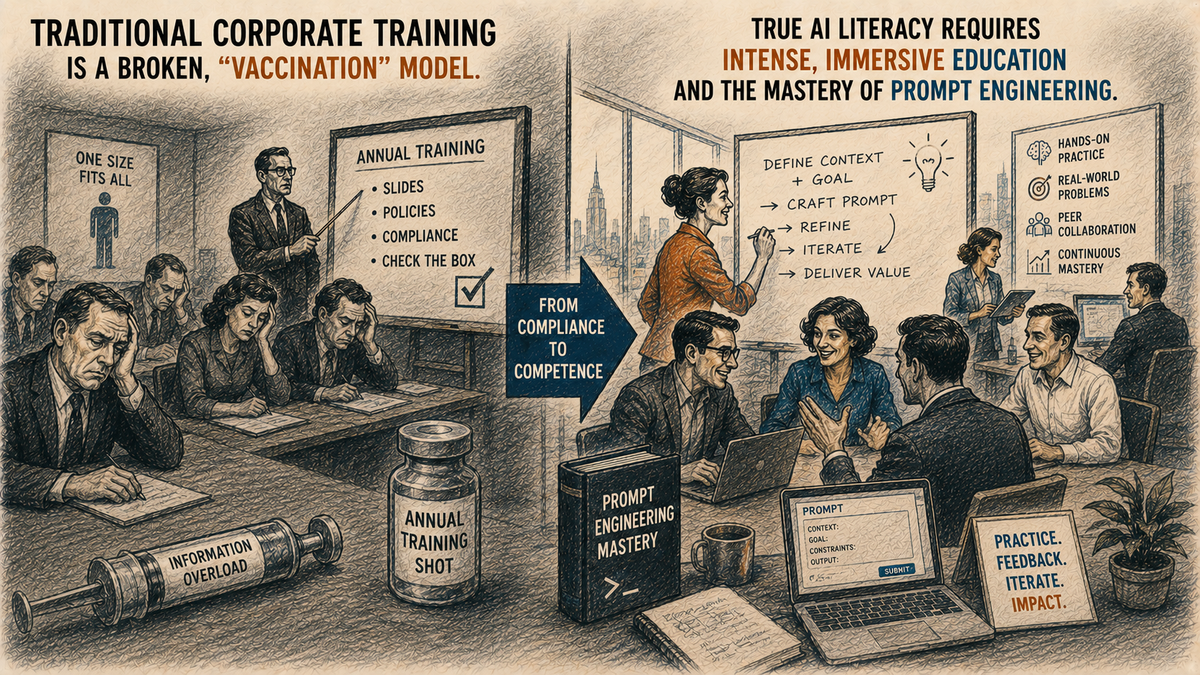
Traditional corporate training is a broken, "vaccination" model. True AI literacy requires intense, immersive education and the mastery of prompt engineering.
"The illiterate of the 21st century will not be those who cannot read and write, but those who cannot learn, unlearn, and relearn." — Alvin Toffler
Why Most Companies Are Failing at AI
Sarah Chen, the Chief Innovation Officer at a mid-sized manufacturing company, faced a peculiar problem. Her organization had invested heavily in AI tools—from coding assistants to advanced analytics platforms—yet productivity gains remained disappointingly modest. The tools were there, but her employees were treating them like sophisticated calculators, asking simple questions and expecting magic answers.
The breakthrough came during an unexpected conversation with Jake, a veteran production manager who had been quietly experimenting with AI on his own time. While others were asking their AI assistant basic questions like "How do I reduce inventory costs?", Jake had crafted detailed prompts that included specific context about their supply chain constraints, seasonal demand patterns, and vendor relationships. His results weren't just better—they were transformational.
But here's what Sarah discovered when she dug deeper into why Jake succeeded where others failed: it wasn't just that he was more motivated or technically inclined. Jake had been trained as an engineer twenty years earlier, when rigorous analytical thinking and clear technical communication were non-negotiable requirements for success. His colleagues, many with business degrees focused on case study analysis and presentation skills, lacked the fundamental cognitive tools that effective AI collaboration demands.
This story illuminates a profound truth that most organizations haven't yet grasped: the AI revolution isn't just exposing gaps in technical training—it's revealing fundamental deficiencies in how we've been preparing people for knowledge work. The employees struggling with AI aren't lacking motivation or intelligence. They're lacking the basic critical thinking and communication skills that our educational system has failed to develop effectively.
The uncomfortable reality is that most of your workforce isn't prepared for AI at all. Not because they can't learn to use the tools, but because they lack the foundational cognitive capabilities that AI collaboration requires. When someone can't think critically about information, can't express complex ideas clearly in writing, and can't maintain appropriate skepticism about authoritative-sounding outputs, they become liabilities rather than assets in an AI-augmented environment.
Most Employees Aren't Ready for AI
The problem runs much deeper than technical training. Most corporate education programs are fundamentally broken, which explains why CFOs routinely dismiss them as expensive exercises with minimal return on investment. The traditional approach of lunch-and-learn sessions, online modules, and occasional workshops fails because it treats learning as an event rather than a process, and because it assumes employees already possess the foundational cognitive skills that effective learning requires.
Consider this simple question: what has anyone ever truly learned at a lunch-and-learn session? The answer is nothing of lasting value, because meaningful skill development cannot occur in artificial environments where people are simultaneously trying to eat, check their phones, and process their daily work pressures while absorbing complex new concepts.
The reality is that most employees lack refined critical thinking skills and cannot express themselves effectively in writing. These aren't just "nice-to-have" capabilities—they're fundamental prerequisites for AI collaboration. When someone with weak critical thinking skills encounters a confident-sounding AI response, they accept it uncritically. When someone cannot articulate their requirements clearly, they cannot craft the sophisticated prompts that AI tools require to produce valuable outputs.
This creates what we might call the "cognitive dependency trap." Instead of AI augmenting human capabilities, it replaces human thinking entirely because the human lacks the skills necessary to evaluate and guide AI outputs effectively. The result is employees who become increasingly dependent on AI systems while adding less and less human value to the collaboration.
Traditional Corporate Training Fails
The fundamental flaw in most corporate training approaches is the impossible expectation that employees can simultaneously maintain their full workload while absorbing complex new skills. It's like trying to learn surgery while performing operations—the cognitive load is too high and the stakes too immediate for effective learning to occur.
Most organizations follow what we might call the "vaccination model" of training. They expose employees to information once and expect that this creates lasting immunity to ignorance. This completely misunderstands how adults develop new capabilities and integrate them into their work patterns.
When employees attend training sessions and then return to environments where the same pressures, systems, and reward structures exist, old habits reassert themselves within days. The training becomes an expensive interruption rather than a transformation catalyst because the organizational environment hasn't changed to support new behaviors.
The economics of this approach are devastating when you calculate the true costs. Consider a company that spends $500,000 on AI training for 200 employees. If the training doesn't result in meaningful behavior change—which it rarely does under traditional approaches—that investment produces zero return while creating the illusion that the organization has addressed its AI readiness challenges.
The Intensive Transformation Model: Treating Employees as Students
The solution requires abandoning traditional corporate training approaches entirely and adopting what we might call the "student model" for professional AI education. This means acknowledging that developing true AI literacy requires the same kind of dedicated time and cognitive space that any serious educational endeavor demands.
Just as you cannot become a surgeon by attending medical school part-time while maintaining a full surgical practice, you cannot develop sophisticated AI collaboration skills while simultaneously managing your regular workload. The cognitive demands are simply too high and the learning too complex to occur in the margins of busy professional lives.
This approach requires enormous organizational courage because it means accepting that some of your best people will be temporarily unavailable for their regular responsibilities. For smaller companies, this represents a particularly difficult challenge because every person's absence creates immediate operational pressures. However, the alternative—attempting to implement AI transformation with an inadequately prepared workforce—almost certainly guarantees failure.
The intensive approach I'm advocating involves selecting high-potential employees for comprehensive AI education programs lasting a minimum of one month and potentially as long as three months. These aren't part-time training sessions squeezed between meetings. They're full-time educational experiences where participants can focus entirely on developing the cognitive and technical skills that AI collaboration requires.
Choosing Your Multipliers
Success depends not just on having an excellent educational program, but on selecting the right people to participate. Not everyone has the combination of skills, mindset, and organizational influence necessary to become effective AI Champions who can multiply their learning throughout the organization.
The selection process should include a formal application where internal candidates demonstrate not just their technical aptitude, but their ability to think critically, communicate clearly, and influence others. This isn't about finding the most senior people or those with the most advanced degrees. It's about identifying individuals who can learn complex concepts quickly, adapt to ambiguous situations, and teach others effectively.
The ideal AI Champion candidate combines domain expertise with learning agility. They understand their business area deeply enough to identify meaningful AI applications, but they're intellectually flexible enough to reimagine how work might be done differently. They can ask probing questions, evaluate complex information, and maintain appropriate skepticism while remaining open to new possibilities.
Perhaps most importantly, AI Champions must have the interpersonal skills necessary to influence organizational change. Technical competence alone isn't sufficient. They need to understand how to manage resistance, communicate complex ideas to diverse audiences, and create psychological safety for experimentation and learning.
Designing the Three-Month Intensive Program
The intensive program must be dense, rigorous, and comprehensive. This isn't a casual exploration of AI capabilities—it's a systematic development of expertise that combines technical understanding, practical application, and teaching skills.
Month One focuses on building foundational understanding of AI systems, not just how to use them but how they actually work. Participants learn about the underlying technology, its capabilities and limitations, and develop what we might call "AI intuition"—the ability to understand when and how to apply AI tools effectively. This phase includes extensive hands-on practice with prompt engineering, learning to craft sophisticated instructions that leverage AI capabilities fully.
Month Two shifts toward practical application, where participants take real business challenges from their departments and work through AI solutions. The key is encouraging them to think outside the box and reimagine processes rather than simply applying AI to existing workflows. They develop business cases for specific AI implementations while learning to balance the "Art of the Possible" with the "Art of the Realistic."
Month Three focuses on developing teaching and change management skills. Participants learn how to evangelize AI effectively, manage resistance to change, and transfer their knowledge to colleagues who may be skeptical or intimidated by new technology. This phase includes practice with public speaking, adult learning principles, and organizational psychology.
Throughout all three months, participants receive ongoing mentorship from experienced AI practitioners—much like graduate students work with faculty advisors. This mentorship continues after the intensive program ends, providing sustained support as Champions encounter new challenges in their regular roles.
Overcoming Professional Resistance
The biggest challenge in implementing intensive AI education isn't technical or financial—it's cultural. Most white-collar professionals view anything resembling apprenticeship-style learning as beneath their status. They invested years and significant money in university degrees specifically to avoid what they perceive as "manual" or "remedial" learning approaches. Asking them to become students again feels like a fundamental attack on their professional identity.
This resistance becomes particularly strong because intensive AI education forces professionals to confront the possibility that their expensive higher education didn't actually prepare them for the most important challenges they now face. When someone with an MBA realizes they need to learn fundamental thinking skills that should have been developed years earlier, it creates cognitive dissonance that can be resolved either by embracing learning or by rejecting the premise that learning is necessary.
Most employees see internal education as useless because, frankly, it usually is ineffective. Companies have trained their workforce to expect low-quality, irrelevant training experiences that provide minimal value and interfere with "real work." Breaking through this skepticism requires creating programs that are demonstrably valuable, intellectually rigorous, and directly relevant to professional advancement.
The key lies in framing and quality. If internal education programs are perceived as high-status, intellectually challenging experiences that enhance rather than remediate professional capabilities, the same people who resist "training" will compete for admission to "advanced professional development programs." This framing shift requires treating participants as elite professionals who are being selected for advanced capabilities rather than remedial students who need basic skills.
For a finance director to embrace intensive AI education, they need to understand immediately how AI capabilities will make them more effective at financial analysis, strategic planning, and business communication. They need to see that mastering AI collaboration isn't about learning to use new tools—it's about developing capabilities that will make them more valuable and influential in their organization. The program needs to connect every learning activity directly to professional advancement and effectiveness, showing how sophisticated prompt engineering techniques translate into better financial modeling, more insightful analysis, and more persuasive recommendations to senior leadership.
The program must also be intellectually challenging enough that completion represents genuine achievement. If the content feels simple or the requirements feel minimal, participants will correctly conclude that the organization doesn't take the subject seriously. However, if the program demands significant intellectual effort and produces demonstrable capability improvements, participants will value the experience and advocate for others to have similar opportunities.
Creating Cultural Permission Through Executive Participation
The most powerful strategy for overcoming resistance involves having senior executives, particularly the CEO, participate in AI education programs themselves and then become vocal advocates for the experience. This approach addresses the fundamental fear that drives resistance: the concern that admitting you need to learn something new suggests you weren't competent before.
When a CEO publicly commits to intensive AI education and then speaks enthusiastically about what they learned and how it's changing their approach to leadership, they create what sociologists call "cultural permission" for others to engage in similar learning. They signal that intellectual humility and continuous learning are characteristics of strong leaders rather than signs of weakness or inadequacy.
Imagine the impact when the CEO completes a three-month AI intensive program and then shares specific examples of how the experience enhanced their strategic thinking, improved their decision-making processes, and provided competitive insights they wouldn't have discovered otherwise. When they describe breakthrough moments where AI collaboration helped them solve complex business challenges or identify new opportunities, they provide credible testimony that skeptical professionals are more likely to accept.
This cascading effect—where the CEO's participation influences their direct reports, who then influence their teams—represents how cultural change actually propagates through organizations. People observe the behaviors that are rewarded and modeled by those they respect and aspire to emulate. When learning becomes associated with success and leadership rather than inadequacy, resistance transforms into enthusiasm.
Having respected senior leaders serve as brand champions creates sustainable momentum for AI adoption throughout the organization. As more executives develop AI capabilities and begin applying them to their work, they create natural demand for similar capabilities among their teams. The education program shifts from something that's imposed by leadership to something that employees request because they see the competitive advantages it provides.
The brand champion strategy also provides ongoing validation for the program's value. When a respected CFO can describe specific ways that AI education improved their financial analysis capabilities, or when a successful sales director shares stories about how AI collaboration helped them develop more effective customer strategies, they create compelling evidence that skeptical professionals cannot easily dismiss. These internal success stories become more powerful than any external marketing or theoretical arguments about AI's potential value.
Making Learning Stick
The most critical aspect of AI education—and where most organizations fail catastrophically—is ensuring that learning becomes permanently embedded in organizational behavior rather than fading away after initial enthusiasm wanes. Most companies invest heavily in training programs and then do nothing to support sustained behavior change. They stop. No follow-up, no reinforcement, no ongoing development. This approach virtually guarantees that expensive training becomes a waste of resources.
True organizational transformation requires what we might call "constant vigilance" until new capabilities become deeply embedded in how work actually gets done. This means creating systematic approaches to reinforcing learning, providing ongoing support for skill development, and maintaining leadership commitment even when immediate results aren't dramatic.
The embedding process requires architectural changes throughout the organization. You need to create triggers that remind people to use their AI skills, systems that make AI tool usage as easy as possible, and rewards that reinforce effective AI collaboration. Without these supporting structures, even the most intensive training will gradually fade as old habits reassert themselves under operational pressure.
Successful embedding also requires creating learning communities where employees can share discoveries, troubleshoot challenges together, and collaborate on developing new applications. These communities become the ongoing engine of skill development that sustains transformation long after formal training ends. They provide social pressure to continue developing capabilities while creating shared purpose around AI adoption.
The mentorship model becomes crucial here, providing sustained support that helps people work through real challenges as they arise. This isn't occasional check-ins—it's structured guidance that prevents people from reverting to familiar approaches when they encounter difficulties. Like graduate school advisors helping students navigate complex research projects, AI mentors help employees adapt their skills to novel situations and continue growing their capabilities.
Prompt Engineering: From Dismissal to Mastery
When generative AI first emerged in the business world, many professionals dismissed "prompt engineering" as a pretentious term for writing good instructions. This skepticism was understandable—the phrase did sound grandiose for what appeared to be simply asking questions more carefully.
However, as AI tools became more sophisticated and their applications more complex, the importance of skillful prompting became undeniable. What initially seemed like basic communication skills revealed itself to be a nuanced craft that could dramatically impact results.
Consider the evolution of prompt sophistication. Early users might have asked an AI assistant: "Write a marketing plan for my product." This approach often yielded generic, unhelpful results that felt like they were written by someone with no understanding of the business context.
A more sophisticated prompt might look like this: "You are an experienced marketing strategist working for a B2B software company. Our product is a project management tool designed specifically for creative agencies with teams of 10-50 people. Our main competitors are Monday.com and Asana, but we differentiate ourselves through superior collaboration features and creative workflow templates. Our target audience consists of creative directors and operations managers who are frustrated with tools that don't understand their unique project needs. Based on this context, develop a go-to-market strategy that emphasizes our unique value proposition while addressing the specific pain points of our target audience."
The difference in output quality between these two approaches is often dramatic. The second prompt provides context, defines the role, establishes constraints, and sets clear expectations. It transforms the AI from a generic content generator into a knowledgeable consultant who understands the specific business context.
Advanced prompt engineering goes even further, incorporating techniques like chain-of-thought reasoning, where you ask the AI to show its work and reasoning process. This approach not only often yields better results but also makes the AI's decision-making process more transparent and trustworthy.
The sophistication of prompting extends beyond just providing more information. Effective prompt engineers learn to structure their requests in ways that align with how AI models process information. They understand that the order of information matters, that examples are often more powerful than abstract descriptions, and that iterative refinement frequently produces better results than attempting to craft the perfect prompt on the first try.
This level of skill development represents a significant investment in workforce education. It's not something that can be mastered in a few hours of training. Like any craft, it requires practice, experimentation, and gradual skill development.
Understanding AI as a Specialized Tool
One of the most important concepts in AI education involves helping employees understand that AI tools are not simply "better" versions of existing tools—they are fundamentally different instruments that require different approaches and thinking patterns.
This distinction is crucial because it affects how people approach learning and using AI tools. If employees think of AI as simply a more powerful version of Google search or a smarter word processor, they will attempt to use their existing skills and workflows with minimal adaptation. This approach inevitably leads to disappointment and under-utilization.
The analogy of the biscuit joiner versus the better hammer illustrates this concept perfectly. A biscuit joiner is a specialized woodworking tool that creates strong, invisible joints between pieces of wood. It's not a better hammer—it's a completely different tool that solves problems hammers can't address. However, using it effectively requires learning new techniques, understanding its specific capabilities, and adapting your woodworking approach.
Similarly, AI tools often require users to reconceptualize their approach to work. A content creator working with AI might need to shift from thinking about "writing articles" to "collaborating with an AI partner to develop ideas, research topics, generate drafts, and refine messages." This isn't just a more efficient version of traditional writing—it's a fundamentally different creative process.
This reconceptualization has profound implications for workflow integration. Organizations that succeed with AI often find that they need to redesign processes rather than simply inserting AI tools into existing workflows. The most powerful applications of AI often emerge when teams rethink their fundamental approach to solving problems.
Consider the example of a consulting firm that initially tried to use AI to speed up their existing research process. Consultants would use AI tools to gather information more quickly, but they maintained their traditional approach to analysis and presentation. The results were modestly better, but nothing transformational.
The breakthrough came when they reconsidered their entire approach to client engagements. Instead of using AI to accelerate existing processes, they redesigned their methodology to leverage AI's unique strengths. They began using AI to generate multiple analytical frameworks, explore scenarios that would be too time-consuming to investigate manually, and create more sophisticated models of client challenges.
This shift required consultants to develop new skills in directing AI analysis, evaluating AI-generated insights, and synthesizing AI output with human expertise. However, the results were dramatically superior to their traditional approach, and clients began to view them as more innovative and thorough than competitors who were still using conventional methods.
Lifelong Learning in the Age of AI
Perhaps the most challenging aspect of AI education is its inherently dynamic nature. Unlike traditional software training, where learning a tool once provides value for years, AI capabilities evolve continuously. New models emerge regularly, existing tools gain new features, and best practices evolve as our understanding deepens.
This reality means that AI education cannot be treated as a one-time event. Organizations must build continuous learning capabilities that help employees stay current with rapidly evolving tools and techniques. This represents a fundamental shift in how we think about professional development.
Traditional approaches to technology training often followed a "train and deploy" model. Employees would attend training sessions, learn to use new tools, and then apply those skills for extended periods. The half-life of these skills was measured in years, making this approach economically viable.
AI education requires a more dynamic model that we might call "learn and adapt." Employees need ongoing support to understand new capabilities, experiment with emerging techniques, and adapt their workflows as tools evolve. The half-life of specific AI skills might be measured in months rather than years.
This shift has significant implications for how organizations structure their learning and development programs. Rather than investing in comprehensive training events, they need to build ongoing learning communities where employees can share discoveries, troubleshoot challenges, and collectively develop expertise.
Some organizations are experimenting with "AI learning networks" where employees regularly share interesting prompts, discuss challenges they've encountered, and collaborate on developing new applications. These communities become laboratories for discovering effective practices and adapting to new developments.
The role of formal training also evolves in this environment. Rather than attempting to teach everything employees need to know about AI, training programs should focus on building foundational skills and learning frameworks that enable ongoing adaptation. Employees need to understand not just how to use current tools, but how to rapidly learn new tools as they emerge.
The Case for K-12 AI Literacy
While most organizations focus their AI education efforts on current employees, forward-thinking leaders are also considering the longer-term implications of AI literacy. The workforce of the future will include employees who grew up with AI tools, and their expectations and capabilities will be fundamentally different from current workers.
This generational shift presents both opportunities and challenges. On one hand, younger employees often demonstrate remarkable intuitive understanding of AI capabilities and limitations. They approach these tools with less preconception and more willingness to experiment. On the other hand, they may lack the domain expertise and critical thinking skills necessary to use AI tools effectively in professional contexts.
Organizations that recognize this dynamic are beginning to engage with educational institutions to help shape AI literacy curricula. They understand that their future employees are being educated today, and influencing that education can provide long-term competitive advantages.
The most effective K-12 AI education programs don't just teach students how to use current AI tools—they develop foundational skills that will remain valuable as technology evolves. These include critical thinking about information sources, comfort with iterative problem-solving, understanding of probability and uncertainty, and skills in articulating complex requirements clearly.
Perhaps most importantly, early AI education can help students develop what we might call "AI intuition"—an understanding of when and how to leverage AI tools effectively. Students who grow up collaborating with AI systems develop natural instincts about how to structure problems, evaluate outputs, and iterate toward better solutions.
This educational foundation also addresses some of the cultural challenges that organizations face when implementing AI tools. Employees who have grown up with AI are less likely to view these tools as threatening or mysterious. They understand intuitively that AI systems are powerful but imperfect tools that require human judgment and oversight.
Creating Cultures of Experimentation and Learning
Successful AI education extends beyond individual skill development to encompass cultural transformation. Organizations must create environments where employees feel safe to experiment, make mistakes, and learn from both successes and failures.
This cultural shift is particularly important because AI tools often require iterative approaches to achieve optimal results. Employees need to feel comfortable with the ambiguity and uncertainty that characterize the early stages of AI implementation. They must be willing to try new approaches, accept that initial results may be disappointing, and persist through the learning curve.
Fear of failure represents one of the biggest barriers to effective AI adoption. Employees who are afraid of making mistakes will stick to safe, simple applications that don't fully leverage AI capabilities. They'll ask basic questions and accept mediocre results rather than pushing the boundaries of what's possible.
Organizations that successfully navigate this challenge often implement "safe-to-fail" experimentation zones where employees can explore AI applications without fear of negative consequences. These might be internal projects, sandbox environments, or designated time for AI exploration.
The key is creating psychological safety around AI experimentation while maintaining appropriate oversight and risk management. Employees need to understand that intelligent risk-taking is valued, but reckless experimentation is not. This balance requires clear guidelines about what types of experiments are encouraged and what boundaries must be respected.
Leadership plays a crucial role in establishing this culture. When executives publicly share their own AI learning journeys, including mistakes and discoveries, they signal that learning is valued over perfection. When managers celebrate creative applications of AI tools, even if they don't immediately succeed, they encourage continued experimentation.
Measuring Success
One of the challenges organizations face in AI education is determining whether their investments are paying off. Traditional training metrics—attendance, completion rates, satisfaction scores—provide limited insight into whether employees are actually becoming more effective AI users.
More meaningful measures focus on behavioral changes and business outcomes rather than just engagement with training materials. These might include the sophistication of AI applications being developed, the quality of AI-generated outputs, the integration of AI tools into critical workflows, and ultimately, the business impact of AI-enabled work.
Some organizations track the evolution of AI usage patterns over time. They look for signs that employees are moving from simple, transactional interactions to more complex, strategic applications. They monitor whether AI tools are being integrated into important business processes rather than being relegated to peripheral tasks.
The most sophisticated organizations also measure the quality of human-AI collaboration. They assess whether employees are developing appropriate levels of trust in AI systems—neither over-relying on them nor under-utilizing their capabilities. They look for evidence that employees understand when to use AI tools and when to rely on human judgment.
This measurement challenge reflects a broader issue with AI implementation: many of the most valuable benefits are qualitative rather than quantitative. Improved decision-making, enhanced creativity, better customer insights, and increased employee satisfaction are all legitimate benefits that can be difficult to measure precisely.
The Economics of AI Education
The financial case for comprehensive AI education becomes clearer when viewed through the lens of risk management rather than just return on investment. Organizations that under-invest in AI education face several significant risks that may not be immediately apparent.
The first risk is competitive disadvantage. As AI tools become more sophisticated and widely adopted, organizations with better-trained workforces will gain significant advantages in productivity, innovation, and customer service. This advantage compounds over time as AI-literate employees become more effective and discover new applications.
The second risk is talent retention. As AI skills become more valuable in the job market, employees who don't have opportunities to develop these capabilities within their current organizations will seek opportunities elsewhere. The cost of replacing experienced employees who leave for AI-related reasons can be substantial.
The third risk is missed opportunities. Organizations whose employees lack AI literacy will fail to identify and pursue potential applications of AI tools. These missed opportunities may not show up in traditional accounting systems, but they represent significant foregone value.
When viewed from this risk management perspective, AI education becomes not just an investment in future capabilities, but insurance against competitive erosion and talent loss. The question shifts from "What will we gain from AI education?" to "What will we lose if we don't invest in AI education?"
The most financially sophisticated organizations also consider the option value of AI education. Even if specific AI applications don't immediately justify their costs, building AI literacy creates options for future value creation. Employees who understand AI capabilities can rapidly adapt to new tools and identify new applications as they emerge.
Making AI Education Stick
One of the persistent challenges in AI education is ensuring that learning translates into changed behavior and improved performance. Many organizations invest heavily in training programs only to find that employees revert to old patterns once they return to their regular work routines.
This challenge is particularly acute with AI tools because they often require sustained practice to achieve proficiency. Unlike traditional software applications that can be mastered relatively quickly, AI tools reveal their full potential only through extended experimentation and refinement.
Successful organizations address this challenge through systematic integration support. They don't just teach employees how to use AI tools—they help redesign workflows and processes to incorporate these tools effectively. They provide ongoing coaching and support during the critical transition period when employees are developing new habits.
Peer learning networks often prove more effective than formal training programs for sustaining behavior change. When employees can share experiences, troubleshoot challenges together, and celebrate successes collectively, they're more likely to persist through the inevitable frustrations that accompany learning new tools.
Management reinforcement also plays a crucial role. When supervisors actively encourage AI tool usage, provide time and resources for experimentation, and recognize improvements in AI-enabled work, they signal that these capabilities are truly valued by the organization.
The Continuous Evolution of AI Literacy
As we look toward the future, it's clear that AI literacy will continue evolving in response to technological developments. The skills that are important today may become less relevant as AI tools become more intuitive and powerful. However, the foundational capabilities we've discussed—critical thinking, systematic problem-solving, and effective human-AI collaboration—will likely remain valuable.
Organizations that build robust AI education capabilities today will be better positioned to adapt as the technology continues advancing. They will have established learning systems, developed cultural norms around experimentation, and built workforces that are comfortable with ongoing technological change.
The ultimate goal of AI education isn't just to help employees use current tools more effectively. It's to build organizational capabilities that can continuously adapt to an rapidly evolving technological landscape. In this sense, AI education is really about building learning organizations that can thrive in an era of permanent technological change.
The workforce of the future will be defined not by their knowledge of specific AI tools, but by their ability to rapidly learn new tools, adapt to changing capabilities, and continuously discover new ways to create value through human-AI collaboration. Organizations that recognize this and invest accordingly will build sustainable competitive advantages in the AI-powered economy.
As we move forward, the question isn't whether AI will transform how we work—it's whether organizations will invest in helping their employees navigate that transformation successfully. The answer to that question will largely determine which organizations thrive in the age of artificial intelligence and which ones become cautionary tales about the cost of educational neglect.
The stakes couldn't be higher, and the time for action is now. Your workforce is your most valuable asset in the AI revolution, but only if you invest in developing their capabilities to match the magnitude of the opportunity. The education of your workforce isn't just a nice-to-have initiative—it's the foundation upon which your AI-powered future will be built.