Chapter 13: AI as Augmentation, Not Replacement
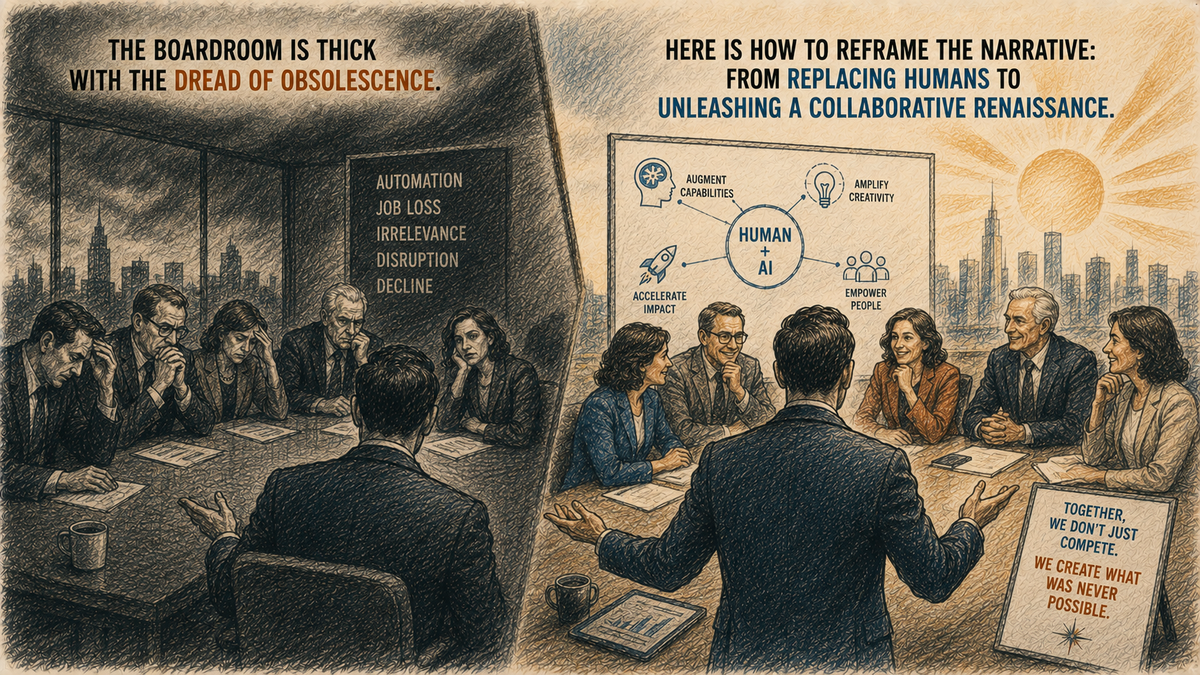
The boardroom is thick with the dread of obsolescence. Here is how to reframe the narrative from replacing humans to unleashing a collaborative renaissance.
"The significant problems we face cannot be solved at the same level of thinking we were at when we created them." - Albert Einstein
Ghost in the Machine Room
Walk into any boardroom discussing AI implementation and you'll encounter it immediately—that palpable tension hanging in the air like smoke from an extinguished candle. Executive faces wear carefully composed expressions while their internal monologues race: Will this technology make half my workforce obsolete? Are we automating ourselves into irrelevance? Should I be updating my own resume?
This existential dread isn't confined to the C-suite. It permeates every level of the organization, from the marketing manager worried about AI-generated content replacing creative teams to the financial analyst questioning whether algorithms will soon handle complex forecasting. The fear is real, visceral, and entirely understandable. Yet it's also fundamentally misplaced—and potentially devastating to your organization's competitive future.
The central challenge facing every leader embarking on AI transformation isn't technical. It's psychological. How do you navigate an organization through its collective fear of obsolescence while simultaneously building the very systems that seem to threaten job security? How do you transform resistance into enthusiasm, anxiety into anticipation?
The answer lies in reframing the entire conversation. This isn't about replacement—it's about renaissance. It's about creating a workplace where human intelligence is amplified, not diminished, where creativity is enhanced, not eliminated, and where strategic thinking is augmented, not automated away.
Replacement Myth
Let's address the elephant in the room with unflinching honesty: AI will indeed impact virtually every job in your organization. But here's the critical distinction that changes everything—"impacted" is fundamentally different from "replaced." This isn't semantic word play; it's the difference between transformation and termination, between evolution and extinction.
Consider the evolution of professional photography. When digital cameras emerged, film photography didn't simply vanish overnight. Instead, the profession transformed. Photographers who embraced digital technology found themselves with unprecedented creative capabilities—the ability to take thousands of shots without film costs, instant preview and adjustment, and sophisticated post-processing tools that would have required a darkroom and years of specialized training. The photographers who thrived weren't those with the steadiest hands or the most expensive film cameras, but those who understood how to leverage digital tools to tell better stories, capture more compelling moments, and deliver superior results to their clients.
The same principle applies across industries. AI doesn't eliminate the need for human judgment, creativity, and expertise—it amplifies these uniquely human capabilities while handling the routine, repetitive, and computationally intensive tasks that consume so much of our working hours.
Take the medical profession as a compelling example. Radiologists initially viewed AI diagnostic tools with suspicion, fearing that machine learning algorithms would render their expertise obsolete. The reality has proven quite different. Studies consistently show that radiologists working with AI diagnostic support significantly outperform both radiologists working alone and AI systems operating independently. The technology doesn't replace the radiologist's deep medical knowledge, pattern recognition skills, or ability to correlate findings with clinical context. Instead, it serves as an incredibly sophisticated screening tool, highlighting potential areas of concern and providing statistical probabilities that inform, rather than dictate, professional judgment.
One striking example comes from Mount Sinai Health System in New York, where AI-assisted radiologists reduced diagnostic time for certain conditions by up to 40% while simultaneously improving accuracy rates. The radiologists didn't become redundant—they became more effective, more accurate, and able to handle larger caseloads while spending more time on complex cases that truly required human expertise.
Anatomy of Augmentation
The creation of this very book provides perhaps the most compelling illustration of what augmented intelligence actually looks like in practice. This book represents something that would have been virtually impossible to create using traditional methods within a reasonable timeframe, yet it emerged from a sophisticated partnership between human expertise and artificial intelligence.
The process began with hundreds of hours of recorded content, transcripts, and documentation created by the authors over years of experience in AI implementation. This vast corpus of knowledge represented decades of collective expertise but existed in scattered formats that would have required months to synthesize manually. The AI system served as the initial organizing intelligence, creating a comprehensive table of contents and identifying key themes across this massive knowledge base.
But here's where the partnership became truly powerful: the AI didn't simply generate content and walk away. Instead, it engaged in an iterative dialogue with the authors, asking probing questions, seeking clarification, and continuously refining its understanding based on human feedback. Each chapter underwent multiple rounds of AI-generated drafts followed by human refinement, creating a collaborative process where the AI's analytical capabilities combined with human strategic insight and contextual understanding.
The result is a book that captures the full depth and nuance of the authors' expertise while maintaining their authentic voice and perspective. The AI augmentation didn't replace human thinking—it amplified it, enabling the creation of something far more comprehensive and sophisticated than either human or artificial intelligence could have produced independently.
This collaborative process illustrates the fundamental principle of augmented intelligence: technology handles the routine, repetitive, and computationally intensive tasks while humans focus on strategic thinking, creative problem-solving, and the nuanced judgment that separates exceptional work from mere competent execution.
Consider how this principle applies across different domains. In equity research, AI systems can continuously monitor vast amounts of financial data, regulatory filings, news sentiment, and market movements, providing researchers with comprehensive analysis within minutes rather than days. But the human researcher's value lies in interpreting what these patterns mean for long-term competitive positioning, understanding how regulatory changes might affect entire therapeutic categories, and assessing which management teams are most likely to execute successfully in changing market conditions.
The magic happens when human strategic insight combines with AI analytical power. Instead of spending seventy percent of their time gathering and organizing information, professionals can dedicate that time to interpretation, relationship building, and the complex judgment calls that create real value for their organizations and clients.
At JP Morgan Chase, the implementation of AI-powered document analysis tools provides another compelling illustration. The bank's legal team previously required 360,000 hours annually to review commercial loan agreements. AI tools now accomplish this same analysis in seconds, freeing lawyers to focus on complex negotiations, strategic legal planning, and client advisory work—the activities that truly require human expertise and generate the most value for both the firm and its clients.
Psychology of Resistance
Before any organization can successfully implement AI augmentation, leaders must understand the psychological dynamics driving resistance. Fear of job displacement is just the surface layer. Beneath it lie deeper concerns about competence, relevance, and professional identity.
The reality is that most resistance stems from lack of understanding and education rather than inherent fear of technology. When people understand what AI can and cannot do, when they see concrete examples of augmentation rather than replacement, and when they experience firsthand how AI can make their work more engaging and valuable, resistance typically transforms into curiosity and enthusiasm.
Many employees have built their career identity around being the person who knows how to navigate complex spreadsheets, remember obscure regulatory requirements, or quickly locate specific information within vast document repositories. When AI systems can perform these tasks instantly, it can feel like the foundation of their professional value is crumbling. However, this perception misses the fundamental reality of augmentation: AI doesn't eliminate human value—it elevates it to higher-order activities that create more meaningful impact.
Consider the transformation in software development that's already underway. Junior software engineers and overseas development firms that competed primarily on cost and basic execution capability are indeed facing disruption. But this disruption creates opportunity for more strategic, business-integrated development work. AI-augmented development tools can now bring software creation back onshore, enabling junior developers to work directly with business users rather than through layers of business analysts and project managers.
This elimination of the traditional "telephone game" in software development represents a fundamental restructuring of how technical work gets done. Instead of requirements passing through multiple translation layers—from business users to business analysts to project managers to offshore development teams—AI enables direct collaboration between business stakeholders and developers. Junior developers gain the opportunity to understand business context and see their work being used, leading to higher job satisfaction and better career development. The business benefits from dramatically improved response times and more accurate solution development.
But this transformation requires acknowledging that certain intermediary roles—business analysts, project managers, and oversight coordinators who primarily existed to manage communication gaps—may become less essential. The key is helping these professionals transition to more strategic roles that focus on business optimization and innovation rather than process management.
Smart leaders recognize that addressing transformation concerns requires more than logical arguments about job creation and economic efficiency. It requires empathy, clear communication, and concrete demonstration of how AI augmentation enhances rather than diminishes human capability and value. Most importantly, it requires honest acknowledgment that while augmentation is the primary pattern, some roles will indeed change significantly or become obsolete.
The key insight: resistance diminishes when people experience firsthand how AI amplifies their existing strengths rather than replacing their core competencies, and when organizations provide clear pathways for skill development and role evolution.
Making Employees Part of the Solution
The most successful AI implementations don't happen to employees—they happen with employees. This distinction is crucial. When workers feel like passive recipients of technological change imposed from above, resistance is natural and often insurmountable. When they become active participants in designing and implementing AI solutions, they transform from skeptics into advocates.
This transformation requires a fundamental shift in how organizations approach AI deployment. Instead of the traditional top-down model where IT departments or external consultants design AI systems in isolation, successful organizations create collaborative development processes that involve end users from the earliest stages.
Consider the approach taken by Siemens in their manufacturing operations. Rather than installing AI-powered predictive maintenance systems and training workers to operate them, Siemens engaged their most experienced maintenance technicians as AI training partners. These technicians helped identify which patterns and indicators the AI should monitor, what constitutes normal versus abnormal operating conditions, and how predictive insights should be presented to be most useful for maintenance decisions.
The result wasn't just a more effective AI system—it was a workforce that felt ownership over the technology. The maintenance technicians didn't see AI as a threat to their expertise; they saw it as a powerful tool that captured and amplified their decades of experience, making their knowledge accessible to newer team members and ensuring that critical insights weren't lost when experienced workers retired.
This collaborative approach yields multiple benefits beyond reduced resistance. Employee involvement improves AI system effectiveness because workers understand operational nuances that might be invisible to external developers. It accelerates adoption because users understand the reasoning behind AI recommendations. Most importantly, it creates internal champions who can help their colleagues understand and embrace AI augmentation.
Managing Unprecedented Change
The transformation you're describing through AI augmentation represents something unprecedented in business history—a fundamental shift in how organizations operate that must happen faster than humans naturally adapt to change. Most people require months or years to adjust to significant role changes, but competitive pressure is compressing adaptation timelines to weeks or months.
This creates what might be called the "adaptation velocity challenge"—organizations must change faster than human psychology typically allows while maintaining operational effectiveness and employee engagement. The solution lies in understanding that this transformation will unfold over years, not months, and requires careful orchestration to be successful.
The most effective approach involves beginning with smaller teams where issues can be identified and resolved, processes can be refined, and organizations can learn about their internal dynamics before large-scale rollout. Think of this like learning to drive—you don't start on the highway during rush hour. You begin in empty parking lots, then quiet residential streets, gradually building skills and confidence before tackling complex traffic situations.
Similarly, organizations need to develop their AI collaboration capabilities in low-risk environments where they can experiment, make mistakes, and refine their approaches before applying these new ways of working to mission-critical processes. Each small team becomes a laboratory for discovering how AI augmentation actually works within the specific organizational culture and operational context.
The timeline reality is both challenging and manageable. While the pressure for transformation is immediate, the actual implementation requires extensive engagement, training, and education. People need to be slowly brought up to speed on the technology and how to use it effectively. This isn't just about learning new tools—it's about developing new ways of thinking about problems, decisions, and work itself.
For managers and leaders, becoming what some might call "luddites" who refuse to engage with AI tools simply isn't an option. We're moving toward a situation where leaders who cannot effectively collaborate with AI systems will become as obsolete as managers who refused to use computers or email in previous technological transitions. The difference is that AI literacy isn't just about learning to use new tools—it requires developing new frameworks for strategic thinking and decision-making in environments where information abundance rather than information scarcity shapes competitive advantage.
Jevons Paradox Effect: Why AI Creates More Work, Not Less
One of the most counterintuitive aspects of AI transformation involves understanding how efficiency improvements often lead to increased rather than decreased demand for human capabilities. This phenomenon, known as Jevons Paradox, suggests that as AI reduces the cost and increases the capability of certain types of work, organizations will identify many more valuable applications for human intelligence than they could previously afford to pursue.
William Stanley Jevons, a 19th-century economist, observed that when steam engines became more fuel-efficient, coal consumption increased rather than decreased. The improved efficiency made steam power economical for many more applications, expanding overall demand for the resource that had become more efficient to use. Applied to human labor in an AI-augmented workplace, this principle suggests a fascinating possibility: instead of replacing human workers, AI might create such an explosion of valuable work opportunities that demand for human capabilities actually increases dramatically.
Consider how this unfolds in practice through our earlier equity research example. When AI handles routine data gathering and preliminary analysis, the researcher doesn't simply complete their existing coverage more quickly and go home early. Instead, they can now maintain deeper analysis across more companies, develop more sophisticated investment theses, provide more nuanced guidance to portfolio managers, and identify investment opportunities that were previously hidden in data complexity. The enhanced analytical capability reveals new layers of valuable work that were always potentially beneficial but never economically feasible.
This pattern appears across knowledge work domains. When AI makes comprehensive market research dramatically faster and cheaper, companies begin conducting market analysis for product categories they previously couldn't afford to investigate. When AI makes financial modeling more accessible, organizations evaluate strategic options across multiple scenarios and timeframes that are too complex to analyze manually. When AI makes customer analysis more sophisticated, businesses identify patterns and opportunities that were buried in data volume.
The result represents both sides of the Jevons Paradox effect. Individuals find themselves doing more work than ever because they have dramatically better tools that reveal previously impossible opportunities. Simultaneously, organizations begin pursuing functions and strategies they normally couldn't accomplish because of resource constraints. Overall, significantly more valuable work gets done, but it's higher-level work that requires human strategic thinking, creativity, and relationship management capabilities.
This has profound implications for performance evaluation in AI-augmented organizations. Rather than trying to separate human contribution from AI augmentation—an exercise that would be as meaningless as evaluating a financial analyst's performance by separating their Excel skills from their analytical thinking—organizations should focus on measuring the overall value creation that emerges from effective human-AI collaboration.
The organizations that recognize and leverage this paradox will find themselves operating at levels of strategic sophistication and market responsiveness that their competitors cannot match. They will be doing more work than ever, but it will be higher-value work that creates competitive advantages and growth opportunities that didn't exist before AI augmentation became possible.
Setting the Tone
Overcoming organizational resistance to AI begins at the top. Leaders who express ambivalence, fear, or uncertainty about AI transformation shouldn't be surprised when these attitudes permeate their organizations. Conversely, leaders who demonstrate genuine enthusiasm for AI's augmentative potential while acknowledging legitimate concerns create permission for their teams to explore, experiment, and embrace new possibilities.
This leadership responsibility extends beyond cheerleading to include active learning and engagement. Leaders who can speak knowledgeably about AI capabilities and limitations, who can share their own experiences with AI tools, and who can articulate clear visions for how AI will enhance rather than replace human capabilities are far more effective at driving organizational adoption.
One technology CEO made AI literacy a personal priority, spending time each week learning to use various AI tools in his own work. He began sharing examples in team meetings: how AI helped him prepare for board presentations, generate alternative strategic scenarios, or quickly research competitive landscapes. His willingness to be vulnerable about his own learning process while demonstrating AI's practical value created psychological safety for his team to begin their own AI exploration.
The message was clear: if the CEO was learning to work with AI rather than being replaced by it, perhaps AI partnership was indeed the future rather than AI replacement.
Practical Strategies for Change Management
Transforming AI resistance into AI advocacy requires systematic change management that addresses both emotional and practical concerns. Several strategies have proven particularly effective across different industries and organizational cultures.
Start small and build momentum. Rather than launching comprehensive AI transformation initiatives, begin with pilot programs that demonstrate clear value in low-risk environments. Success stories from these pilots become powerful tools for expanding AI adoption throughout the organization.
Create learning communities. Establish internal groups where employees can share AI experiences, troubleshoot challenges, and celebrate successes. These communities provide peer support that is often more influential than top-down communication about AI benefits.
Invest in training and development. Provide comprehensive education not just about how to use specific AI tools, but about AI capabilities, limitations, and best practices for human-AI collaboration. Employees who understand AI are less likely to fear it and more likely to use it effectively.
Recognize and reward AI adoption. Celebrate employees who successfully integrate AI into their workflows, achieve better outcomes through AI augmentation, or help their colleagues navigate AI implementation. Recognition reinforces positive behaviors and signals organizational commitment to AI partnership.
Address concerns directly. Create forums where employees can voice fears, ask questions, and receive honest answers about AI's impact on their roles and career paths. Avoiding difficult conversations only increases anxiety and rumor-spreading.
Digital Workplace Dynamic: Lessons from Remote Work
The COVID-19 pandemic provided an unexpected preview of how people adapt to working with non-human entities. Millions of employees who had never worked remotely suddenly found themselves interacting primarily through digital interfaces, managing relationships with colleagues they might never meet in person, and navigating workplace dynamics without the benefit of physical presence and emotional cues.
This transition revealed both opportunities and risks that directly apply to AI workplace integration. Some employees thrived in digital environments, finding that reduced social friction allowed them to focus more effectively on their work. Others struggled with the absence of human connection and the impersonal nature of digital interaction.
These patterns suggest important considerations for AI workplace integration. Employees who became comfortable with digital interaction may more readily accept AI colleagues and AI-mediated workflows. However, the pandemic also revealed how digital interaction can sometimes reduce empathy and courtesy—behaviors that could extend to human-AI interaction and potentially influence how people treat human colleagues.
Organizations implementing AI systems should monitor these dynamics carefully. Are employees who work extensively with AI systems maintaining appropriate professional behavior with human colleagues? Are they developing unrealistic expectations for immediate responses and perfect accuracy from human coworkers based on their AI interactions?
One consulting firm addressed this concern by establishing "digital workplace etiquette" guidelines that applied to both human and AI interactions. The guidelines emphasized that whether working with AI systems or human colleagues, professional courtesy, clear communication, and realistic expectations remained essential for effective collaboration.
Measuring the Transformation
Successfully overcoming AI resistance requires measuring not just adoption rates but transformation quality. Traditional metrics like training completion rates or system usage statistics provide incomplete pictures of how effectively an organization has transformed AI skeptics into AI partners.
More meaningful metrics include employee satisfaction scores specifically related to AI augmentation, the percentage of employees who voluntarily expand their AI usage beyond required applications, and qualitative measures of how AI has changed job satisfaction and work quality.
One financial services firm developed what they called an "AI transformation dashboard" that tracked both quantitative and qualitative measures. Quantitative metrics included AI tool usage rates, productivity improvements, and error reduction rates. Qualitative metrics included employee surveys about job satisfaction, perceived value of AI tools, and confidence in career development within an AI-augmented workplace.
The dashboard revealed interesting patterns. Departments with the highest initial resistance often showed the most dramatic improvements in satisfaction scores once employees became comfortable with AI augmentation. These employees, having overcome significant initial skepticism, often became the most enthusiastic advocates for expanding AI implementation to other areas of the organization.
How Adoption Accelerates
AI adoption within organizations often follows network effects similar to social media platforms or communication tools. Early adopters begin using AI tools and achieving better outcomes, which creates interest among their colleagues. As more employees begin experimenting with AI, knowledge sharing increases, best practices develop, and organizational comfort with AI partnership grows exponentially.
Understanding these network effects can help leaders strategically plan AI implementation. Instead of mandating universal adoption, focus on identifying and supporting natural early adopters who can serve as internal influencers and knowledge sources. Provide these employees with advanced training, access to cutting-edge tools, and opportunities to share their experiences with colleagues.
One manufacturing company leveraged this approach by identifying employees who were already using consumer AI tools like ChatGPT or Claude in their personal lives. These employees became "AI ambassadors," receiving additional training on enterprise AI tools and serving as mentors for colleagues beginning their own AI journeys. The program was so successful that employees began volunteering to become ambassadors, viewing it as a career development opportunity rather than an additional responsibility.
The Post-Resistance Organization
Organizations that successfully navigate the transition from AI resistance to AI partnership often discover that the transformation extends far beyond technology adoption. These organizations develop what might be called "adaptive intelligence"—the ability to continuously evolve their processes, roles, and strategies as AI capabilities advance.
In post-resistance organizations, employees don't just accept AI as a tool; they become active participants in identifying new opportunities for AI application. They understand their work well enough to recognize which tasks could be enhanced through AI augmentation and sophisticated enough about AI capabilities to propose realistic implementations.
These organizations also develop more nuanced understanding of human value in an AI-augmented world. Rather than viewing human skills as either relevant or obsolete, they recognize the complex interplay between human and artificial intelligence that creates the most powerful outcomes.
The competitive advantage of post-resistance organizations isn't just their effective use of AI tools—it's their cultural capacity to continuously adapt as AI capabilities evolve. While competitors struggle with each new wave of AI advancement, these organizations have developed the psychological and operational flexibility to rapidly integrate new capabilities and identify novel applications.
From Resistance to Renaissance
Overcoming AI resistance isn't about convincing employees that their fears are unfounded. Many concerns about AI's disruptive potential are entirely valid. Instead, it's about reframing the conversation from replacement to augmentation, from obsolescence to enhancement, from threat to opportunity.
The most successful AI transformations begin with honest acknowledgment that AI will indeed change how work gets done, what skills are most valuable, and how organizations create value for customers. They continue with clear demonstration that these changes, while significant, represent evolution rather than elimination of human contribution to organizational success.
The goal isn't to create organizations where humans compete with AI, but where humans and AI form partnerships that achieve outcomes neither could accomplish alone. In these partnerships, AI handles the routine, repetitive, and computationally intensive tasks that consume so much human time and energy, while humans focus on the creative, strategic, and relationship-building activities that drive meaningful business outcomes.
Organizations that successfully navigate this transformation don't just overcome resistance—they unlock new levels of human potential. Their employees don't just accept AI; they become more capable, more creative, and more strategically valuable because of their AI partnerships.
This is the true promise of AI augmentation: not a future where humans become obsolete, but one where human capabilities are amplified, human creativity is enhanced, and human strategic thinking is supported by unprecedented analytical power. The organizations that realize this promise will be those that transform resistance into partnership, fear into opportunity, and change into competitive advantage.
The choice facing every leader is clear: continue operating under the replacement paradigm and watch as fear constrains your organization's AI potential, or embrace the augmentation paradigm and unlock the transformative power of human-AI partnership. The future belongs to organizations brave enough to choose partnership over replacement, enhancement over elimination, and renaissance over resistance.