Chapter 12: Leading from the Top
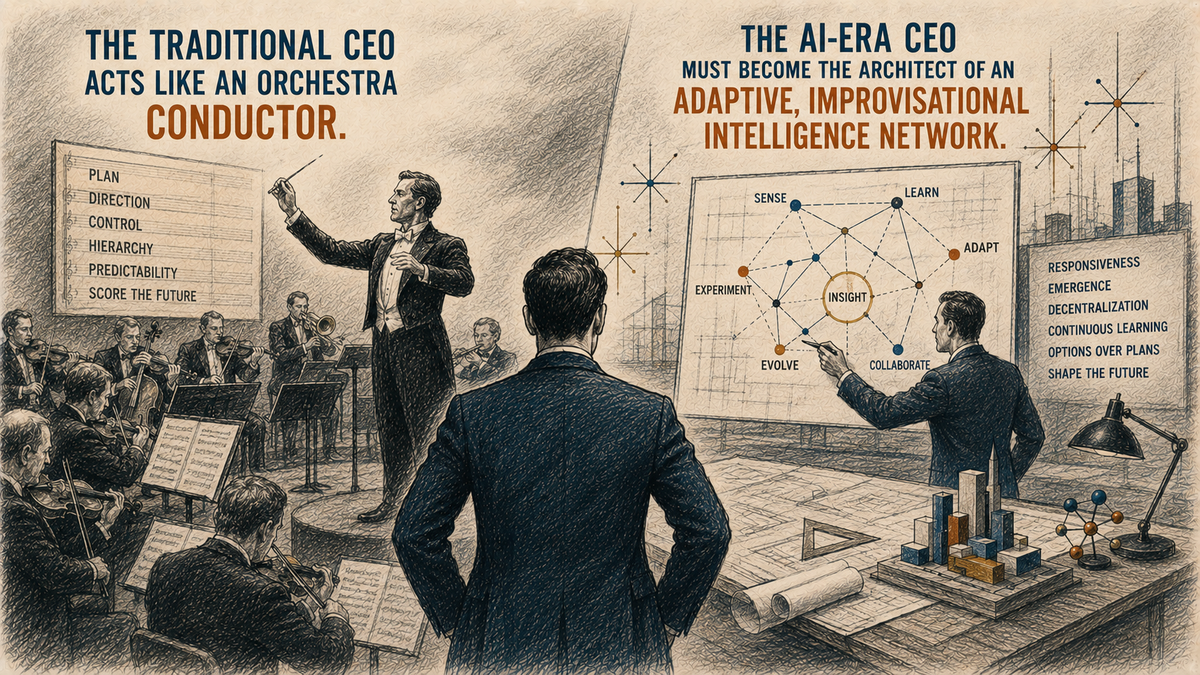
The traditional CEO acts like an orchestra conductor. The AI-era CEO must become the architect of an adaptive, improvisational intelligence network.
"The first responsibility of a leader is to define reality. The last is to say thank you. In between, the leader is a servant." — Max De Pree
When Marc Benioff stood before Salesforce's annual Dreamforce conference in 2023, he didn't delegate the AI conversation to his CTO or head of product. Instead, he personally unveiled Einstein GPT, speaking passionately about how artificial intelligence would fundamentally reshape not just Salesforce's products, but the entire fabric of how businesses operate. This wasn't a technology announcement—it was a CEO declaring that the fundamental nature of business leadership itself was about to change forever.
Benioff understood something that most CEOs are still struggling to grasp: we are witnessing the end of the traditional CEO role as we've known it for the past century. The conductor of the corporate orchestra—coordinating human talent and organizational resources to execute predetermined strategies—is becoming as obsolete as the factory foreman in the age of automation. What's emerging instead is something entirely new: the architect of adaptive intelligence networks.
Death of the Conductor Model
For generations, business schools have taught future CEOs to think like orchestra conductors. You hire talented musicians, provide them with sheet music, and coordinate their performance to create beautiful, predictable outcomes. Success meant precise timing, flawless execution, and the ability to manage complex human dynamics within well-defined roles and processes.
This model worked brilliantly in a world where competitive advantages were built through incremental improvements in efficiency, quality, or customer experience. Strategic planning could follow annual or quarterly cycles because competitive dynamics changed slowly enough to allow for deliberate, staged responses. The CEO's primary responsibilities were hiring the right people, building the right processes, and creating the right culture to deliver predictable business outcomes.
But that world is disappearing with breathtaking speed. Consider the fundamental structural flaw that persists in most organizations today: the Chief Information Officer typically reports to the CFO or COO rather than directly to the CEO. This reporting structure made sense when technology was viewed as a cost center designed to support existing business operations. IT departments implemented systems that automated existing processes, and CEOs could safely delegate these decisions to their technical teams while focusing on strategy, market positioning, and stakeholder management.
This traditional separation between business strategy and technology implementation has become a fatal weakness in the age of artificial intelligence. When AI can automate complex reasoning, generate creative content, and make autonomous decisions, technology becomes inseparable from business strategy itself. Organizations that maintain the old reporting structures are essentially declaring that their most transformational capabilities will be managed as operational expenses rather than strategic assets.
The implications are staggering. Imagine if Amazon's Jeff Bezos had treated cloud computing as an IT cost center rather than recognizing AWS as a fundamental reimagining of what Amazon could become. Or consider what would have happened if Netflix's Reed Hastings had delegated streaming technology decisions to a CTO reporting through the CFO, viewing it merely as a more efficient way to deliver DVDs rather than a complete transformation of the entertainment industry.
Most businesses simply don't comprehend the magnitude of change approaching them. They're falling back on traditional management practices precisely when those practices are becoming most dangerous. They don't fully understand AI's transformational capacity because they're viewing it through the lens of previous technology implementations rather than recognizing it as the emergence of artificial workforce capabilities that will fundamentally reshape how value gets created and competitive advantage gets sustained.
Emergence of Adaptive Intelligence Networks
The reconceptualized CEO role that's emerging looks nothing like traditional business leadership. Instead of conducting orchestras, these leaders are designing and operating adaptive intelligence networks—dynamic systems that combine human creativity and judgment with artificial intelligence capabilities to create outcomes that neither humans nor AI could achieve independently.
Think of this transformation like the difference between conducting a traditional symphony orchestra and directing an improvisational jazz ensemble that includes both human musicians and AI music generation systems. The traditional conductor follows predetermined sheet music and coordinates timing. The jazz director sets creative themes and parameters, then facilitates collaborative innovation between human and artificial intelligence to generate music that emerges from the interaction itself.
This jazz director needs fundamentally different skills. They must understand both human creativity and AI capabilities. They need to establish creative constraints that guide without limiting. They must recognize emerging patterns and know when to amplify them or redirect them. Most importantly, they need to maintain coherent artistic vision while enabling continuous innovation and adaptation.
The strategic implications of this shift are profound. When AI agents can analyze market conditions, identify opportunities, and implement responses in real-time, the traditional strategic planning cycle compresses from months to days or even hours. The CEO's role evolves from periodic strategic adjustment to continuous strategic orchestration—maintaining long-term vision while adapting tactical approaches continuously based on AI-generated insights and rapidly changing competitive conditions.
This requires developing what we might call "dynamic strategic thinking"—the ability to design systems that can discover strategic opportunities, test strategic hypotheses, and adapt strategic approaches autonomously while maintaining organizational coherence and direction. It's like playing chess against opponents who can think thousands of moves ahead, while simultaneously managing a team that includes both human players and AI systems with superhuman tactical capabilities.
New Leadership Skill Set
The reconceptualized CEO requires a fundamentally different array of competencies than traditional business education provides. Three capabilities become absolutely essential: engineering thinking, systems thinking, and temporal strategic thinking.
Engineering thinking teaches leaders to understand complex systems, design for reliability and scalability, and think in terms of feedback loops and optimization. When your organization includes AI agents that can modify their own behavior based on outcomes, traditional management approaches break down completely. You need engineering discipline to design systems that remain stable and predictable even as they adapt and evolve continuously.
Consider the difference between managing a human sales team and orchestrating a hybrid team that includes AI agents capable of analyzing customer data, generating personalized proposals, and learning from interaction outcomes in real-time. Traditional sales management focuses on motivation, training, and performance coaching. Hybrid team orchestration requires understanding how AI learning algorithms work, how to design feedback loops that improve both human and AI performance, and how to maintain quality control when agents are adapting faster than human supervisors can monitor.
Systems thinking becomes crucial because AI agents create interactions and dependencies that human managers couldn't previously coordinate or even perceive. A CEO needs to understand how changes in one part of the organization might cascade through AI-mediated processes to create unexpected outcomes elsewhere. They're designing ecosystems rather than managing hierarchies.
Imagine implementing a new customer service AI agent that learns from successful human interactions. Traditional thinking might focus on the direct efficiency gains in the customer service department. Systems thinking recognizes that this AI agent might also generate insights that improve product development, identify new market opportunities, or reveal operational inefficiencies in completely different business units. The CEO needs to design organizational structures that can capture and capitalize on these emergent insights rather than allowing them to remain isolated within functional silos.
Temporal strategic thinking requires operating across multiple time horizons simultaneously, but with added complexity that previous generations of leaders never faced. AI capabilities evolve so rapidly that strategic decisions made today might be implemented by AI systems that have fundamentally different capabilities than those available when the strategy was conceived.
This means CEOs must develop scenarios not just for different market conditions, but for different technological capabilities that might emerge during strategy implementation. They need to design adaptive strategies that can take advantage of AI improvements without becoming dependent on specific technological assumptions that might become obsolete.
Organizational Design for Human-AI Collaboration
The most profound implication of this reconceptualization involves rethinking organizational structure itself. When significant portions of your workforce consist of AI agents that can be rapidly deployed, scaled, or reconfigured, organizational boundaries become fluid in ways that have never existed before.
Traditional organizational charts assume relatively static reporting relationships and clear functional boundaries. But AI agents can collaborate across these boundaries automatically, share information instantaneously, and coordinate complex activities without human oversight. This creates opportunities for organizational designs that would have been impossible to manage with purely human workforces.
Consider a product development organization where AI agents can simultaneously work on market research, competitive analysis, technical specification development, and customer feedback analysis. These agents can share insights in real-time, identify contradictions or opportunities that span functional areas, and adapt their approach based on emerging information. The traditional product management role evolves from coordinating separate functional teams to orchestrating collaborative intelligence networks that include both human expertise and AI capabilities.
This transformation also fundamentally changes the relationship between strategy and execution. Traditional organizations maintain clear separation between strategic decision-making concentrated at senior levels and operational execution distributed throughout the organization. This separation exists partly because human cognitive limitations make it impossible for individual managers to simultaneously handle high-level strategic thinking and detailed operational oversight.
AI agents don't have these cognitive limitations. They can maintain strategic context while executing detailed tasks, and they can coordinate complex activities across multiple domains simultaneously. This means the traditional strategy-execution separation becomes not just unnecessary but potentially counterproductive.
The reconceptualized CEO designs AI-augmented systems that continuously discover strategic opportunities, test strategic hypotheses, and adapt strategic approaches in real-time rather than making strategic decisions and cascading them down through organizational hierarchies. They become architects of strategic learning systems rather than primary strategic decision-makers.
Redefining Competitive Advantage
Perhaps the most staggering implication of this transformation involves how competitive advantage gets built and sustained. In the emerging landscape, competitive advantage shifts decisively toward organizations with better AI capabilities, better data, and better processes for human-AI collaboration. This represents the most fundamental change in the nature of competitive advantage since the industrial revolution.
Traditional competitive advantages—location, capital, even human talent—could often be replicated given enough time and resources. But AI-enhanced capabilities create network effects and learning loops that become self-reinforcing. Organizations that develop superior AI capabilities can accelerate their learning, improve their decision-making, and adapt to market changes faster than competitors.
The data dimension of this competitive equation creates particularly powerful advantages. Consider a company that begins collecting and organizing data strategically today versus one that waits two years. The early starter doesn't just get a two-year head start—they get two years of AI-enhanced data collection, two years of learning what data matters most, and two years of building AI models that improve with more data. The late starter faces an exponentially harder challenge rather than a linear catch-up situation.
This suggests that data strategy might actually be more urgent than AI capability development, since AI capabilities can be acquired or licensed, but proprietary data advantages are much harder to replicate. The reconceptualized CEO must therefore think about their organization as a learning system first and an operational system second, designing feedback loops that allow AI agents to improve performance continuously while creating data collection strategies that enhance AI capabilities over time.
Measurement Challenge
This fundamental transformation in competitive dynamics requires completely new approaches to measuring organizational health and CEO effectiveness. Traditional CEOs are evaluated primarily on financial performance—revenue growth, profit margins, shareholder returns. These metrics assume relatively stable competitive environments where past performance predicts future potential.
But in rapidly evolving AI-driven competitive landscapes, financial performance becomes a lagging indicator that might not capture the most important aspects of organizational health. A company might show strong financial performance today while simultaneously falling behind in AI capabilities, data quality, or human-AI collaboration processes that will determine future competitiveness.
The reconceptualized CEO must develop new frameworks for measuring organizational health that capture leading indicators of competitive positioning in an AI-driven world. They need to track the rate of AI capability development, the quality of human-AI collaboration, the effectiveness of organizational learning systems, and the speed of strategic adaptation.
This creates a fundamental challenge in stakeholder communication. CEOs must help employees, customers, investors, and partners understand why traditional metrics might not reflect organizational health accurately, while building confidence in new measurement approaches that may not have established benchmarks or peer comparisons.
Board Governance Evolution
This reconceptualization also fundamentally changes the relationship between CEO leadership and board oversight. Traditional board governance assumes relatively predictable business cycles where strategic decisions can be evaluated based on quarterly or annual performance metrics. Directors rely on financial reports, market share data, and operational metrics that have been standardized across industries and time periods.
But if competitive dynamics are changing rapidly due to AI capabilities, and if strategic implementation is increasingly automated, then traditional governance approaches might actually impede organizational adaptation. Board directors need to understand why investments in AI capabilities, data infrastructure, and human-AI collaboration processes are strategic necessities rather than speculative technology projects.
The reconceptualized CEO becomes an educator for their board, helping directors understand why traditional risk management and performance evaluation approaches need to evolve. They must translate technical AI capabilities into strategic business implications and help boards develop new frameworks for evaluating organizational health and competitive positioning.
This educational responsibility extends beyond the boardroom. The CEO must help all stakeholders understand that the transformation they're leading isn't about implementing new technology but about preparing for a fundamentally different competitive landscape where the basic assumptions about how organizations create value are changing.
Psychological Dimension of Transformation
Perhaps the most challenging aspect of this reconceptualization involves the psychological and emotional dimensions of leadership transition. Most current CEOs built their careers and developed their leadership identities around the conductor model. They've been successful by mastering traditional strategic thinking, organizational design, and performance management approaches.
We're asking them to acknowledge that many of their core professional competencies may become less relevant while developing entirely new capabilities that they may not feel naturally suited for. This requires not just intellectual understanding but emotional resilience and genuine humility about learning new approaches to leadership.
Traditional business intuition, developed through decades of experience with human-only organizations, might sometimes lead to counterproductive decisions in hybrid human-AI environments. The reconceptualized CEO must develop what we might call "learning leadership"—the ability to maintain confidence and authority while continuously updating their understanding of what effective leadership looks like.
This means modeling intellectual humility while maintaining organizational confidence in their direction. They must demonstrate that admitting uncertainty about emerging AI capabilities and asking questions about new approaches is a sign of leadership strength rather than weakness.
The Inevitability Factor
The transformation we're describing isn't a possibility—it's an inevitability. The only question is timing: how quickly will competitive advantages shift toward better AI capabilities, better data, and better human-AI collaboration processes? Organizations that recognize this early and begin the reconceptualization process will build compounding advantages that may become insurmountable for late adopters.
This creates enormous strategic pressure. CEOs are caught between the need to maintain current business performance, which requires focusing on existing capabilities and markets, and the need to prepare for a fundamentally different competitive landscape, which requires investing in capabilities that may not provide immediate returns.
The reconceptualized CEO role requires what we might call "temporal strategic thinking"—the ability to optimize current performance while building future capabilities, maintain stakeholder confidence while preparing for disruptive change, and demonstrate short-term results while making long-term investments.
Educational Imperative
If the CEO role is evolving this dramatically, then traditional approaches to preparing business leaders may be not just inadequate but potentially counterproductive. Future CEOs might need educational backgrounds that combine traditional business strategy with systems thinking, AI and data science literacy, organizational psychology, and complexity science.
They need to understand not just how to manage organizations, but how to design adaptive systems that can evolve continuously in response to technological and competitive changes. This suggests that business education itself needs fundamental reconceptualization to prepare leaders for the AI-transformed business landscape.
The reconceptualized CEO must also become a teacher within their organization, helping managers, employees, and partners understand why traditional approaches to work, collaboration, and decision-making need to evolve. They become guides through unprecedented change rather than commanders of established operations.
The Future is Now
The reconceptualization we're describing isn't a distant future scenario—it's happening today. Organizations across industries are beginning to discover that their traditional leadership approaches break down when applied to AI-augmented operations. The CEOs who recognize this early and begin developing new leadership capabilities will have enormous advantages over those who try to apply conductor-model thinking to adaptive intelligence networks.
This transformation represents the most significant evolution in business leadership since the emergence of modern corporate structures. The traditional CEO role as orchestra conductor is becoming obsolete not because it was inadequate for its time, but because the fundamental nature of organizational capabilities is changing.
The leaders who thrive in the next decade will be those who most completely embrace this reconceptualization. They will understand that their primary responsibility isn't managing human resources but orchestrating hybrid human-AI systems that can adapt, learn, and evolve continuously. They will design organizations that can discover and pursue opportunities faster than purely human competitors while maintaining the creativity, judgment, and ethical grounding that only human leadership can provide.
The AI imperative isn't just about implementing new technology—it's about fundamentally reimagining what business leadership means in an age of artificial intelligence. The reconceptualized CEO role we've described represents both the greatest challenge and the greatest opportunity in modern business history. The leaders who embrace this transformation early will shape the future of business itself. Those who cling to traditional conductor models will find themselves leading orchestras in a world that has moved on to jazz.