Chapter 11: Choosing the Right Tools
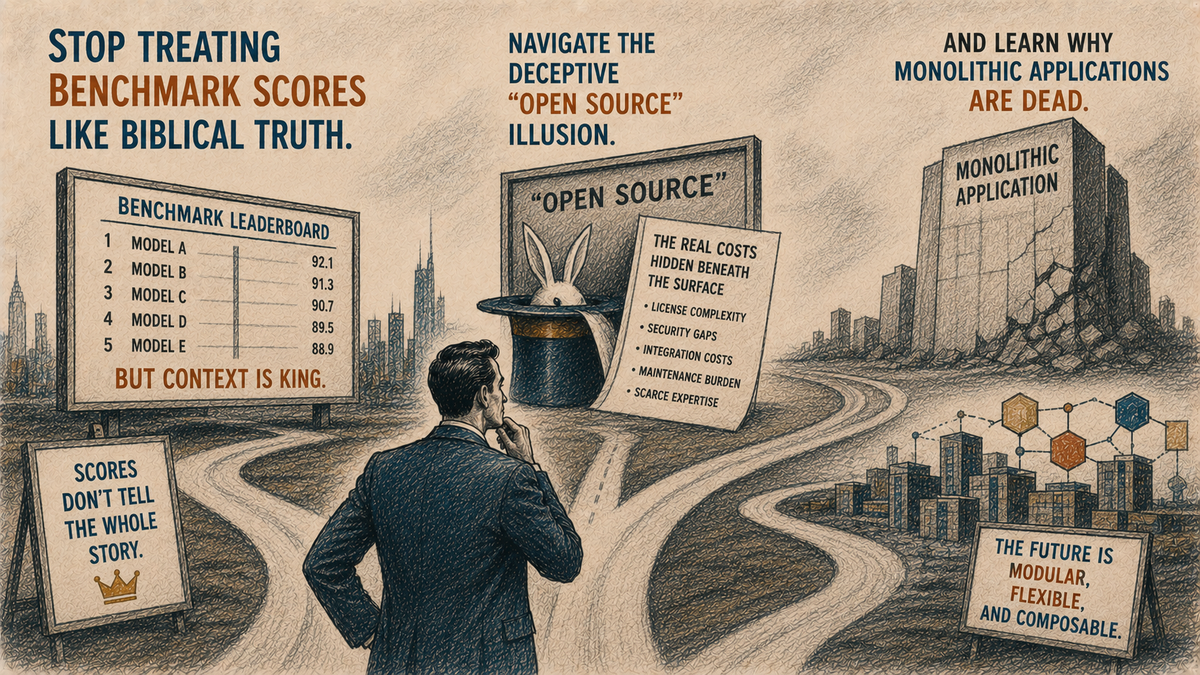
Stop treating benchmark scores like biblical truth. Navigate the deceptive "open source" illusion and learn why monolithic applications are dead.
"The greatest danger in times of turbulence is not the turbulence itself, but to act with yesterday's logic." - W. Edwards Deming
Arsenal of Intelligence
Standing at the edge of the AI revolution, business leaders face a bewildering array of choices that would make even the most seasoned technology executive's head spin. OpenAI's GPT models, Google's Gemini, Anthropic's Claude, Meta's Llama, and dozens of other contenders vie for attention in a marketplace that seems to reinvent itself every Tuesday. Meanwhile, agent frameworks like LangChain, AutoGPT, and CrewAI promise to orchestrate these models into sophisticated digital workforces. The Model Context Protocol (MCP) and Google's Agent-to-Agent (A2A) frameworks herald a future where AI systems communicate seamlessly.
But here's the uncomfortable truth: choosing the wrong AI infrastructure is like building your factory on quicksand. The decision you make today about which models to deploy, which frameworks to adopt, and whether to bet on open source or closed source solutions will determine not just your AI success, but your competitive survival.
This chapter cuts through the marketing noise to reveal the critical factors that should drive your AI architecture decisions. We'll explore why model benchmarks are largely theater, why "open source" isn't what you think it is, and how emerging standards like MCP and A2A are quietly reshaping the entire AI landscape.
Why Benchmarks Are Beautiful Lies
In the early days of personal computing, buyers obsessed over processor speeds and RAM capacity. Today's AI buyers exhibit similar behavior, religiously comparing benchmark scores as if they were biblical truth. GPT-4 scores 86.4% on MMLU (Massive Multitask Language Understanding), while Claude 3.5 Sonnet achieves 88.3%. Gemini Pro boasts superior performance on mathematical reasoning tasks. These numbers feel reassuring, scientific, and objective.
They're also largely meaningless for your business.
Consider the case of TechFlow Industries, a mid-sized manufacturing company that spent months evaluating LLMs based on benchmark performance. They selected a model that excelled in general knowledge tasks, only to discover it consistently failed at understanding their specific industry jargon and processes. Meanwhile, their competitor deployed a "lower-performing" model that had been fine-tuned for manufacturing workflows and achieved dramatically better results in practice.
The benchmark fallacy stems from a fundamental misunderstanding of how AI models actually work in business contexts. Academic benchmarks test general capabilities across broad domains—can the model solve high school math problems? Can it answer questions about historical events? Can it write coherent prose? But your business doesn't need a model that can discuss 18th-century poetry; you need one that understands your customers, your processes, and your unique challenges.
Dr. Maria Rodriguez, who led AI transformation at a Fortune 500 financial services firm, puts it bluntly: "We tested twelve different models on our actual use cases—contract analysis, regulatory compliance, customer service. The model that ranked highest on public benchmarks performed worst on our real work. The model that excelled at our tasks barely appeared in the benchmark comparisons we'd been studying."
This reveals the first critical principle of AI tool selection: test everything with your actual data, your actual problems, and your actual users. Benchmarks can provide rough guidance, but they're no substitute for empirical validation in your specific context.
Who Owns Your AI Future?
The choice between open source and closed source AI models represents far more than a technical decision—it's a strategic bet on your organization's future autonomy. But first, we need to dispel a pervasive myth: most "open source" AI models aren't actually open source in any meaningful sense.
When Meta released Llama 2 and called it "open source," the tech community celebrated. Finally, a powerful model free from the constraints of OpenAI's API limitations or Google's cloud dependencies! But look closer at what "open" actually means in this context. You can download the model weights—the numerical parameters that define the model's behavior. You can run inference on your own hardware. You can even fine-tune the model for your specific needs.
What you can't access is the training data, the training methodology, the specific techniques used to align the model with human preferences, or the full details of the infrastructure required to recreate it. This is "open weight," not open source. It's like getting a compiled binary program and calling it open source because you can execute it.
True open source AI models—where the complete training pipeline, data, and methodologies are transparent—remain rare and generally less capable than their commercial counterparts. This creates a fascinating strategic dilemma for business leaders.
Closed source models like GPT-4, Claude, or Gemini offer several compelling advantages:
Performance Leadership: The most capable models today are proprietary. OpenAI's GPT-4, Anthropic's Claude 3.5 Sonnet, and Google's Gemini Pro consistently outperform open alternatives on most tasks. If you need cutting-edge capabilities, you're likely looking at closed source options.
Reduced Infrastructure Burden: Running large language models requires substantial computational resources. A single inference on a 70-billion parameter model can cost thousands of dollars worth of GPU time if you're building from scratch. Cloud APIs abstract away this complexity, letting you focus on application development rather than infrastructure management.
Continuous Improvement: Closed source providers continuously improve their models, often releasing updates that enhance performance, reduce costs, or add new capabilities. Your applications benefit from these improvements without additional development effort.
Safety and Alignment: Commercial providers invest heavily in making their models safer, more reliable, and better aligned with human values. While not perfect, these models generally exhibit fewer concerning behaviors than raw, unfiltered alternatives.
But closed source models come with significant strategic risks:
Vendor Dependency: Your AI capabilities are entirely dependent on your provider's roadmap, pricing decisions, and business continuity. When OpenAI temporarily restricted access to GPT-4 in early 2023, thousands of applications experienced degraded performance overnight.
Cost Unpredictability: API pricing can change dramatically. Usage costs that seem reasonable at prototype scale can become prohibitive at production volumes. One enterprise client discovered their AI-powered customer service system would cost $2.3 million annually at full deployment—nearly ten times their initial estimates.
Data Privacy Concerns: Sending your data to external APIs creates potential privacy and security risks. Even with strong contractual protections, you're trusting third parties with potentially sensitive information.
Limited Customization: While you can prompt-engineer closed source models extensively, you can't fundamentally alter their behavior or fine-tune them for your specific domain.
Open weight models offer a different value proposition:
Sovereignty: Once you've downloaded the model weights, you own them. No one can revoke your access, change your pricing, or alter the model's behavior without your consent.
Customization: You can fine-tune open weight models on your specific data, potentially achieving better performance for your use cases than general-purpose alternatives.
Cost Predictability: After the initial infrastructure investment, your costs are primarily computational. You can optimize for efficiency and scale without per-token pricing concerns.
Privacy: Your data never leaves your infrastructure, providing maximum privacy and security.
But open weight models require significant technical sophistication:
Infrastructure Complexity: Running large models efficiently requires expertise in GPU optimization, distributed computing, and model serving architectures. The learning curve is steep and the ongoing operational burden substantial.
Model Management: You're responsible for model updates, security patches, and performance optimization. This requires dedicated AI infrastructure teams.
Capability Gaps: Open weight models typically lag behind state-of-the-art closed source alternatives, though this gap is narrowing rapidly.
The strategic decision framework becomes clearer when you consider your organization's specific context:
Choose closed source when:
- You need cutting-edge capabilities immediately
- You have limited AI infrastructure expertise
- You're building customer-facing applications where model quality is paramount
- Your use cases are well-served by general-purpose models
- You can tolerate vendor dependency for faster time-to-market
Choose open weight when:
- Data privacy is paramount
- You have specific domain requirements that benefit from customization
- You have the technical expertise to manage AI infrastructure
- Long-term cost predictability is crucial
- You're building core competitive advantages that require full control
Many successful organizations adopt a hybrid approach, using closed source models for rapid prototyping and general-purpose tasks while developing open weight capabilities for mission-critical, domain-specific applications.
Rise of the Agent Ecosystem
While the open vs. closed source debate rages, a more fundamental shift is quietly reshaping the AI landscape: the emergence of agentic computing. Individual AI models, regardless of their provenance, are giving way to sophisticated ecosystems of specialized agents that collaborate to solve complex problems.
This transformation parallels the evolution of software architecture from monolithic applications to microservices. Just as breaking large applications into smaller, specialized services improved scalability and maintainability, breaking complex AI tasks into smaller, specialized agents improves reliability and capability.
Consider the traditional approach to AI-powered customer service. You might deploy a single large language model to handle all customer inquiries—answering questions about products, processing returns, scheduling appointments, and escalating complex issues. This monolithic approach works for simple cases but struggles with complexity.
An agentic approach deploys multiple specialized agents: a routing agent that determines the customer's intent, a product information agent that answers technical questions, a billing agent that handles account issues, a scheduling agent that manages appointments, and an escalation agent that knows when to involve human representatives. Each agent excels at its specific domain while collaborating to provide comprehensive customer service.
This agent-based architecture offers several advantages:
Specialization: Each agent can be optimized for its specific task, potentially using different models, training data, or fine-tuning approaches.
Reliability: If one agent fails, others can continue operating. The system degrades gracefully rather than failing completely.
Maintainability: You can update, retrain, or replace individual agents without disrupting the entire system.
Scalability: Different agents can scale independently based on demand patterns.
Transparency: Agent-based systems make it easier to understand how decisions are made and where errors occur.
But orchestrating multiple agents introduces new complexities. How do agents communicate with each other? How do they share context and memory? How do you prevent conflicting actions or circular dependencies? How do you maintain security when agents interact with external systems?
The Protocol Wars: MCP vs. A2A
Enter the Model Context Protocol (MCP) and Google's Agent-to-Agent (A2A) framework—two emerging standards that aim to solve the agent orchestration challenge. Understanding these protocols is crucial because they represent the infrastructure layer that will enable the agent economy.
The Model Context Protocol, developed by Anthropic, addresses a fundamental problem in multi-agent systems: how do you enable agents to discover and use tools, share memory, and maintain security boundaries? MCP provides a standardized way for AI agents to interact with external resources—databases, APIs, file systems, and other services—through a consistent interface.
Think of MCP as the HTTP of the agent world. Just as HTTP enabled different web applications to communicate regardless of their underlying technology stack, MCP enables different AI agents to interact with tools and services regardless of their specific implementation.
The protocol defines several key capabilities:
Tool Discovery: Agents can automatically discover what tools and services are available in their environment, much like how web browsers discover available resources through links and APIs.
Shared Memory: Multiple agents can access and update shared information stores, enabling coordination and collaboration across complex workflows.
Security Boundaries: MCP includes authentication and authorization mechanisms to ensure agents can only access resources they're permitted to use.
Context Preservation: The protocol maintains context across agent interactions, preventing the loss of important information as tasks flow between different agents.
Google's Agent-to-Agent framework takes a different approach, focusing specifically on how AI agents communicate with each other rather than with external tools. A2A is designed to enable large-scale agent coordination, where hundreds or thousands of specialized agents might collaborate on complex tasks.
The differences between MCP and A2A reflect different visions of the agent future:
MCP emphasizes tool integration: It's designed for scenarios where agents need to interact with existing business systems—CRM platforms, databases, file servers, and external APIs. This makes it particularly relevant for enterprise applications where AI agents must integrate with established IT infrastructure.
A2A emphasizes agent coordination: It's optimized for scenarios where the primary challenge is coordinating multiple AI agents, each with specialized capabilities. This makes it more relevant for complex problem-solving scenarios that require diverse expertise.
In practice, successful agent ecosystems will likely need both capabilities. Consider a sophisticated AI system for managing corporate travel:
- A planning agent uses MCP to access calendar systems, travel databases, and expense management tools
- Specialized booking agents use A2A to coordinate flight, hotel, and ground transportation reservations
- A compliance agent uses MCP to check corporate travel policies and approval workflows
- An optimization agent uses A2A to negotiate with booking agents and find cost-effective solutions
- A notification agent uses MCP to update calendar systems and send confirmations
The protocol wars matter because they're determining the standards that will govern AI agent interactions for years to come. Organizations that choose the wrong protocol risk being locked out of the broader agent ecosystem as it evolves.
Early indicators suggest that MCP may have an advantage in enterprise environments due to its focus on tool integration, while A2A may excel in research and complex problem-solving contexts. But the landscape remains fluid, and successful organizations are preparing for a multi-protocol future.
Choosing Your Agent Architecture
Beyond protocols, organizations must navigate a bewildering array of agent development frameworks. LangChain, AutoGPT, CrewAI, AgentGPT, and dozens of other platforms promise to simplify agent development. Each offers different abstractions, capabilities, and architectural philosophies.
LangChain emerged as an early leader by providing comprehensive tooling for chaining together AI models, external APIs, and business logic. Its strength lies in its extensive ecosystem of integrations and its modular architecture that allows developers to mix and match components.
But LangChain's flexibility comes at a cost: complexity. Simple agent workflows can require hundreds of lines of configuration code. The learning curve is steep, and the abstraction layers can make debugging difficult when things go wrong.
AutoGPT takes a different approach, focusing on autonomous agents that can plan and execute complex tasks with minimal human intervention. It's designed for scenarios where you want to give an agent a high-level goal and let it figure out how to achieve it.
The AutoGPT approach works well for research and exploration tasks but can be unpredictable in production environments. Autonomous agents sometimes pursue creative solutions that violate business rules or security policies.
CrewAI specializes in multi-agent coordination, providing tools for defining agent roles, responsibilities, and collaboration patterns. It's particularly strong for scenarios that require human-like team dynamics among AI agents.
The framework choice depends heavily on your specific use cases:
Choose LangChain when:
- You need extensive integration with existing systems
- You want maximum flexibility and customization options
- You have experienced developers who can navigate the complexity
- You're building diverse AI applications with different requirements
Choose AutoGPT when:
- You're solving research or exploration problems
- You can tolerate unpredictable agent behavior
- You want to minimize development effort for simple tasks
- You're building internal tools rather than customer-facing applications
Choose CrewAI when:
- You're implementing complex multi-agent workflows
- You need clear role definitions and responsibility boundaries
- You're modeling human-like team collaboration patterns
- You're building systems that require coordination between diverse AI capabilities
But here's the deeper strategic insight: the framework you choose today will shape your AI capabilities for years to come. These platforms are still evolving rapidly, and architectural decisions made now will determine your ability to adapt as the technology matures.
Beyond Proof of Concept
The gap between proof-of-concept success and production reliability represents one of the most dangerous pitfalls in AI deployment. Models that perform brilliantly in controlled tests can fail spectacularly when confronted with the messy complexity of real-world business operations.
Consider the experience of GlobalTech Services, a consulting firm that spent six months evaluating different AI models for automating proposal generation. Their testing methodology seemed rigorous: they evaluated five different models on a dataset of 100 historical proposals, measuring accuracy, coherence, and stylistic consistency. One model clearly outperformed the others across all metrics.
But when they deployed the winning model to production, disaster struck. The model worked perfectly for proposals that resembled their training data but produced gibberish when confronted with unusual client requirements, technical specifications outside its training domain, or regulatory constraints specific to certain industries. Within weeks, they had to revert to manual proposal generation while their competitors gained ground.
The problem wasn't with the model itself—it was with the testing methodology. Their evaluation dataset, while large enough to seem representative, didn't capture the full complexity and variability of real-world proposal requirements. More importantly, their testing metrics focused on output quality rather than business outcomes.
Effective AI testing requires a fundamentally different approach:
Test with Actual Users: Academic benchmarks and synthetic datasets can't capture how real users interact with AI systems. Deploy limited pilots with actual users performing real tasks. Measure not just accuracy but user satisfaction, task completion rates, and workflow efficiency.
Test Edge Cases: AI models often fail gracefully on typical inputs but catastrophically on unusual ones. Systematically test boundary conditions, unusual inputs, and scenarios that weren't well-represented in training data.
Test Under Load: Performance characteristics can change dramatically as usage scales. A model that responds instantly to individual queries might become unusably slow when handling hundreds of concurrent requests.
Test Failure Modes: How does the system behave when models produce wrong answers, when external APIs fail, or when users provide malformed inputs? Robust AI systems must handle failure gracefully.
Test Business Impact: Ultimately, AI success is measured by business outcomes, not technical metrics. Does the AI system actually improve customer satisfaction, reduce costs, or increase revenue? These outcomes often differ significantly from technical performance measures.
The most successful AI deployments follow a gradual rollout strategy:
- Laboratory Testing: Validate basic functionality with controlled datasets and synthetic scenarios
- Limited Pilot: Deploy to a small group of internal users with non-critical workflows
- Expanded Pilot: Gradually increase user base and use case complexity while monitoring performance
- Phased Production: Roll out to production users in phases, maintaining the ability to quickly revert if issues arise
- Full Deployment: Complete rollout with comprehensive monitoring and feedback systems
This approach requires patience and discipline, qualities often in short supply when organizations are eager to demonstrate AI progress. But rushing to production without adequate testing has destroyed more AI initiatives than any technical limitation.
Making AI Work with Everything Else
Perhaps the most underestimated challenge in AI deployment is integration with existing business systems. AI models don't operate in isolation—they must connect to databases, integrate with CRM systems, authenticate with corporate directories, comply with governance policies, and fit into established workflows.
This integration burden is often invisible during proof-of-concept development. Demo applications can operate with mock data, simplified workflows, and relaxed security requirements. But production systems must handle the full complexity of enterprise IT environments.
Consider the authentication challenge alone. A customer service AI agent might need to:
- Authenticate with the corporate directory to verify user permissions
- Access customer data from CRM systems with appropriate privacy controls
- Integrate with ticketing systems to track issue resolution
- Connect to knowledge bases with role-based access controls
- Log all interactions for compliance and audit requirements
Each integration point introduces potential failure modes, security vulnerabilities, and maintenance overhead. Successful AI deployments require as much attention to integration architecture as to model selection.
The emerging agent frameworks address some integration challenges, but they also introduce new ones. Agent-to-agent communication requires network protocols, service discovery mechanisms, and distributed system monitoring. Multi-agent workflows need orchestration platforms that can handle partial failures, retry logic, and rollback capabilities.
Organizations that underestimate integration complexity often find themselves trapped in "AI purgatory"—their models work well in isolation but can't be deployed at scale because the integration effort exceeds their technical capabilities.
Total Cost of AI Ownership
The economics of AI deployment extend far beyond model licensing costs. Understanding the total cost of ownership requires accounting for infrastructure, integration, maintenance, training, and opportunity costs.
Infrastructure Costs: Open weight models require substantial computational resources. A single H100 GPU costs $30,000 and consumes enough electricity to power several homes. Running a 70-billion parameter model for a medium-sized enterprise can require dozens of these GPUs, plus networking, storage, and cooling infrastructure.
Integration Costs: Connecting AI systems to existing business processes often requires custom development, API integration, and workflow redesign. These costs can exceed model costs by an order of magnitude.
Operational Costs: AI systems require ongoing monitoring, maintenance, and optimization. Model performance degrades over time as data distributions shift. Security patches, compliance updates, and performance tuning require dedicated expertise.
Training Costs: Organizations must invest in training their workforce to effectively use AI tools. This includes not just technical training but change management, workflow redesign, and cultural adaptation.
Opportunity Costs: Perhaps most importantly, choosing the wrong AI architecture can lock organizations out of future opportunities. Technical debt in AI systems compounds quickly as the technology evolves.
The cost equation differs dramatically for different approaches:
Closed Source APIs offer predictable per-token pricing but can become expensive at scale. Organizations using GPT-4 for customer service report costs ranging from $0.50 to $5.00 per customer interaction, depending on conversation complexity.
Open Weight Models require substantial upfront infrastructure investment but offer more predictable ongoing costs. The break-even point typically occurs at around 10-50 million tokens per month, depending on the specific model and infrastructure efficiency.
Hybrid Approaches balance cost and capability by using closed source models for complex tasks and open weight models for routine operations. This requires sophisticated routing logic but can optimize both performance and economics.
Future of AI Tooling
As we look toward the future of AI tooling, several trends are reshaping the landscape:
Commoditization of Base Models: The performance gap between different foundation models is narrowing. OpenAI's GPT-4, Anthropic's Claude, and Google's Gemini deliver similar capabilities for most business use cases. Competition is shifting from raw model performance to specialized capabilities, integration ease, and economic efficiency.
Rise of Domain-Specific Models: General-purpose models are giving way to specialized alternatives optimized for specific industries or use cases. Medical AI models trained on clinical data, legal models trained on case law, and financial models trained on market data often outperform general-purpose alternatives in their domains.
Agent-First Architectures: The future belongs to systems designed from the ground up for multi-agent collaboration. Monolithic AI applications will seem as antiquated as mainframe computers.
Protocol Standardization: The current protocol fragmentation will consolidate around a few dominant standards. Organizations that choose early winners will benefit from ecosystem effects, while those that bet on losing protocols will face migration costs.
Edge AI Integration: AI capabilities are moving closer to data sources and user interactions. Edge AI reduces latency, improves privacy, and enables offline operation, but requires new deployment and management approaches.
Regulatory Compliance: AI governance requirements are tightening globally. Organizations must plan for transparency, auditability, and bias detection requirements that will reshape AI system architectures.
The winners in this evolving landscape will be organizations that maintain strategic flexibility while building deep AI capabilities. This requires balancing cutting-edge experimentation with practical deployment, vendor relationships with internal capabilities, and standardization with customization.
Talent and Partnership Imperative
The choice between open source and closed source models is ultimately meaningless without the right people to implement them. And here's the uncomfortable truth most executives avoid: finding ML engineers who can both "do the math" and speak business language is extraordinarily difficult.
Most organizations face a stark choice: build this capability internally over years, or partner with firms that already have it. But choosing the wrong partner can be more devastating than choosing the wrong model.
The Big Consulting Firm Mirage
There's a dangerous mythology in corporate America that big consulting firms represent safety. McKinsey, Deloitte, Accenture—their brands suggest risk mitigation, proven methodologies, and enterprise-grade delivery. But in the AI space, this perception is not just wrong—it's actively harmful.
These firms operate as sophisticated body shops, optimizing for billable hours rather than business outcomes. They'll put armies of junior consultants on your AI transformation at 3-5x the cost of nimbler alternatives, delivering beautiful PowerPoint decks and proof-of-concept demos that never scale to production.
The real risk isn't working with a smaller firm—it's paying millions for the illusion of progress while your competitors race ahead with actual AI capabilities.
Testing Partner Capabilities: The $100-500K Proof Point
Smart organizations test consulting partnerships the same way they test AI models: with real problems and measurable outcomes. Start with a $100-500K proof of concept that genuinely challenges the firm's capabilities.
But don't just test their ability to build a demo. Test whether they understand production deployment, integration complexity, and business impact measurement. Can their engineers speak directly to your business stakeholders? Do they understand your domain deeply enough to ask the right questions? Can they deliver working systems faster than your internal teams can write requirements documents?
Most importantly: do they have more skin in the game than just their next invoice?
The Direct Connection Revolution
The most successful AI implementations eliminate the traditional business analyst and project manager layer entirely. Put ML engineers directly in contact with business users, even though they speak different languages. This isn't just more efficient—it's the only way to build systems that actually solve real problems.
The translation tax of business analysts and project managers can easily add 25% overhead to large projects and more for smaller ones. Meanwhile, AI-augmented developers are operating at 2x capacity, handling everything from code generation to status reporting to documentation. The productivity math is overwhelming: you're paying a 25% tax to slow down people who are already twice as fast.
The Speed Imperative: Embracing Uncertainty Over False Security
In AI transformation, speed trumps caution. The gap between organizations that move fast and those that move carefully is widening every quarter. If your AI deployment timeline includes months of requirements gathering, stakeholder alignment, and risk mitigation planning, you're already losing.
But this isn't just about project management—it's about fundamentally rethinking corporate risk tolerance. Big firms typically have tremendous overhead and move much slower than smaller firms. Speed is not their forte. Their elaborate risk mitigation processes, designed to prevent every possible failure, actually guarantee the worst failure of all: competitive irrelevance.
The organizations that will win are those willing to "rip off the bandage"—eliminating intermediary roles, connecting engineers directly to business problems, and iterating rapidly based on real user feedback. This approach will break some things, but breaking things fast and fixing them is infinitely preferable to building things slowly and perfectly.
Uncertainty and failure are good for growth. Small companies understand this instinctively—they must embrace risk and learn from failure because survival depends on it. Large corporations have insulated themselves from this feedback loop with layers of process and bureaucracy, but AI is about to expose the fragility and weakness of this old system.
Organizational Architecture for AI Success
AI-native organizations look fundamentally different from traditional enterprises. They're flatter, faster, and more networked. The hierarchical structures that made sense in the industrial age become liability in the AI age.
Smart executives are already redesigning their organizations around this reality:
- Engineers own end-to-end delivery, from requirements to deployment
- Business stakeholders work directly with technical teams
- AI handles administrative overhead—project updates, documentation, status reporting
- Decision-making cycles compress from months to weeks
Strategic Recommendations
Based on the analysis in this chapter, here are specific recommendations for different types of organizations:
For Large Enterprises with Substantial IT Resources:
- Adopt a hybrid approach: closed source APIs for rapid development, open weight models for strategic applications
- Start with smaller, nimble consulting partners for initial AI implementations—test them with $100-500K proof of concepts
- Eliminate the business analyst/project manager layer and connect engineers directly to business stakeholders
- Build internal AI infrastructure capabilities to reduce long-term vendor dependency, but move fast rather than perfectly
For Mid-Size Organizations with Limited IT Resources:
- Start with closed source APIs to minimize infrastructure complexity
- Partner with specialized boutique AI consulting firms—avoid the big firm body shops
- Focus on business outcomes rather than technical sophistication
- Plan for gradual transition to hybrid approaches as capabilities mature, but don't over-plan
For Startups and Agile Organizations:
- Prioritize speed to market over technical purity—break things fast and fix them
- Use closed source APIs for core capabilities while experimenting with open alternatives
- Design for flexibility from the beginning—avoid architectural decisions that prevent future pivots
- Hire ML engineers who can speak business language and put them directly in contact with users
For Regulated Industries:
- Prioritize explainability and auditability over raw performance
- Consider open weight models for sensitive applications where data privacy is paramount
- Move fast within regulatory constraints—don't use compliance as an excuse for inaction
- Partner with smaller firms that understand both your domain and regulatory requirements
The key insight is that there's no universal "best" approach to AI tooling. The optimal architecture depends on your specific context, constraints, and objectives. But organizations that understand the trade-offs, move with speed over caution, and maintain strategic flexibility will be best positioned to navigate the AI revolution successfully.
As Deming reminded us, the greatest danger in turbulent times is acting with yesterday's logic. The AI tooling landscape is evolving rapidly, and yesterday's best practices may be tomorrow's technical debt. But more fundamentally, our entire model for corporate governance—especially for public companies—is proving incompatible with the speed and uncertainty that AI demands.
The rapid change AI will bring about is going to break the old system and expose its fragility and weakness. Organizations that continue to optimize for predictability and risk elimination will find themselves unable to adapt when AI redefines their competitive landscape overnight.
The future belongs not to those who choose the perfect AI tools, but to those who choose wisely, adapt quickly, and integrate thoughtfully. Your AI tooling decisions today will determine whether you're building the foundation for AI-powered competitive advantage or digging your own technological grave. The question isn't whether you can afford to embrace uncertainty—it's whether you can afford not to.