Chapter 10: Cloud, Edge, and the Great Power Debate
Deploying AI at scale requires industrial-strength infrastructure. Navigate the staggering energy costs and compute requirements of the modern AI arms race.
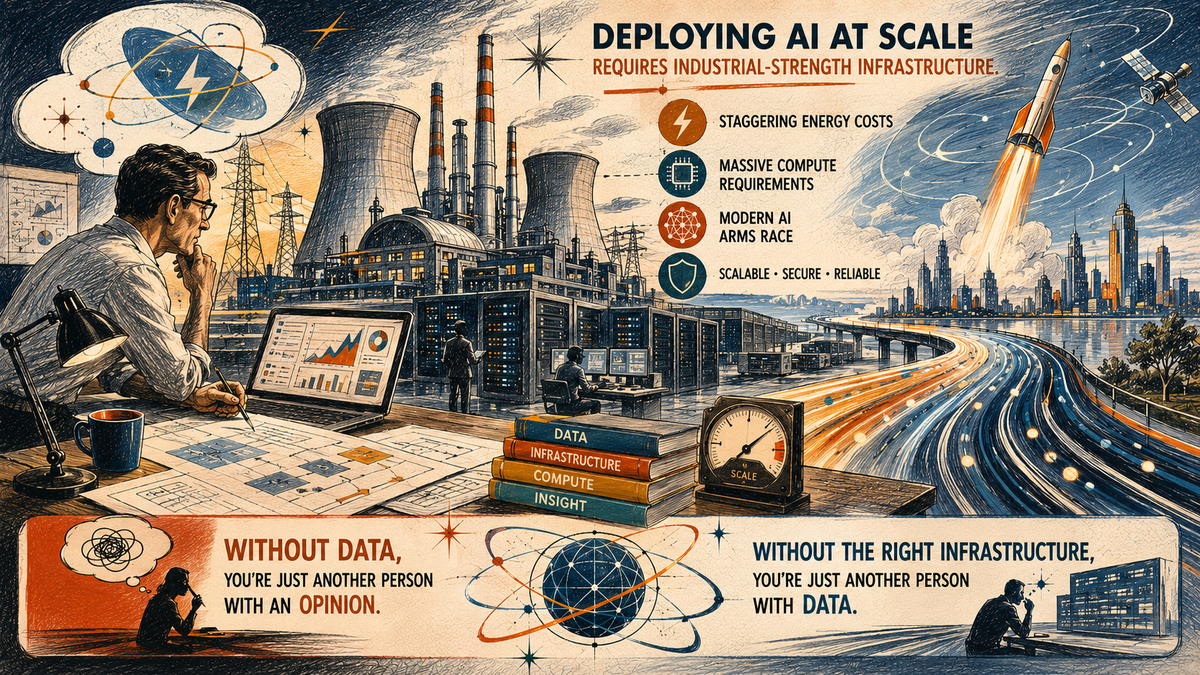
"Without data, you're just another person with an opinion. Without the right infrastructure, you're just another person with data."
The Infrastructure Reality Check
When executives think about AI transformation, they often fixate on the allure of intelligent systems and transformative outcomes. They envision AI agents revolutionizing customer service, generative models creating compelling marketing content, and reasoning systems solving complex business problems. What they don't always appreciate is the industrial-strength infrastructure required to make these visions reality.
Think of AI infrastructure as the difference between admiring a Formula 1 race car in a showroom and actually racing it at Monaco. The car may look impressive sitting still, but it requires a pit crew, specialized fuel, precision engineering, and a track capable of handling 200-mile-per-hour speeds. Similarly, AI models may demonstrate impressive capabilities in demonstrations, but deploying them at enterprise scale requires infrastructure that can handle computational demands that would have been unimaginable just a few years ago.
The infrastructure choices you make today will determine not just whether your AI initiatives succeed, but how much they cost to operate, how quickly they can scale, and whether they can evolve with your business needs. This isn't just a technology decision—it's a strategic business decision that will ripple through your organization for years to come.
The Cloud: Your AI On-Ramp to the Future
For most organizations, cloud computing represents the most practical entry point into serious AI deployment. This isn't because cloud is inherently superior to on-premises infrastructure—it's because cloud providers have already made the massive investments in specialized hardware, networking, and expertise that most companies simply cannot justify building themselves.
Consider the economic reality: A single high-end GPU cluster suitable for training large language models can cost millions of dollars. Google's latest seventh-generation Tensor Processing Units deliver 42.5 exaflops of compute power in a single pod—more computational capacity than most supercomputers possessed just a few years ago. When Google announced that this seventh-generation TPU is 3,600 times more performant than their first-generation TPU from 2018, while being 40% more energy efficient than the previous generation, they weren't just showcasing technical progress. They were demonstrating the kind of infrastructure arms race that individual companies cannot hope to win.
The cloud becomes your accelerator because it transforms these massive capital investments into operating expenses that scale with your usage. Instead of betting your budget on hardware that may be obsolete before you've fully utilized it, you can access cutting-edge infrastructure as a service, paying only for what you use while maintaining the flexibility to scale up or down as your needs evolve.
But cloud adoption for AI isn't just about accessing powerful hardware—it's about accessing ecosystems. Major cloud providers don't just offer raw compute power; they provide integrated platforms that include pre-trained models, development tools, data management services, and deployment frameworks. When you choose a cloud provider for AI, you're not just renting servers—you're buying into a comprehensive development and deployment ecosystem that can accelerate your time to value.
This ecosystem advantage becomes particularly important when you consider the complexity of modern AI applications. A sophisticated AI system might require multiple models working in concert, real-time data processing, secure storage for sensitive information, and integration with existing business systems. Building this from scratch would require expertise in machine learning, distributed systems, security, networking, and data engineering. Cloud platforms provide much of this functionality as managed services, allowing your teams to focus on business logic rather than infrastructure management.
However, cloud adoption for AI also introduces new considerations that many organizations underestimate. The most significant is cost management. While cloud provides access to powerful infrastructure without massive upfront investment, it can also lead to surprisingly high ongoing costs if not managed carefully. AI workloads are fundamentally different from traditional applications—they're computationally intensive, data-hungry, and often require specialized hardware that commands premium pricing.
Hidden Mathematics of AI Costs
Understanding AI costs requires grasping the computational complexity underlying these systems. Modern large language models process tokens through what's essentially brute force computation—every token passes through the entire model, layer by layer. The computational complexity is approximately O(L•T²), where L represents the number of layers and T represents the number of input tokens. This means that doubling the number of tokens in your input roughly quadruples the computational cost.
To put this in perspective, GPT-3 required 3.14 × 10²³ floating-point operations to train. These aren't just big numbers—they represent real costs that translate directly to your bottom line. When you submit a query with a thousand tokens to a large language model, and that query gets processed through a model with hundreds of layers, the system is performing billions of calculations. Do that a thousand times per day, and you're talking about trillions of operations. Scale that to enterprise usage levels, and the numbers become astronomical.
This is why model selection becomes a critical business decision, not just a technical one. Many organizations default to the largest, most capable models available, assuming that bigger is always better. But the relationship between model size and performance isn't linear, while the relationship between model size and cost often is. A model that performs 10% better but costs 300% more to operate may not be the right choice for your use case.
Smart organizations develop a tiered approach to model selection. They use smaller, more efficient models for routine tasks and reserve larger models for complex problems that truly require their capabilities. They understand that the goal isn't to use the most impressive technology—it's to solve business problems cost-effectively.
Consider a customer service application that needs to classify incoming support tickets. A massive general-purpose language model might achieve 95% accuracy on this task, while a smaller, fine-tuned model might achieve 92% accuracy at one-tenth the cost. For most businesses, the 3% difference in accuracy doesn't justify the 10x difference in operating costs, especially when the smaller model can be continuously improved with your specific data.
This cost consideration becomes even more critical when you factor in the total cost of ownership. The visible costs—the charges from your cloud provider for compute time—are just the beginning. You also need to account for data transfer costs, storage costs for model artifacts and training data, the cost of specialized personnel to manage these systems, and the cost of continuous monitoring and optimization.
Art and Science of Cost Optimization
Effective AI cost management starts with understanding your token economics in granular detail. Every interaction with an AI model consumes tokens for both input and output, and these tokens have real costs associated with them. Organizations that succeed at scale develop sophisticated monitoring systems that track token usage across different applications, users, and use cases.
One financial services company discovered that their internal document summarization tool was consuming 40% of their AI budget because employees were regularly submitting entire research reports—sometimes hundreds of pages—for summarization. By implementing intelligent document chunking and summary aggregation, they reduced their token consumption by 75% while actually improving summary quality.
Model fine-tuning represents another powerful cost optimization strategy, though it requires upfront investment in time and expertise. Fine-tuning allows you to take a smaller, more efficient base model and train it specifically for your use case. The result is often a model that performs as well as a much larger general-purpose model for your specific tasks, but at a fraction of the operational cost.
The mathematics here are compelling: if you can achieve equivalent performance with a model that's one-tenth the size, you've potentially reduced your inference costs by 90%. Over the course of a year, this could represent millions of dollars in savings for large-scale deployments.
However, fine-tuning isn't a silver bullet. It requires high-quality training data, expertise in machine learning, and ongoing maintenance as your use cases evolve. Organizations need to weigh the upfront costs and complexity of fine-tuning against the long-term operational savings.
Another critical optimization strategy involves intelligent caching and result reuse. Many AI applications generate similar outputs for similar inputs, but organizations often fail to take advantage of this redundancy. By implementing sophisticated caching strategies, you can avoid re-computing results for queries that are substantially similar to previous ones.
One e-commerce company implemented semantic caching for their product description generation system. Instead of generating new descriptions for every product, they identified when new products were sufficiently similar to existing ones and reused descriptions with minor modifications. This reduced their generative AI costs by 60% while maintaining description quality.
Edge Revolution
While cloud computing provides the on-ramp for most AI initiatives, edge computing represents the next frontier for organizations with specific requirements around latency, privacy, or regulatory compliance. Edge AI involves deploying AI models closer to where data is generated and decisions need to be made, rather than sending everything to centralized cloud servers.
The drivers for edge AI are compelling in certain scenarios. In manufacturing, real-time quality control systems need to make decisions in milliseconds, not the hundreds of milliseconds required for round-trip communication to the cloud. In healthcare, patient monitoring systems may need to continue functioning even when network connectivity is unreliable. In financial services, algorithmic trading systems require response times measured in microseconds.
But edge AI also addresses growing privacy and regulatory concerns. When sensitive data never leaves your premises, you dramatically reduce your exposure to data breaches and regulatory violations. For organizations in highly regulated industries like healthcare, financial services, or government, this can be the difference between compliance and catastrophic penalty.
Google's innovations in edge AI, particularly their Gemini models optimized for edge deployment, demonstrate how this technology is maturing. These models can run on specialized hardware at the edge while maintaining substantial capability, enabling sophisticated AI applications that don't require constant cloud connectivity.
However, edge AI introduces its own complexities. Edge devices have limited computational resources, which means models must be carefully optimized for size and efficiency. This often involves model compression techniques like quantization and pruning, which can reduce model accuracy. Organizations must carefully balance the benefits of edge deployment against these trade-offs.
Edge AI also requires different expertise and management approaches. Instead of managing a few powerful servers in the cloud, you're managing potentially thousands of edge devices, each with their own hardware characteristics, software requirements, and failure modes. This distributed complexity can quickly overwhelm organizations that aren't prepared for it.
Energy as the New Currency
Perhaps no aspect of AI infrastructure is more sobering than its energy requirements. Modern AI systems consume enormous amounts of electricity, not just during training but during ongoing operation. As AI becomes more pervasive in business operations, energy consumption is becoming a significant operational expense and environmental concern.
The numbers are staggering. Training a large language model can consume as much electricity as a small city uses in a month. But training costs are often one-time expenses—the ongoing inference costs are where the real impact lies. Every query processed by a large language model requires significant computational resources, which translates directly to energy consumption.
This creates a fundamental tension for organizations committed to sustainability goals. AI can deliver tremendous business value, but it comes with a substantial carbon footprint. Organizations are increasingly finding themselves in the position of having to choose between AI capabilities and environmental commitments, or finding ways to optimize both simultaneously.
The energy efficiency improvements in hardware are helping, but they're not keeping pace with the growth in AI usage. Google's seventh-generation TPUs are 40% more energy efficient than their predecessors, which is significant progress. But when AI usage is growing exponentially, even dramatic efficiency improvements may not be enough to prevent overall energy consumption from increasing.
This is driving innovation in several directions. Companies are investing heavily in renewable energy sources to power their data centers. They're developing more efficient algorithms that can achieve similar results with less computation. They're exploring new hardware architectures optimized for AI workloads. And they're implementing sophisticated workload scheduling systems that can shift computing to times and locations where clean energy is most available.
For business leaders, this means energy considerations must be integrated into AI strategy from the beginning. This isn't just about corporate social responsibility—it's about operational sustainability. As energy costs rise and carbon regulations tighten, organizations with energy-efficient AI strategies will have significant competitive advantages.
Infrastructure as Strategic Advantage
The organizations that will thrive in the AI era are those that understand infrastructure not as a necessary evil, but as a source of strategic advantage. They recognize that the right infrastructure choices can accelerate innovation, reduce costs, and enable capabilities that competitors cannot match.
This starts with developing infrastructure literacy among business leaders. You don't need to become a systems architect, but you need to understand the fundamental trade-offs between different infrastructure approaches. You need to grasp how infrastructure decisions affect your ability to scale, your operational costs, and your strategic flexibility.
Consider how Netflix transformed from a DVD-by-mail service to a streaming giant. This transformation wasn't just about content or user experience—it was fundamentally enabled by infrastructure choices. Netflix invested heavily in content delivery networks, developed sophisticated recommendation algorithms, and built systems capable of handling massive concurrent video streams. These infrastructure investments became strategic moats that competitors struggled to replicate.
Similarly, organizations that make smart AI infrastructure choices today are building competitive advantages that will compound over time. They're developing expertise in managing AI workloads efficiently. They're building data pipelines that can feed AI systems continuously. They're creating development environments that accelerate AI innovation. Most importantly, they're building the organizational muscle memory needed to operate AI systems at scale.
Orchestrating Complexity
The future of AI infrastructure isn't cloud or edge—it's the intelligent orchestration of both, along with on-premises systems, into hybrid architectures that optimize for different requirements simultaneously. This orchestration represents both an opportunity and a challenge for organizations.
The opportunity lies in the flexibility to optimize different workloads for different environments. Batch processing for model training might happen in the cloud where you can access massive computational resources on demand. Real-time inference for customer-facing applications might happen at the edge to minimize latency. Sensitive data processing might remain on-premises to maintain control and compliance.
The challenge lies in managing this complexity without it overwhelming your organization. Hybrid architectures require sophisticated orchestration systems, comprehensive monitoring, and teams with expertise across multiple platforms and paradigms. They also require new approaches to security, data governance, and cost management that span multiple environments.
Organizations that master this hybrid orchestration will have tremendous advantages. They'll be able to optimize costs by running workloads in the most efficient environments. They'll be able to meet diverse regulatory and performance requirements simultaneously. They'll be able to leverage innovation from multiple vendors and platforms without being locked into any single approach.
But this mastery doesn't happen overnight. It requires systematic investment in capabilities, careful planning of architecture evolution, and cultivation of teams that can think across traditional infrastructure boundaries.
Building Your Infrastructure Strategy
Developing an effective AI infrastructure strategy requires balancing immediate needs with long-term flexibility. You need to make decisions that serve your current requirements while preserving options for future evolution.
Start by understanding your requirements in detail. What are your performance requirements for different use cases? What are your cost constraints? What are your regulatory and compliance obligations? What are your security and privacy requirements? How important is vendor independence? How much infrastructure complexity can your organization realistically manage?
These questions don't have universal answers—they depend on your industry, your organization's capabilities, and your strategic priorities. A healthcare organization will have different priorities than a retail company. A startup will make different trade-offs than an established enterprise.
Next, develop a migration path that allows you to learn and adapt. Most organizations should start with cloud-based solutions that provide immediate access to AI capabilities without massive upfront investment. As you gain experience and understanding of your requirements, you can make more sophisticated decisions about hybrid architectures, edge deployment, and specialized infrastructure.
Finally, invest in the capabilities needed to make infrastructure a competitive advantage rather than a constraint. This means developing in-house expertise in AI infrastructure management, building relationships with multiple vendors to avoid lock-in, and creating systems for continuous monitoring and optimization.
Infrastructure Imperative
In the AI era, infrastructure is destiny, but infrastructure alone is not enough. The organizations that succeed will be those that understand this reality and act accordingly. They'll invest in infrastructure not as a cost center, but as a strategic enabler. They'll develop the expertise needed to make infrastructure decisions that compound their competitive advantages over time.
More critically, they'll recognize that the democratization of AI infrastructure has fundamentally altered the competitive landscape. When everyone has access to the same powerful tools, competitive advantage shifts to organizational capability—specifically, the ability to execute with speed and precision.
This shift creates what we might call the "execution imperative." Organizations must develop the capacity for rapid experimentation, quick decision-making, and continuous adaptation. This requires flattening hierarchies that slow down information flow, removing people obstacles that impede progress, and altering corporate messaging to align with the speed demands of the AI era.
The most challenging aspect of this transformation is that it often requires leadership changes that go beyond individual development. When executives have built their careers on approaches that worked well in slower-moving environments, they may struggle to adapt to the pace and decision-making requirements that AI demands. This places a critical responsibility on boards of directors to evaluate whether current leadership has the capabilities required for future success, not just the ability to manage current operations.
However, the harsh reality of organizational governance is that boards either possess the courage to make difficult leadership transitions or they don't. Organizational courage isn't a capability that can be developed through training or frameworks—it's either an intrinsic characteristic of leadership or it emerges from external competitive pressures that make difficult decisions unavoidable. Boards that have spent decades in consensus-driven, risk-averse environments don't suddenly develop the willingness to remove competent but misaligned executives simply because the business context has changed. The most dangerous assumption any organization can make is that their board will demonstrate courage when needed if they haven't demonstrated it when it wasn't absolutely required.
The window for building these capabilities is narrowing rapidly. As AI becomes more pervasive and competition intensifies, the organizations with superior execution capabilities will increasingly dominate their markets. The time to begin building these capabilities is now, before organizational inertia becomes a constraint on your AI ambitions rather than an enabler of them.
The future belongs to organizations that can harness the power of AI at scale, efficiently, and sustainably. That future is being built not just on the infrastructure decisions you make today, but on the organizational capabilities you develop to leverage that infrastructure effectively.