Chapter 9: The Seven Deadly Sins of Data
Quality, Availability, Volume, Ownership, Privacy, Alignment, and Bias. Beware the invisible corruptions quietly sabotaging your AI models from within.
"The most important thing in communication is hearing what isn't said." - Peter Drucker
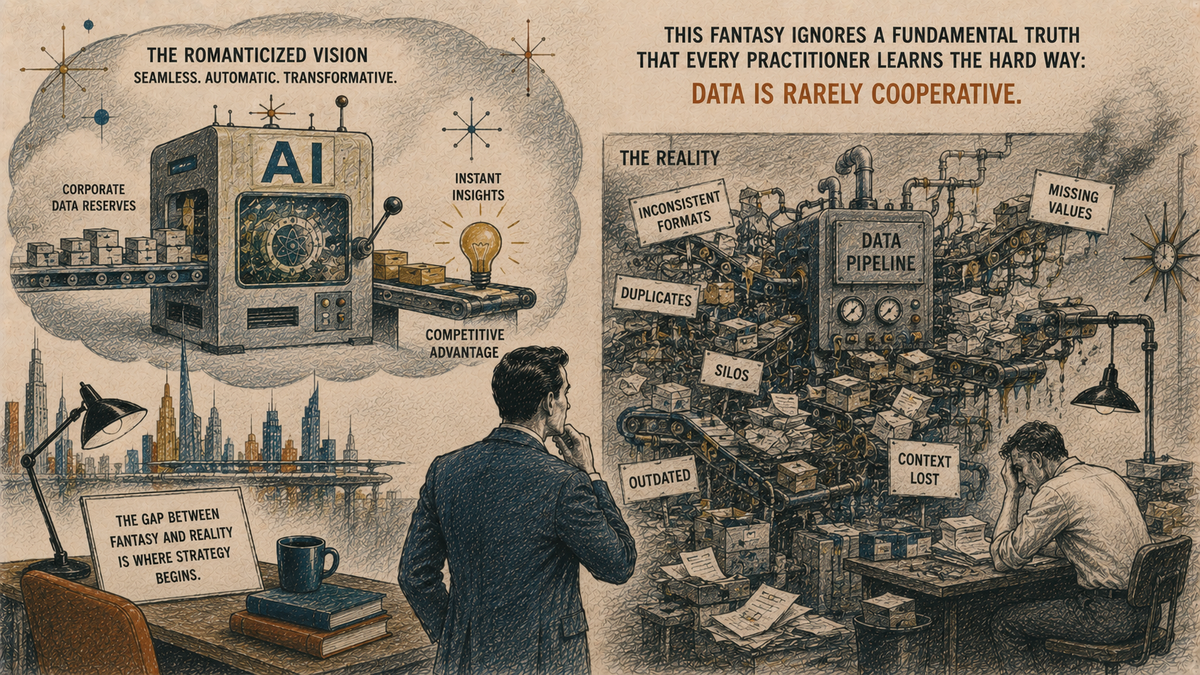
The romanticized vision of artificial intelligence often portrays a seamless transformation where algorithms magically extract insights from corporate data reserves, instantly delivering competitive advantage. This fantasy ignores a fundamental truth that every practitioner learns the hard way: data is rarely cooperative. Like the ancient sins that tempt human nature, data sins lurk within every organization, quietly sabotaging AI initiatives with a sophistication that makes them particularly dangerous.
You can have the most advanced algorithms, the most powerful computing infrastructure, and the most talented data scientists, but if your data suffers from any of these seven deadly sins, your AI projects will falter. Unlike traditional software applications that might gracefully degrade when fed imperfect inputs, AI systems built on flawed data don't just fail—they fail confidently, producing results that appear credible while being fundamentally wrong.
Consider this sobering reality: when you put bad gasoline in your car, you know immediately. The engine sputters, makes disturbing noises, and eventually grinds to a halt. You understand something is wrong. But when you feed bad data into an AI algorithm, it often continues to chug along, producing seemingly reasonable outputs that you might celebrate as success while completely missing the mark. This silent failure mode makes data quality issues not just technical problems, but business-critical risks that can undermine your entire AI strategy.
The seven deadly sins of data—Quality, Availability, Volume, Ownership, Privacy, Alignment, and Bias—represent the most common and dangerous pitfalls that organizations encounter in their AI journeys. Understanding these sins is not merely an academic exercise; it's a practical necessity for any leader serious about AI transformation. Each sin has the power to corrupt your AI initiatives in unique ways, and like their moral counterparts, they often appear in combination, amplifying each other's destructive potential.
Data Quality
Data quality represents perhaps the most insidious of the seven sins because it masquerades as competence. Most organizations believe they have good quality data simply because it appears syntactically correct—it fits neatly into relational databases, passes basic validation checks, and looks professional in spreadsheets. This surface-level assessment creates a dangerous illusion of readiness that can devastate AI initiatives.
True data quality extends far beyond semantic correctness. It encompasses fitness for purpose, a concept that requires you to evaluate whether your data accurately represents the problem you're trying to solve. A dataset can be grammatically perfect, mathematically precise, and structurally sound while being profoundly wrong for your specific use case.
Take the case of a major retail chain that spent millions developing a customer behavior prediction model using five years of meticulously maintained transaction data. The data passed every quality check their IT department could devise—no missing values, consistent formatting, proper referential integrity. Yet the model consistently made poor predictions about customer preferences. The problem? The company had undergone a significant brand repositioning three years earlier, fundamentally changing their customer base and shopping patterns. The older data, while technically perfect, was misaligned with current customer behavior, rendering the model worse than useless.
This example illustrates why data quality cannot be assessed in isolation from business context. Quality is not an absolute measure but a relative one that depends entirely on your intended application. The same dataset might be excellent for one use case and terrible for another. Your data quality assessment must therefore begin not with the data itself, but with a clear understanding of what you're trying to achieve.
Organizations serious about data quality must implement continuous profiling, testing, and monitoring systems that go beyond traditional data validation. You need metrics that assess not just whether your data is internally consistent, but whether it accurately represents the current state of your business environment. This requires establishing feedback loops between your AI outputs and real-world outcomes, allowing you to detect when model performance degrades due to underlying data quality issues.
The foundation of effective data quality management lies not in sophisticated technology but in organizational culture. Like the Federal Aviation Administration's approach to aviation safety, organizations must create environments where identifying and reporting data quality issues is not just encouraged but celebrated. The FAA's success in aviation safety stems from a culture where anyone can report problems without fear of retribution, knowing that issues will be investigated and resolved quickly. This same principle must apply to data quality.
Consider implementing a simple but powerful "Data Quality Health Check" that any business stakeholder can understand and use. This assessment focuses on five fundamental questions that reveal the most critical quality issues: First, "Can you trace this data back to its source?" This tests data lineage and helps identify where quality issues might originate. Second, "Does this data make business sense?" This catches obvious anomalies that technical validation might miss. Third, "How old is this data?" This addresses timeliness and relevance concerns. Fourth, "Who else is using this data, and are they getting the same results?" This reveals consistency issues across different applications. Finally, "What would happen to our business if this data were wrong?" This prioritizes quality efforts based on business impact.
A manufacturing company discovered the power of this cultural approach when they established a "data quality hotline" that allowed any employee to report suspected data issues anonymously. Within months, they uncovered a systematic problem in their quality control data that had been masked by fears of blame and retribution. Production line workers had noticed patterns in defect rates that didn't match the official quality reports, but had been reluctant to challenge the "official" data. Once they felt safe to speak up, the company discovered a two-year-old calibration error in their testing equipment that was causing quality issues to be systematically underreported. The financial impact was significant, but the cultural transformation was even more valuable.
The most successful organizations go beyond just removing fear—they actively incentivize data quality vigilance through meaningful recognition and rewards. In high-stakes environments like financial trading systems, where invalid trade data can have enormous economic implications, finding and reporting critical data issues should be treated as a career-enhancing achievement worthy of substantial recognition. One investment firm implemented a "Data Guardian" program that provided both financial rewards and public recognition for employees who identified significant data quality issues. The program transformed data quality from a burden into a competitive advantage, with employees actively seeking opportunities to improve data integrity.
However, true transparency remains rare in most organizations. While executives often pay lip service to transparency, the reality frequently means transparency only to immediate managers who may then filter, manipulate, or suppress information for their own benefit. Genuine "sunshine transparency"—where all issues are visible to everyone who needs to see them—requires fundamental changes in organizational structure and incentives. This means creating systems where data quality issues are visible across organizational boundaries and where hiding problems becomes more career-limiting than revealing them.
The practical challenge most organizations face is that they cannot afford six months to fix all data quality issues before beginning AI initiatives, especially since the full depth of quality problems often remains unknown until you actually use the data. The solution lies in adopting a risk-based, iterative approach that identifies and addresses the most critical issues first. Start with the obvious problems that can be detected through basic profiling—missing values, impossible data ranges, format inconsistencies, and clear business rule violations. These "low-hanging fruit" issues often represent a significant portion of data quality problems and can be resolved relatively quickly.
The more subtle quality issues—those involving complex business logic, temporal relationships, or domain-specific validity rules—typically reveal themselves only through actual use of the data in AI applications. This reality suggests that organizations should plan for continuous data quality improvement rather than attempting to achieve perfection before starting. The key is to establish monitoring and feedback systems that can quickly identify when subtle quality issues begin to impact AI performance, allowing for rapid remediation without derailing entire projects.
When data quality issues inevitably surface, the organizational response reveals the true nature of corporate culture. The most successful organizations approach these discoveries with brutal honesty and systematic problem-solving rather than emotional reactions. Leaders who create environments where managers can state facts without fear of retribution find that data quality problems become opportunities for improvement rather than sources of organizational dysfunction. This requires moving beyond the instinctive management response of seeking someone to blame toward a more productive focus on understanding root causes and implementing systematic solutions.
The "Five Whys" methodology proves particularly effective for data quality problem-solving because it forces organizations to move beyond surface-level fixes toward addressing fundamental systemic issues. When a data quality problem emerges, asking "why" repeatedly—why did this happen, why wasn't it detected, why don't we have monitoring in place, why aren't our processes adequate, why haven't we invested in data quality infrastructure—typically reveals that the technical data problem is actually a symptom of deeper organizational challenges around priorities, incentives, and cultural attitudes toward data excellence.
Organizations that embrace this systematic approach to data quality problem-solving find that AI initiatives become stronger over time rather than weaker. Data quality failures, when properly analyzed and addressed, create more robust AI systems and more mature data governance capabilities. The key is recognizing that AI is not going away, so retreating from AI initiatives in response to data quality challenges makes little strategic sense. Instead, these challenges should drive investments in the foundational data capabilities that will ultimately enable more sophisticated and reliable AI applications.
This imperative for data quality excellence will only intensify as organizations become increasingly dependent on AI for critical business decisions. The standards for "acceptable" data quality that might suffice today will prove inadequate as AI systems become more central to business operations. What constitutes good data quality now will not be sufficient a year from now, as the stakes of data-driven decision making continue to rise. Bad data simply is not good business in an AI-powered world, where the cascading effects of poor data quality can amplify across multiple automated systems and business processes.
The challenge lies in recognizing that data quality metrics must be domain-dependent and organization-specific. What constitutes acceptable quality for one company's customer data may be entirely inadequate for another company's financial trading data. However, every organization should establish baseline metrics that provide visibility into fundamental data health indicators. Too many organizations operate with no data quality metrics whatsoever, missing obvious problems that basic monitoring would catch immediately.
Consider the case of a financial services firm that operated for years without implementing basic data quality monitoring. When problems were occasionally discovered, they were fixed quietly without broader communication or systematic analysis of root causes. This approach meant that similar problems continued to emerge repeatedly, creating a cycle of reactive fixes rather than proactive prevention. The company was essentially flying blind regarding the quality of the data that powered their most critical business decisions. Only when they implemented basic completeness, consistency, and timeliness metrics did they begin to understand the true scope of their data quality challenges and develop systematic approaches to address them.
The path forward requires organizations to move beyond treating data quality as a technical afterthought toward recognizing it as a fundamental business capability. This means establishing metrics that matter for your specific business context, creating transparency around data quality issues, and building organizational capabilities that can prevent problems rather than just react to them. The investment in these capabilities will determine whether your organization thrives or struggles in an increasingly AI-dependent business environment.
Among the seven deadly sins of data, three stand out as having the potential to kill AI projects immediately: Quality, Availability, and Volume. These represent the foundational requirements that must be met for any AI system to function at all. Poor data quality renders even the most sophisticated algorithms useless. Inadequate data availability means you cannot build or train your systems. Insufficient data volume leaves you with models that cannot generalize beyond their training examples. While the remaining sins—Ownership, Privacy, Alignment, and Bias—are equally dangerous in their long-term implications, they typically allow projects to proceed initially before revealing their destructive potential over time.
The prioritization of remediation efforts should begin with culture as the foundational element, though organizational leaders can make a compelling argument that cultural change, data strategy development, and metrics implementation must occur in parallel rather than sequentially. Cultural transformation provides the foundation for sustainable improvement by creating an environment where data quality issues can be identified, reported, and addressed without fear of retribution. However, culture change takes time, and AI initiatives often cannot wait for complete cultural transformation before beginning.
The most effective approach involves laying the groundwork for cultural success while simultaneously developing a comprehensive data strategy and implementing basic quality metrics. This parallel approach allows organizations to begin measuring and improving their data quality immediately while building the cultural foundations necessary for long-term success. The key is recognizing that these elements reinforce each other—good metrics enable better decision-making, which supports cultural change, which enables more sophisticated metrics and strategy development.
For executives who suddenly realize they have been operating blind regarding their data quality while already deep into AI initiatives, the response must be swift and systematic. The first thirty days should focus on immediate risk assessment and damage control, implementing basic quality monitoring for the most critical data sources and identifying any obvious problems that could cause immediate harm. The next thirty days should concentrate on expanding monitoring coverage and beginning systematic quality improvement for high-impact issues. The final thirty days of this initial ninety-day response should focus on establishing sustainable processes and governance structures that can prevent future quality problems while continuing to improve existing data assets.
This crisis response approach, while necessary, underscores why proactive data quality management represents such a critical competitive advantage. Organizations that invest in comprehensive data governance before launching major AI initiatives avoid the painful and expensive process of retrofitting quality controls onto live systems. More importantly, they build AI capabilities on solid foundations that can support increasingly sophisticated applications as their AI maturity evolves.
The challenge becomes even more complex when dealing with unstructured data—emails, documents, chat logs, and multimedia content—which now represents the majority of enterprise data. Traditional data quality tools designed for structured databases are inadequate for assessing the fitness of unstructured content. You need new approaches that can evaluate semantic relevance, contextual appropriateness, and domain-specific accuracy across diverse content types.
Furthermore, data quality is not a one-time achievement but an ongoing discipline. As your business evolves, your data quality requirements evolve with it. What constituted high-quality data last year might be inadequate or even misleading today. This dynamic nature of quality requirements demands continuous investment in data monitoring and improvement processes.
The manufacturing example illustrates this principle powerfully: when a company has poor data quality about the manufacturing quality of their products, it creates a cascade of downstream problems including higher than usual return rates, customer dissatisfaction, and potential safety issues. The data quality problem becomes a business continuity problem, demonstrating why executives must treat data quality as a fundamental business risk rather than merely a technical concern.
Data Availability - The Illusion of Access
The assumption that valuable data is readily accessible represents one of the most common blind spots in AI planning. Organizations often discover too late that the data they need exists somewhere within their infrastructure but remains effectively inaccessible due to technical, organizational, or regulatory barriers.
Data availability encompasses multiple dimensions that must align for successful AI implementation. First, the data must be technically accessible—stored in systems that can be queried and extracted efficiently. Second, it must be organizationally accessible, meaning you have the permissions and approvals necessary to use it. Third, it must be refreshable, allowing you to maintain current datasets as your AI systems operate in production. Finally, it must be interpretable, with sufficient documentation and context to understand what the data represents and how it was collected.
Consider the experience of a global manufacturing company that initiated an AI project to optimize supply chain operations. The project team identified dozens of relevant data sources across different geographic regions and business units. However, they discovered that each region used different ERP systems with incompatible data schemas. Some critical data was stored in legacy systems with limited query capabilities. Other data required approval from multiple stakeholders across different time zones. By the time the team assembled a complete dataset, the business priorities had shifted, and the original use case was no longer relevant.
The timeliness dimension of availability often proves particularly challenging. Different business processes generate data at different frequencies and with different latencies. Sales transactions might be available in near-real-time, while customer satisfaction surveys might be compiled monthly. Manufacturing quality data might be available hourly from automated systems but require manual validation that introduces weeks of delay. These timing mismatches can severely limit the types of AI applications you can build and their business impact.
Accessibility challenges are often compounded by the cybersecurity imperative that has led many organizations to err on the side of excessive data protection. While security is crucial, overly restrictive access controls can make internal data effectively unavailable to legitimate AI initiatives. You need documented, expedient processes for requesting and reviewing data access that balance security with business agility.
Discoverability represents another critical aspect of availability. In large organizations, no individual can possibly know about every dataset that exists, where it's located, and how to access it. AI opens up new possibilities for using diverse data types, making comprehensive data cataloging essential. You need robust metadata management systems that allow potential users to understand what data assets exist, what they contain, who owns them, and how to request access.
The availability challenge extends beyond internal data to external sources. Market data, syndicated research, public datasets, and third-party APIs can provide valuable augmentation to internal data, but each comes with its own availability constraints. Some external data sources are expensive, others have usage limitations, and still others may be discontinued without notice. Building AI systems that depend on external data requires careful consideration of these dependencies and appropriate contingency planning.
The Goldilocks Problem
The relationship between data volume and AI success follows a complex, non-linear pattern that defies simple rules. Too little data produces models that cannot generalize beyond their training examples, while too much data creates storage, processing, and cost challenges that can overwhelm your infrastructure. Like Goldilocks searching for the perfect porridge, you need to find the volume that's "just right" for your specific use case.
The challenge begins with the recognition that different types of AI applications have vastly different volume requirements. A simple classification model might achieve excellent performance with thousands of examples, while a large language model requires billions of tokens for effective training. Computer vision applications might need millions of labeled images, while time series forecasting might work well with months of historical data. There is no universal answer to the question "How much data do I need?"
Volume requirements also depend heavily on the complexity of the problem you're solving and the quality of your data. High-quality, well-curated datasets can often achieve better results with smaller volumes than larger collections of noisy data. This creates an interesting trade-off between data quality and quantity that requires careful optimization.
A financial services firm learned this lesson when developing a fraud detection system. Initial models trained on millions of historical transactions showed poor performance due to the rarity of actual fraud cases in the dataset. The team discovered that a smaller, more carefully curated dataset with better fraud examples and improved feature engineering produced superior results. Volume alone was not the answer; intelligent sampling and data preparation proved more valuable.
The dangers of too little data extend beyond poor model performance to include overfitting and bias. Small datasets may not adequately represent the full range of scenarios your AI system will encounter in production, leading to models that perform well in testing but fail in real-world applications. This problem is particularly acute when dealing with edge cases or rare events that may be critical to business outcomes.
Conversely, excessive data volume creates its own set of problems. Storage costs scale linearly with volume, while processing costs often scale superlinearly due to the computational complexity of many AI algorithms. Large datasets also increase training times, making experimentation slower and more expensive. In some cases, the marginal benefit of additional data may not justify these increased costs.
The emergence of synthetic data generation offers a potential solution to volume challenges, but it must be used with extreme caution. Synthetic data can help augment small datasets or create training examples for rare scenarios, but it can also introduce artifacts and biases that don't exist in real-world data. The key is to use synthetic data as a complement to, not a replacement for, real data, and to validate carefully that synthetic augmentation improves rather than degrades model performance.
Data volume also interacts with privacy and regulatory requirements in complex ways. Regulations like GDPR emphasize data minimization—collecting and processing only the data necessary for your specific purpose. This principle can conflict with the machine learning tendency to assume that more data is always better. Organizations must find ways to balance regulatory compliance with AI performance requirements.
The Presumption of Permission
The assumption that possession equals permission represents one of the most legally dangerous data sins. Organizations often operate under the mistaken belief that if they have access to data, they have the right to use it for any purpose, including AI development. This presumption can expose companies to significant legal, financial, and reputational risks.
Data ownership encompasses both legal rights and practical responsibilities. Legal ownership involves understanding copyright, licensing terms, and contractual obligations associated with your data sources. Just because data exists within your corporate boundaries doesn't mean you own it or have unlimited rights to use it. Customer data, employee information, third-party content, and externally sourced datasets all come with specific usage restrictions that must be carefully evaluated.
Consider the experience of a media company that developed an AI system to automatically generate content summaries from news articles. The system worked beautifully in testing, processing thousands of articles from various sources to create concise, readable summaries. However, the legal team discovered that many of the source articles were protected by copyright and licensing agreements that explicitly prohibited automated processing for content generation. Despite the technical success of the AI system, the company had to abandon the project due to legal constraints.
Internal data access can also be restricted in ways that affect AI initiatives. Different departments or business units may have contractual or regulatory obligations that limit how their data can be used. Customer data collected for one purpose may not be legally or ethically appropriate for other applications without explicit consent. Employee data is subject to privacy laws and internal policies that may restrict its use in AI systems.
The ownership challenge becomes particularly complex in the context of machine learning model development. When you train a model on copyrighted or licensed data, questions arise about the intellectual property status of the resulting model. Some argue that the model contains derivative elements of the training data, while others contend that it represents a fundamentally new creation. Legal precedents in this area are still evolving, creating uncertainty for organizations developing AI systems.
Open source and publicly available datasets present their own ownership challenges. While these data sources may be freely accessible, they often come with specific licensing terms that impose obligations on users. Some licenses require attribution, others restrict commercial use, and still others require that derivative works be made available under similar terms. Failure to comply with these obligations can result in legal liability even when using "free" data.
The ownership dimension also includes practical considerations about data stewardship and accountability. Someone within your organization must take responsibility for understanding the provenance of your data, maintaining compliance with usage restrictions, and ensuring that data use remains aligned with legal and ethical obligations. This stewardship role becomes increasingly complex as AI systems integrate data from multiple sources with different ownership and licensing terms.
Organizations must develop comprehensive data inventory and rights management processes that track not just what data they have, but where it came from, what restrictions apply to its use, and who within the organization is authorized to make decisions about its application. This governance framework must evolve continuously as new data sources are added and as legal and regulatory requirements change.
Data Privacy
Privacy violations in AI systems can result in catastrophic consequences that extend far beyond regulatory fines to include permanent reputational damage and loss of customer trust. The privacy sin is particularly treacherous because it often manifests gradually, creating exposure that builds over time before erupting into crisis.
Modern privacy regulations like GDPR, CCPA, and emerging legislation worldwide have transformed data privacy from a best practice into a legal imperative with severe financial penalties. However, compliance extends beyond simply avoiding regulatory violations to encompass ethical obligations to protect individual privacy and maintain public trust in AI systems.
The privacy challenge in AI is fundamentally different from traditional data processing because machine learning systems can infer sensitive information from seemingly innocuous data combinations. A model trained on purchasing patterns might inadvertently learn to predict health conditions, financial status, or personal relationships. These emergent privacy risks are often invisible during development but can create significant liability when discovered in production.
Unstructured data poses particularly acute privacy risks because personally identifiable information (PII) can be embedded in ways that are difficult to detect and remove through automated processing. Email conversations might contain social security numbers, medical information, or financial details scattered throughout seemingly innocent business discussions. Chat logs might include personal conversations that occurred during business hours. Document repositories might contain confidential information that was never intended for AI processing.
A healthcare organization discovered this challenge when developing an AI system to analyze patient communication patterns. Despite careful attempts to anonymize the data, the system inadvertently learned to identify specific patients through combinations of timing patterns, communication styles, and mentioned symptoms. Even though no explicit patient identifiers were included in the training data, the model's ability to re-identify individuals created significant privacy violations.
The concept of data minimization—collecting and processing only the data necessary for your specific purpose—becomes critical in AI development. While machine learning practitioners often assume that more data leads to better models, privacy regulations require you to justify the necessity of each data element you collect and process. This creates tension between AI performance optimization and privacy compliance that must be carefully balanced.
Privacy risks are compounded by the global nature of many AI systems. Data collected in one jurisdiction may be processed in another with different privacy laws. Cloud-based AI services might store or process data across multiple countries, each with its own regulatory requirements. Organizations must ensure that their AI systems comply with the most restrictive privacy requirements among all applicable jurisdictions.
The temporal dimension of privacy adds another layer of complexity. Consent for data use can be withdrawn, regulatory requirements can change, and data that was legally collected for one purpose may become problematic for AI applications. Organizations need processes for ongoing privacy assessment and the ability to remove or modify data in response to changing requirements.
Privacy-preserving AI techniques like differential privacy, federated learning, and homomorphic encryption offer potential solutions but come with their own implementation challenges and performance trade-offs. These advanced techniques require specialized expertise and may not be suitable for all use cases. Organizations must carefully evaluate whether the privacy benefits justify the increased complexity and potential performance impacts.
Data Alignment
Data alignment addresses a subtle but critical question: does your data accurately represent the world in which your AI system will operate? This sin is particularly dangerous because well-aligned data from the past may become misaligned as business conditions change, while perfectly good data from other contexts may be inappropriate for your specific domain.
The alignment challenge begins with understanding that all data reflects the specific conditions under which it was collected. These conditions include the time period, geographic location, customer base, product mix, competitive environment, and countless other factors that may have changed since the data was created. AI models trained on historically aligned data may fail catastrophically when these underlying conditions shift.
A classic example occurred when a major e-commerce company expanded from urban to rural markets using customer behavior models trained exclusively on urban data. The models consistently overestimated demand for certain product categories and underestimated others, leading to significant inventory and logistics problems. The data quality was excellent, the volume was substantial, and the models were technically sound, but the fundamental misalignment between urban and rural customer behavior patterns undermined the entire initiative.
Domain alignment represents another critical dimension. Data that accurately represents one industry, geographic region, or customer segment may be completely inappropriate for another. This challenge is particularly acute when organizations attempt to leverage external datasets or pre-trained models that were developed in different contexts. The apparent universality of some AI models can mask fundamental alignment issues that only become apparent in production.
The temporal dimension of alignment is especially challenging because it's often invisible until performance degrades. A financial services firm developed credit risk models using several years of historical data that performed exceptionally well in testing. However, the models were trained during a period of economic stability and failed to account for the changed customer behavior patterns that emerged during subsequent economic uncertainty. The data perfectly represented the past but was misaligned with current conditions.
Cultural and linguistic alignment adds another layer of complexity for organizations operating across diverse markets. Models trained on data from one cultural context may make assumptions or exhibit biases that are inappropriate for other cultural settings. Language models trained primarily on English text may perform poorly when applied to other languages or cultural contexts, even when technically functional.
Alignment issues can also emerge from changes in business strategy or operations. When companies undergo mergers, acquisitions, strategic pivots, or significant operational changes, previously well-aligned data may become less representative of current realities. The data doesn't become "bad" in an absolute sense, but its alignment with current business conditions deteriorates.
Organizations must develop systematic approaches for assessing and maintaining data alignment. This includes establishing baselines for what "good" performance looks like, implementing monitoring systems that can detect alignment drift, and creating processes for updating or replacing data sources when alignment deteriorates. The key is to recognize that alignment is not a static property but a dynamic relationship that requires ongoing attention.
Data Bias and Drift
Data bias and drift represent perhaps the most philosophically complex of the seven sins because they force us to confront uncomfortable truths about the nature of data and the systems that generate it. Unlike other data quality issues that can be objectively measured and corrected, bias often reflects deeper structural inequalities and systemic issues that cannot be easily remediated through technical means.
Data bias manifests in multiple forms, each with its own implications for AI systems. Historical bias reflects past discrimination or unfair treatment that has been encoded in data over time. For example, hiring data from organizations with historically discriminatory practices will teach AI systems to perpetuate those same discriminatory patterns. Representation bias occurs when certain groups or scenarios are underrepresented in training data, leading to models that perform poorly for those underrepresented cases.
The infamous case of Amazon's AI recruiting tool illustrates how historical bias can corrupt AI systems in subtle ways. The system was trained on resumes submitted over a ten-year period, during which the company's technical roles were dominated by men. The AI learned to penalize resumes that included words like "women's," such as "women's chess club captain," and showed preference for traditionally male-dominated schools and activities. While the system was never explicitly told to discriminate against women, it learned to do so from the biased patterns in historical data.
Sampling bias represents another common form of corruption where the data collection process systematically excludes or overrepresents certain groups. Online surveys might underrepresent older demographics who are less likely to participate in digital research. Location-based data collection might miss rural populations or areas with limited connectivity. Even seemingly objective data sources like sensors or transaction systems can exhibit sampling bias if they're deployed unevenly across different populations or geographic areas.
The challenge of addressing bias is complicated by the fact that removing apparent bias can itself introduce bias. When you attempt to eliminate certain demographic or cultural factors from your data, you may inadvertently remove information that is legitimately relevant to the problem you're solving. Medical AI systems, for example, may need to account for genuine biological differences between different demographic groups to provide effective treatment recommendations.
Data drift represents the temporal dimension of bias, where the statistical properties of your data change over time in ways that degrade model performance. This can occur due to changes in user behavior, market conditions, competitive landscape, or countless other factors. The COVID-19 pandemic provided a dramatic example of data drift, where models trained on pre-pandemic data became unreliable as consumer behavior, economic patterns, and social interactions changed fundamentally.
Concept drift occurs when the relationship between inputs and outputs changes over time, even if the statistical properties of the inputs remain stable. For example, the factors that predict customer churn might change as competitive dynamics evolve, even if customer demographic patterns remain consistent. This type of drift is particularly difficult to detect because traditional monitoring approaches focused on input data distributions may miss the changed relationships.
Organizations must implement comprehensive monitoring systems that can detect various forms of bias and drift in their AI systems. This includes statistical monitoring of data distributions, performance monitoring across different demographic groups, and business outcome monitoring that can identify when model predictions no longer align with real-world results. The goal is not to eliminate all bias—an impossible task—but to understand and manage bias in ways that align with organizational values and regulatory requirements.
Governance, Monitoring, and Continuous Improvement
Understanding the seven deadly sins of data is only the beginning of building robust AI systems. Organizations must develop comprehensive data governance frameworks that address each of these challenges systematically. This governance must extend beyond traditional IT data management to encompass business stakeholders, legal teams, and external partners who contribute to your data ecosystem.
The governance framework must be supported by technical infrastructure that enables continuous monitoring and improvement of data quality across all seven dimensions. This includes automated data profiling systems, privacy scanning tools, bias detection algorithms, and drift monitoring capabilities. However, technology alone is insufficient; human oversight and judgment remain essential for interpreting results and making decisions about data use.
Organizations must also develop cultural capabilities that support data excellence. This includes training programs that help business stakeholders understand data quality requirements, processes that reward careful attention to data issues, and communication channels that enable rapid identification and resolution of data problems. The goal is to create an organizational culture where data quality is everyone's responsibility, not just the IT department's concern.
The investment in addressing these data sins is substantial, but the cost of ignoring them is far higher. AI initiatives built on flawed data foundations will fail, sometimes catastrophically and often in ways that damage organizational credibility and competitive position. The organizations that succeed in the AI revolution will be those that take data governance seriously from the beginning, investing in the foundational capabilities necessary to support sophisticated AI applications.
As you embark on your AI transformation journey, remember that data is not just the fuel that powers your AI systems—it's the foundation that determines whether those systems will serve your organization or undermine it. The seven deadly sins of data are not merely technical challenges to be solved; they represent fundamental business risks that require sustained attention and investment. Your success in AI will ultimately be determined not by the sophistication of your algorithms or the power of your computing infrastructure, but by your ability to master the complexities of data in all its flawed, biased, and beautiful reality.
The stakes could not be higher. In the AI-powered future, your data quality will determine your competitive destiny. But perhaps the most important lesson for executives is surprisingly simple: treat your data like you would treat your body or that expensive, high-performance car you spent a fortune on—with great respect. You wouldn't ignore warning signs about your health or skip maintenance on a precision vehicle. You shouldn't ignore the health of your data either.
Just as you invest in regular health checkups and preventive care, your data requires continuous monitoring and proactive maintenance. Just as you use premium fuel and quality parts in your high-performance vehicle, your AI systems deserve high-quality, well-maintained data. The organizations that understand this fundamental principle—that data quality is not a one-time project but an ongoing discipline requiring respect, investment, and vigilance—will be the ones that thrive in the AI revolution.
Choose to address these sins now, before they choose to destroy your AI ambitions later. The future belongs to organizations that respect their data enough to manage it properly.