Chapter 8: Data is the Lifeblood of AI
Most organizations are drowning in a tsunami of "Dark Data." AI without good data is like a Formula 1 car running on cheap gasoline.
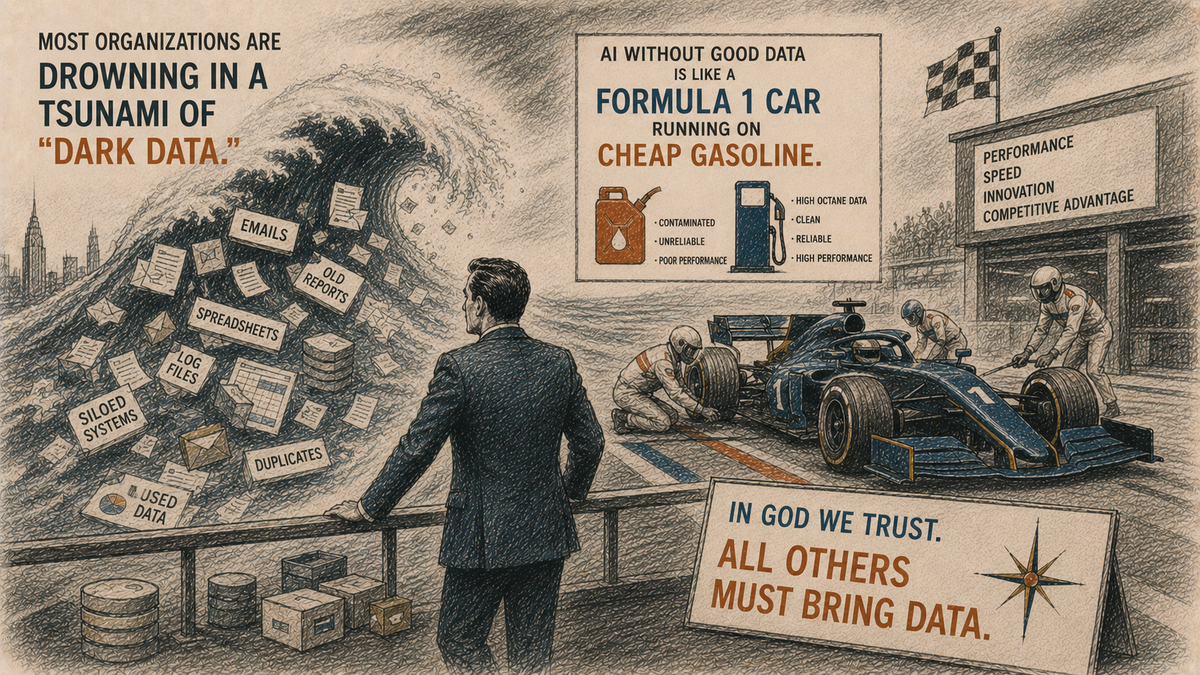
"In God we trust. All others must bring data."— W. Edwards Deming
The most profound business transformations in history have one thing in common: they fundamentally changed how organizations create, manage, and leverage their most valuable assets. The industrial revolution transformed manufacturing through machinery and processes. The information revolution transformed commerce through computing and networks. Now, the AI revolution is transforming everything through one critical asset that most organizations barely understand: their data.
If AI is the engine of the next business revolution, then data is unquestionably its fuel. Not just any fuel—the right fuel, refined properly, delivered consistently, and optimized for performance. Yet here's the uncomfortable truth that should keep every executive awake at night: most organizations are sitting on massive reserves of untapped potential while simultaneously running their AI initiatives on fumes.
The data paradox facing modern businesses is stark. Companies generate more data today than ever before—emails, documents, customer interactions, sensor readings, transaction logs, social media mentions, video calls, chat messages. This data tsunami creates an illusion of abundance. Executives assume they're data-rich when they're actually insight-poor. They confuse having data with having useful data, storing information with understanding it, and collecting metrics with creating value.
This is not merely an academic distinction. The quality, accessibility, and strategic deployment of your data will determine whether your AI initiatives deliver transformational results or expensive disappointments. It will dictate whether you become an AI-powered competitor or become disrupted by one.
The Great Data Awakening
Most organizations treat their data like that cluttered garage you keep meaning to organize. You know there's valuable stuff in there somewhere—tools you spent good money on, materials that could be useful, equipment that might come in handy—but it's all buried under years of accumulation. When you need something specific, you can't find it. When you do find it, it's often broken, outdated, or not quite what you remember.
Now imagine if that garage contained the raw materials for building the future of your business. Would you leave it in chaos?
The first step in any serious AI strategy is conducting what we call a "data awakening"—a systematic audit of what data you actually have, where it lives, how it's structured, and whether it's fit for purpose. This isn't a job for the IT department alone. This requires business leaders who understand the strategic value of different data types and can prioritize based on business impact.
Consider the case of a mid-sized manufacturing company that launched an AI initiative to optimize their supply chain. They assumed they had excellent data because they'd invested heavily in enterprise resource planning (ERP) systems over the past decade. What they discovered during their data awakening was sobering: their inventory data was updated daily, but their supplier performance data was updated monthly. Their quality metrics were precise but only captured formal inspections, missing informal observations from the shop floor. Their customer demand data was detailed but didn't account for seasonal variations in buying patterns.
The result? Their first AI model predicted inventory needs with impressive statistical accuracy but consistently missed the subtle patterns that experienced supply chain managers intuitively understood. The data was technically correct but strategically incomplete.
This experience isn't unusual. It's typical. Organizations invest millions in data collection systems without investing comparable resources in data strategy, data quality, or data accessibility. They focus on the plumbing without considering what needs to flow through the pipes.
Structured vs. Unstructured Divide
Traditional business intelligence focused primarily on structured data—the neat rows and columns of databases, the carefully categorized metrics in dashboards, the precisely formatted reports that could be easily analyzed with conventional tools. This made sense in a world where computing power was expensive and data analysis required specialized skills.
Generative AI has fundamentally changed this equation. For the first time in business history, we can economically extract meaningful insights from unstructured data at scale. Those thousands of customer service emails gathering digital dust in your archives? They contain patterns about product defects, feature requests, and user experience problems that could inform product development for years. The recorded sales calls that nobody ever reviews? They're treasure troves of competitive intelligence, market feedback, and objection handling techniques.
The meeting transcripts, project documentation, internal communications, customer feedback forms, support tickets, and presentation files that organizations generate daily represent an enormous untapped resource. We call this the "Dark Data" problem—information that organizations collect and store but never analyze or act upon.
GenAI transforms this dark data into what we term "illuminated assets." Natural language processing can now extract themes from customer complaints, identify patterns in employee feedback, summarize lengthy documents, and even generate insights from video content. The economic barriers that once made unstructured data analysis prohibitively expensive have largely disappeared.
A global consulting firm discovered this when they applied AI to analyze five years of project retrospective documents. These post-mortem reports had been filed away and largely forgotten, but AI analysis revealed consistent patterns: projects that exceeded budgets by more than 20% almost always shared three specific characteristics that could be identified in the planning phase. Projects that received the highest client satisfaction scores consistently included certain engagement practices that weren't part of the firm's standard methodology. The insights were there all along, buried in thousands of pages of unstructured text that nobody had the time or tools to analyze systematically.
Data Inventory Challenge
Before you can strategically leverage your data assets, you need to know what you have. This sounds obvious, but it's remarkable how many organizations begin AI initiatives without a comprehensive data inventory. They know their transactional data fairly well—customer records, financial information, operational metrics—but they're often completely unaware of the breadth and depth of their unstructured data assets.
A comprehensive data inventory should catalog not just what data you have, but:
Location and Accessibility: Where does the data reside? Is it in cloud storage, on-premises servers, third-party systems, or distributed across multiple platforms? Can it be accessed programmatically, or does it require manual extraction?
Format and Structure: Is it structured (databases, spreadsheets), semi-structured (JSON, XML), or unstructured (documents, emails, media files)? What are the file formats, and are they compatible with modern AI tools?
Volume and Growth: How much data do you have, and at what rate is it growing? Are there storage costs or processing limitations to consider?
Age and Relevance: How current is the data? Is historical data still relevant to current business conditions? Are there regulatory requirements about data retention or deletion?
Quality and Completeness: What's the error rate? Are there missing fields, inconsistent formats, or data quality issues that would impact AI model performance?
Legal and Compliance Status: What are the legal restrictions on this data? Are there privacy regulations, contractual limitations, or intellectual property concerns?
Business Context: What business processes generate this data? Who uses it currently? What business questions could it potentially answer?
One technology company found that they had customer interaction data stored in seventeen different systems—CRM, support tickets, sales communications, product usage logs, marketing automation, survey responses, social media monitoring, and more. Each system captured different aspects of the customer relationship, but no single view brought it all together. Their AI initiative initially focused on improving customer satisfaction, but they quickly realized that understanding customer satisfaction required integrating data across all these touchpoints.
The integration challenge revealed something interesting: customers who appeared satisfied based on support ticket data (quick resolution times, positive ratings) were sometimes churning at high rates. The complete picture required combining support data with usage patterns, sales communications, and even social media sentiment. The AI model trained on this integrated dataset could predict customer churn three months in advance with 85% accuracy—but only because they'd invested the effort to create a comprehensive data inventory first.
Economics of Data Readiness
Many organizations underestimate the cost and complexity of making their data AI-ready. They budget for AI tools, model development, and infrastructure but forget to account for the substantial investment required to clean, organize, and structure their data for machine learning applications.
Data preparation typically consumes 60-80% of any AI project's time and resources. This isn't inefficiency—it's the necessary foundation work that determines project success. Organizations that try to shortcut data preparation invariably face problems later: models that perform well in testing but fail in production, results that look impressive but don't translate to business value, or AI systems that work initially but degrade over time.
The economics become more favorable when you consider data preparation as an investment rather than a cost. Clean, well-organized data supports multiple AI initiatives over time. The customer data integration effort that enables churn prediction can also power personalization algorithms, market segmentation models, and lifetime value calculations. The document analysis infrastructure that extracts insights from legal contracts can also process regulatory filings, competitive intelligence, and internal policy documents.
A financial services company spent six months and considerable resources creating a unified customer data platform that integrated information from their banking, insurance, and investment divisions. The initial use case was improving cross-selling recommendations, but the same data foundation later supported fraud detection, risk assessment, regulatory reporting, and customer service optimization. The data preparation investment paid dividends across multiple business functions.
This is why data strategy must be approached holistically rather than project by project. Organizations that prepare data assets strategically can launch AI initiatives faster, achieve better results, and scale more efficiently than those that treat each AI project as a standalone effort.
Metadata
In the AI era, metadata—data about data—becomes critically important in ways that most organizations don't yet appreciate. Metadata provides the context that allows AI systems to understand not just what the data says, but what it means and how it should be used.
Consider a simple example: a dataset containing customer purchase amounts. Without metadata, an AI model sees numbers. With proper metadata, it understands that these numbers represent revenue in US dollars, were recorded at the time of purchase, exclude taxes and shipping, and reflect completed transactions only. This context dramatically improves model performance and reduces the risk of misinterpretation.
Rich metadata becomes even more crucial when dealing with unstructured data. A document repository might contain thousands of files, but metadata can identify which documents are contracts versus proposals, which are current versus archived, which require special handling due to confidentiality, and which are authoritative versus draft versions.
One manufacturing company transformed their maintenance operations by applying AI to their repair documentation. Technicians had been creating maintenance reports for years, but these reports were filed away without systematic analysis. The AI initiative required developing metadata schemas that captured not just what was in each report, but the context: which equipment, what type of maintenance, environmental conditions, technician experience level, parts availability, and more.
With this metadata framework, AI could identify patterns that were impossible to see otherwise. Certain equipment failures were strongly correlated with specific environmental conditions but only when maintenance was performed by technicians with less than two years of experience. Some "random" failures actually followed predictable patterns when analyzed across multiple variables. The AI system eventually reduced unplanned downtime by 35%, but the real enabler wasn't sophisticated algorithms—it was comprehensive metadata that provided proper context for pattern recognition.
Data Governance
AI amplifies both the value and the risks associated with your data. A small data quality problem that might cause minor reporting errors in traditional systems can completely undermine an AI model's credibility. A privacy oversight that might result in a minor compliance issue in conventional applications can create significant regulatory exposure when data is used to train AI models.
This amplification effect makes data governance not just important but mission-critical for AI success. Data governance in the AI era requires thinking beyond traditional concerns about accuracy and security to include questions about bias, fairness, explainability, and algorithmic transparency.
Consider bias, which can creep into AI systems through data in subtle ways. A hiring algorithm trained on historical employee data might perpetuate past discrimination if the training data reflects biased hiring practices. A credit scoring model might inadvertently discriminate against certain demographic groups if the training data includes proxy variables that correlate with protected characteristics. A marketing optimization system might reinforce stereotypes if it's trained on data that reflects societal biases.
Identifying and mitigating these biases requires governance processes that go far beyond traditional data quality checks. Organizations need frameworks for auditing data for potential bias, testing AI models for fairness across different groups, and monitoring systems for discriminatory outcomes over time.
A healthcare organization learned this lesson when they developed an AI system to prioritize patient care based on historical treatment data. The system performed well in testing, accurately predicting which patients needed immediate attention based on symptoms and medical history. However, when deployed, it consistently under-prioritized certain patient populations who historically had received less aggressive care due to various systemic factors. The AI system had learned to replicate historical treatment patterns rather than optimize for patient outcomes.
The solution required not just technical fixes but governance processes that could identify such issues before deployment. They developed bias testing protocols that evaluated model performance across different patient demographics, created feedback mechanisms that could detect discriminatory outcomes in real-time, and established review processes that involved clinical staff who understood the business context of the AI recommendations.
Integration Challenge
Perhaps the most underestimated challenge in making data AI-ready is integration. Modern organizations generate data in dozens of different systems, formats, and structures. Customer data might exist in CRM systems, e-commerce platforms, customer service tools, marketing automation systems, financial applications, and social media monitoring tools. Each system was designed to solve specific problems and uses different data models, formats, and conventions.
AI initiatives often require combining data from multiple sources to create comprehensive views that enable sophisticated analysis. The customer churn prediction model needs to combine transaction history, support interactions, product usage patterns, and engagement metrics. The supply chain optimization algorithm requires integrating supplier data, inventory levels, demand forecasts, logistics information, and external market conditions.
This integration challenge extends beyond technical compatibility to include semantic consistency. Different systems might use different customer identifiers, date formats, currency codes, or business rules. Sales data might record revenue when deals are signed, while accounting data might record revenue when payments are received. Marketing data might track leads by campaign source, while sales data might track leads by sales representative.
Resolving these inconsistencies requires business knowledge, not just technical expertise. It requires understanding how different parts of the organization define concepts like "customer," "sale," "active user," or "satisfied client." It requires mapping between different coding schemes, reconciling different timing conventions, and establishing authoritative sources for key business entities.
A retail company discovered this complexity when they tried to create a unified view of customer behavior across their physical stores, e-commerce platform, and mobile app. Each channel tracked customers differently: in-store purchases were linked to loyalty card numbers, online purchases were linked to email addresses, and mobile app usage was linked to device identifiers. Some customers used different email addresses for different channels. Some shared loyalty cards with family members. Some made purchases as guests without creating accounts.
Creating a unified customer view required developing sophisticated matching algorithms that could identify when different records referred to the same person, business rules for handling edge cases like shared accounts, and governance processes for maintaining data quality over time. The effort took months and required collaboration between IT, marketing, sales, and customer service teams. But the result enabled personalization capabilities, inventory optimization, and customer lifetime value analysis that were impossible with siloed data.
Real-Time Reality
Modern business moves at digital speed, and AI systems must often operate in real-time or near-real-time to deliver value. This creates data freshness requirements that many organizations are unprepared to meet. Batch processing systems that update data overnight might be adequate for reporting purposes but insufficient for AI applications that need to respond to changing conditions immediately.
Consider fraud detection, where delays measured in minutes can mean the difference between stopping fraudulent transactions and accepting significant losses. Or inventory management, where real-time demand signals can prevent stockouts or reduce excess inventory. Or personalization systems, where recommendations based on stale data miss opportunities to engage customers effectively.
Meeting real-time data requirements often necessitates significant infrastructure investments in streaming data platforms, real-time processing capabilities, and low-latency storage systems. But the infrastructure is only part of the challenge. Organizations must also develop business processes that can consume and act on real-time insights, governance systems that can maintain data quality at speed, and monitoring capabilities that can detect problems before they impact business operations.
A transportation company learned this when they developed an AI system for dynamic pricing based on real-time demand and supply conditions. The algorithm worked beautifully in testing, adjusting prices based on demand patterns, competitor pricing, and capacity utilization. However, the data infrastructure was built for batch processing, with pricing data updated every four hours. In rapidly changing market conditions, four-hour-old data might as well have been four days old. By the time the pricing algorithm responded to demand spikes, the opportunity had often passed.
The solution required rebuilding their data infrastructure to support real-time data streaming, implementing new monitoring systems to ensure data quality at speed, and retraining operations teams to work with dynamic rather than static pricing models. The investment was substantial, but the improved revenue optimization capabilities paid for the infrastructure investment within six months.
Leadership Must Get Religion
Technical solutions alone cannot address the data challenges facing AI initiatives. Success requires cultural changes that make data literacy, data quality, and data sharing organizational priorities rather than IT responsibilities. But here's the uncomfortable truth: the single most critical aspect of data strategy is that the highest levels of the organization must genuinely appreciate that they need one—and this needs to be part of the culture of the firm, not just hollow words.
We've all witnessed organizations where leadership pays lip service to being "data-driven" while continuing to make decisions based on gut instinct, politics, or whoever speaks loudest in the room. They think they have a data strategy because they hired a Chief Data Officer and bought some analytics tools. But real data strategy requires a fundamental shift in how organizations think, operate, and reward behavior.
The wake-up call varies by industry and circumstance. In highly regulated sectors like finance and pharmaceuticals, regulatory pressure provides some motivation. Competitive threats can drive urgency, though in many industries it's unclear what competitors are actually doing until it's too late. But fear alone shouldn't be the primary driver. The most powerful motivator is an enlightenment about the art of the possible—a genuine understanding of what can be accomplished when you truly leverage internal data assets.
This should be obvious, but it isn't to most organizations. It requires thinking differently about data as a strategic asset rather than a operational byproduct. The resistance to this shift can be staggering, even when organizations are arguably leaving tens or hundreds of millions of dollars in potential revenue on the table.
Arrogance Blindness Problem
One of the most dangerous obstacles to data strategy adoption is intellectual arrogance—the belief that certain individuals know better than everyone else simply because they've been doing a job for an extended period. This creates a form of intellectual blindness where leaders dismiss outside input despite having no outside experience themselves. They become convinced of their own brilliance while operating with an increasingly narrow view of the world.
This isn't subtle organizational resistance—it's overt and often nasty. These leaders actively push out people who are different or hold different opinions, creating a self-reinforcing echo chamber that eliminates dissenting voices. The more they eliminate opposing viewpoints, the more convinced they become of their own superiority. It's an organizational death spiral disguised as confident leadership.
The intellectual blindness usually bursts only when outside forces beyond their control intervene. Eventually, market conditions change, competitors emerge, or accumulated bad decisions catch up with them. By then, it's often too late to recover the lost ground.
CEO's Strategy Imperative
If you're a CEO who has experienced this data strategy enlightenment, the first action is to communicate this priority throughout the entire organization and make it crystal clear that any impediments will be dealt with swiftly. This cannot be a trickle-down message that gets diluted through layers of management. Communication needs to be direct, clear, and unambiguous. Your subordinates must understand that data strategy implementation is not optional and needs to happen immediately.
The next step is crafting execution plans while ensuring that incentives—financial and otherwise—align with corporate goals. Those who don't embrace the new direction can leave willingly or otherwise. This sounds harsh, but transformation requires commitment from everyone, especially leadership.
To prove you're serious, create direct communication channels where people can share ideas and concerns without fear of repercussion. This might be a dedicated hotline, email address, secure messaging channel, or collaboration platform. Yes, it's time-consuming for executives, but it's essential. The message must be clear: the CEO is not only serious about data strategy but is accessible directly, not through fifteen layers of management. This sends a subtle but powerful signal that everyone needs to get on board.
Communication
This direct communication approach is crucial because when CEOs make themselves inaccessible or route communication through management layers, every layer interprets the message their own way. Middle managers suddenly become "CEO whisperers," controlling information flow to maintain their power and relationships. They don't want their people going around them because direct access threatens their gatekeeping authority.
But here's the critical caveat: creating a communication channel and then not responding to it destroys any remaining trust. It becomes just another management trick. Employees need encouragement to say exactly what's on their minds with no fear of repercussions, complete privacy, and mandatory confidentiality. HR cannot be part of this process—they have no place in these communications. Most employees loathe HR and see them as the enemy, speech police who patrol, filter, and censor information rather than facilitate honest dialogue.
The CEO must be the only one seeing these messages and the only one responding. When someone overcomes their fear to speak truth to power and receives only silence, it's not just professional disappointment—it's personal betrayal. It's like telling your partner something deep that's bothering you to improve the relationship and being completely ignored. It's brutal and devastating to trust.
Employee surveys often represent this communication theater—management goes through the motions of asking for feedback but never responds meaningfully, so employees learn to ignore them as corporate performance art.
Speed of Cultural Change
With the right incentives and clear consequences, organizational change can happen remarkably fast. The size and complexity of the organization matter, but transformation doesn't have to take years. Sometimes it requires pushing people out to demonstrate that the new message is serious, but change can accelerate quickly when people understand the stakes.
Think about it: when someone receives news that their arteries are blocked due to poor lifestyle choices, some get the message immediately and change their behavior overnight. Organizational behavior can shift similarly when the consequences are clear and the incentives are properly aligned.
However, there must be a robust feedback loop. If the CEO opens direct communication lines but nothing happens with the information received, old habits return immediately. Leaders must be extremely engaged and responsive. It doesn't require responding to everyone, but enough responses to send a clear message to the rank and file that their input matters. Some CEOs respond to texts from frontline employees in real-time—this sends an incredibly powerful signal that real change is happening.
A consumer goods company demonstrated this transformation when they democratized access to customer feedback data while implementing direct CEO communication channels. Previously, customer insights were filtered through market research reports and multiple management layers. The AI initiative required making raw data accessible to product teams while creating direct pathways for employee insights to reach leadership.
The combination of data access and direct communication transformed their product development process. Product teams could identify customer needs directly from feedback data while also sharing operational insights directly with leadership. They spotted emerging trends months before competitors and solved implementation problems faster because frontline employees could communicate obstacles directly to decision-makers without bureaucratic interference.
Future of Data Strategy
As AI capabilities continue to evolve, the strategic importance of data will only increase. Organizations that build strong data foundations today will have significant advantages in developing and deploying future AI capabilities. Those that continue to treat data as an afterthought will find themselves increasingly disadvantaged.
The next generation of AI systems will require even higher quality data, more sophisticated integration capabilities, and more robust governance frameworks. Multimodal AI systems that combine text, image, audio, and video data will create new integration challenges. Agentic AI systems that can take autonomous actions will require even more rigorous data quality and bias testing. Federated learning approaches that train models across multiple organizations will require new frameworks for data sharing and privacy protection.
Organizations should be preparing for these future requirements now by building flexible, scalable data infrastructures that can evolve with advancing AI capabilities. This means investing in modern data platforms that can handle diverse data types, implementing governance frameworks that can scale across different AI applications, and developing organizational capabilities that can adapt to changing requirements.
The companies that emerge as AI leaders will be those that recognize data as their most strategic asset and invest accordingly. They will treat data preparation not as a necessary evil but as a competitive advantage. They will build organizational capabilities around data that extend far beyond the IT department. They will create cultures that value data quality, data sharing, and data-driven decision making.
Data Imperative
The harsh reality is that AI without good data is like a Formula 1 race car running on cheap gasoline—it might move, but it won't deliver the performance you're paying for. Organizations can spend millions on AI tools, hire the best data scientists, and implement the most sophisticated algorithms, but if the underlying data is poor quality, incomplete, or inappropriate for the use case, the results will be disappointing.
The data imperative for AI success is clear: organizations must treat data as a strategic asset that requires active management, substantial investment, and executive attention. This means conducting comprehensive data inventories, investing in data quality and integration capabilities, implementing robust governance frameworks, and building organizational cultures that value data literacy and data sharing.
The time for treating data as an IT problem is over. Data strategy must become business strategy, with the same level of attention and resources that organizations dedicate to other critical assets. The organizations that understand this imperative and act on it will be the ones that successfully harness AI to transform their businesses. Those that don't will find themselves increasingly outcompeted by organizations that do.
Your data is the foundation of your AI future. How solid is that foundation today? More importantly, what are you doing to strengthen it for tomorrow? The answers to these questions may well determine whether your organization thrives or struggles in the AI-powered economy that's rapidly emerging.
The data revolution is here. The question isn't whether you'll participate—it's whether you'll lead or follow. The choice is yours, but the time to choose is now.