Chapter 7: Recognizing AI Success
The most profound AI victories happen quietly under your nose. How to measure the true impact of augmented intelligence when traditional metrics fail to capture the magic.
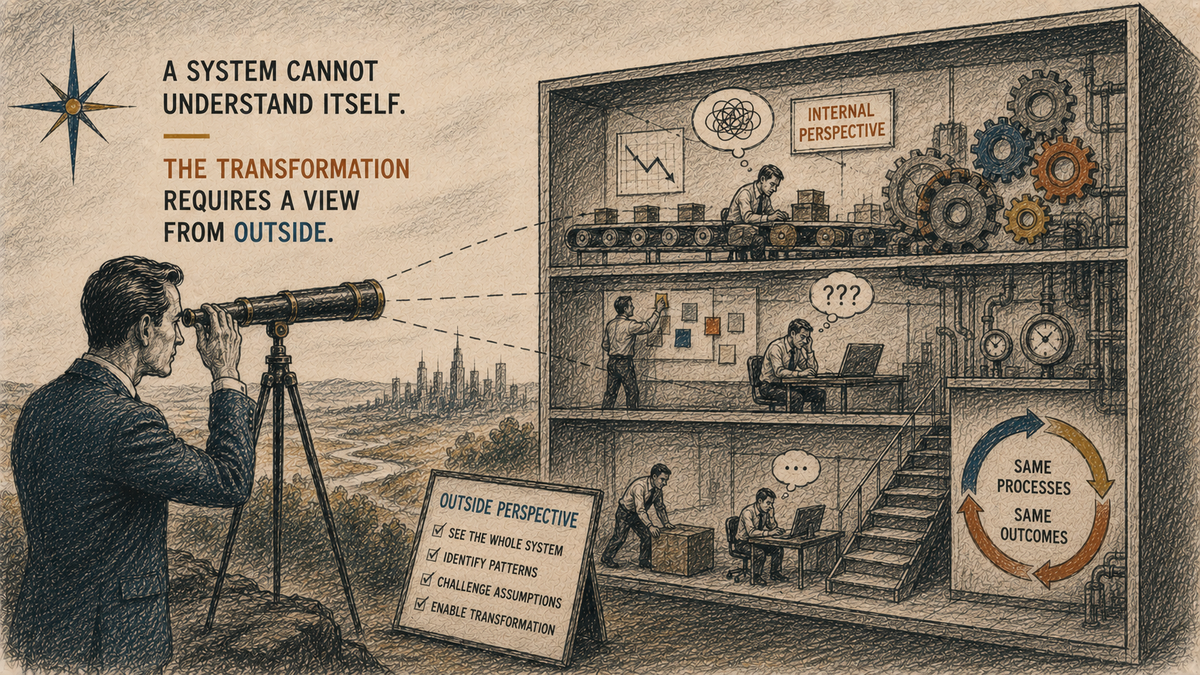
"A system cannot understand itself. The transformation requires a view from outside." — W. Edwards Deming
The question sounds almost absurd at first glance. Of course you would know if your AI initiatives were successful, right? After all, you're a seasoned executive who has navigated countless technology implementations, market expansions, and organizational transformations. You know success when you see it.
But here's the uncomfortable truth: AI success doesn't always announce itself with fanfare. It doesn't always come wrapped in the familiar metrics that have guided your decision-making for decades. In fact, some of the most profound AI successes might be happening right under your nose, while you're looking elsewhere, waiting for the wrong signals.
Consider this scenario: Your customer service team has been piloting an AI-powered chatbot for six months. The usage statistics show steady adoption. The customer satisfaction scores remain stable. But here's what the numbers don't capture—your human agents are now handling thirty percent more complex cases because the AI is successfully filtering out routine inquiries. They're more engaged, learning new skills, and retention has quietly improved. Customer resolution times for complex issues have shortened, but this improvement is buried in aggregate metrics that also include the routine cases now handled by AI.
Is this success? Absolutely. Would your traditional measurement systems have flagged it as such? Probably not.
This is the paradox of AI measurement in the modern enterprise. We're trying to measure a fundamentally different kind of technology with measurement systems designed for a different era. It's like trying to evaluate the internet's impact using only telephone call metrics. The tools are inadequate for the task.
But perhaps more fundamentally, we're discovering that AI is exposing a measurement problem that has plagued knowledge work for decades: the challenge of measuring human intellectual productivity when variation between individuals and tasks makes meaningful comparison nearly impossible. W. Edwards Deming, the quality management pioneer who transformed manufacturing, understood this challenge intimately. His famous Red Bead Experiment demonstrated that apparent differences in worker performance were often just statistical variation within a flawed system, not meaningful differences in individual capability.
For decades, knowledge work has been running its own version of the Red Bead Experiment. We've been trying to measure and rank knowledge workers—marketers, consultants, analysts, developers—based on outcomes that are largely determined by system variation rather than individual performance. One software developer might complete a feature in three days while another takes two weeks, but the complexity, requirements clarity, technical debt, and countless other variables make direct comparison meaningless. Yet organizations continue to attempt these comparisons, leading to frustration and misguided performance management.
AI changes this equation fundamentally. By reducing human variation in knowledge work processes while preserving human creativity and judgment, AI creates the possibility of applying Deming's statistical process control principles to intellectual work for the first time in business history.
Measuring What Matters
The breakthrough insight here is that AI models themselves can become powerful tools for measuring consistency and work output. Consider the revolutionary possibility: the same AI systems that are augmenting human work can simultaneously analyze and measure the patterns, quality, and consistency of that work. This creates a feedback loop that was impossible in traditional knowledge work environments.
In Deming's Red Bead Experiment, workers drew beads from a container, with the number of red beads representing defects. Deming demonstrated that the variation in red bead counts between workers was purely random—a function of the system, not worker skill. The workers blamed for poor performance were simply victims of statistical variation. The profound lesson was that you cannot meaningfully measure individual performance within a system that contains high inherent variation.
Knowledge work has been trapped in its own version of this experiment for decades. The marketing manager who produces a mediocre campaign isn't necessarily less skilled than one who produces a brilliant campaign—they might simply be working with different constraints, audiences, timing, or market conditions. The software developer who takes longer to complete a feature might be dealing with legacy code complexity, unclear requirements, or integration challenges that aren't visible to management.
AI fundamentally changes this dynamic by standardizing much of the variable execution work while amplifying human creativity and strategic thinking. When AI handles content generation, initial analysis, routine coding, and other standardizable tasks, the remaining human contribution becomes much more measurable and comparable. The marketing manager's strategic thinking, creative direction, and audience insight become the differentiating factors, while AI ensures consistent execution quality.
This creates what we might call "statistical knowledge work"—intellectual processes that finally contain enough consistency to be meaningfully measured, analyzed, and improved using rigorous statistical methods. AI doesn't just improve knowledge work productivity; it makes knowledge work productivity measurable for the first time.
The implications are profound. Organizations can begin applying process capability studies to content creation, statistical control charts to research analysis, and continuous improvement methodologies to strategic planning. The same quality management principles that revolutionized manufacturing can finally be applied to the intellectual processes that drive modern business value.
Separating True Skill from Execution Variation
Your insight about AI helping to tease apart genuine human skills from execution inconsistencies is particularly profound. Consider a highly creative strategist who struggles with writing but has exceptional conceptual thinking abilities. In traditional knowledge work environments, this person's contributions might be undervalued because their ideas are poorly communicated. The brilliant insights get lost in clumsy execution.
With AI assistance, this same strategist can focus on what they do best—generating innovative concepts and strategic frameworks—while AI handles the writing, formatting, and presentation aspects where they struggle. Suddenly, their true value becomes visible and measurable. The organization can separate strategic thinking capability from communication execution, measuring each component appropriately.
This separation of creative thinking from execution consistency is one of AI's most transformative effects on knowledge work measurement. We can finally measure what we actually want to measure: human insight, creativity, judgment, and strategic thinking, rather than getting distracted by execution variables that obscure true capability.
Most organizations approach AI measurement the same way they approach any technology investment: through the lens of traditional ROI calculations, implementation milestones, and user adoption rates. These metrics aren't wrong, but they're woefully incomplete when it comes to AI.
The executive who proudly reports that their AI tool has achieved eighty percent user adoption might be missing the more important question: what are those users actually accomplishing with the tool that they couldn't do before? The finance team that celebrates a positive ROI calculation based on reduced processing time might be overlooking the fact that the AI has enabled their analysts to tackle entirely new categories of problems that were previously impossible to address.
The problem with traditional metrics is that they measure efficiency gains in existing processes rather than the expansion of capabilities that AI truly offers. It's the difference between measuring how much faster you can travel on foot versus recognizing that you've just invented the automobile.
Take the case of a mid-sized manufacturing company that implemented an AI-powered predictive maintenance system. Six months in, the traditional metrics looked disappointing. The system had a modest impact on overall equipment downtime, and the cost savings were barely covering the investment. The project seemed like a candidate for the chopping block.
But a deeper analysis revealed something remarkable: while overall downtime hadn't dramatically decreased, the nature of the downtime had fundamentally changed. Catastrophic equipment failures—the kind that shut down entire production lines for days—had virtually disappeared. The AI was identifying potential issues early enough to schedule planned maintenance during off-hours. The company hadn't just improved efficiency; they had transformed their entire approach to equipment reliability. The value wasn't just in the cost savings; it was in the risk mitigation and the strategic flexibility that came from predictable operations.
Traditional ROI calculations would have missed this entirely.
Measurement Framework That Actually Matters
Recognizing AI success requires a more sophisticated measurement framework—one that captures not just what you're doing differently, but what you're now capable of doing that was previously impossible or impractical.
This framework operates on three levels: efficiency gains, capability expansion, and strategic transformation. Each level requires different metrics and different timeframes for evaluation.
Efficiency gains are the most straightforward to measure and the most familiar to traditional business measurement. These include the classic metrics: time saved, costs reduced, errors eliminated, and processes accelerated. If your AI implementation is working at this level, you should see measurable improvements in existing workflows within the first few months of deployment.
But here's where many organizations make their first critical mistake: they stop measuring at the efficiency level. They declare victory when they've achieved their projected cost savings and move on to the next initiative. In doing so, they miss the real value that AI can deliver.
Capability expansion is where AI begins to show its true potential. This is about doing things that were previously impossible or impractical given your resource constraints. It's the insurance company that can now analyze unstructured data from claims adjusters' notes at scale, identifying fraud patterns that human reviewers would never have the time to spot. It's the retail company that can now provide personalized product recommendations based on real-time analysis of customer behavior across multiple channels.
Measuring capability expansion requires different metrics. Instead of asking how much faster you're doing existing tasks, you need to ask what new tasks you're now able to undertake. What insights are you generating that weren't possible before? What decisions are you making with greater confidence? What opportunities are you pursuing that you couldn't have even considered six months ago?
The challenge with capability expansion metrics is that they often don't have historical baselines for comparison. You can't measure how much better you are at something you've never done before. This requires organizations to develop new measurement approaches, often involving proxy metrics or qualitative assessments that capture the expanded scope of possibilities.
Strategic transformation is the most profound level of AI impact, but also the most difficult to measure in traditional terms. This is where AI doesn't just improve what you do—it changes what business you're in. It's Amazon's transformation from an online bookstore to a cloud computing giant, enabled in part by the AI and machine learning capabilities they developed to optimize their own operations. It's Netflix's evolution from a DVD-by-mail service to a content creation powerhouse, driven by their sophisticated recommendation algorithms and content analytics.
At this level, success metrics might include new revenue streams, market position changes, or competitive advantages that would be impossible without AI capabilities. But these transformations often take years to fully manifest, and the causal relationships between AI investments and business outcomes can be complex and indirect.
The Qualitative Dimension: Stories Behind the Numbers
Numbers tell part of the story, but AI success often reveals itself through qualitative changes that are harder to quantify but no less important. These are the stories that emerge from the trenches—the daily experiences of the people who work with AI tools and the customers who benefit from AI-enhanced services.
Consider the story of a financial advisory firm that implemented an AI system to help their advisors prepare for client meetings. The quantitative metrics showed a modest improvement in meeting preparation time and a slight increase in client satisfaction scores. But the real story emerged from conversations with the advisors themselves.
They reported feeling more confident in their recommendations because the AI was surfacing relevant research and market insights they might have missed. They were spending less time on routine data gathering and more time on high-value activities like strategic planning and relationship building. Most importantly, they were having different conversations with their clients—deeper, more insightful discussions about long-term financial goals rather than reactive conversations about market movements.
The clients, meanwhile, began commenting on the quality of the advice they were receiving. They felt that their advisors were better prepared and more knowledgeable. Some clients started referring friends and family members at a higher rate than before, though this increase couldn't be directly attributed to the AI system in any traditional measurement framework.
This is what authentic AI success often looks like: a collection of small but meaningful improvements in human performance that compound over time into significant business value. The challenge is that these improvements often happen gradually and may not be immediately visible in aggregate metrics.
Depth of Engagement Statistics
One of the most common measurement mistakes organizations make is conflating usage with value. High adoption rates might make executives feel good about their AI investments, but they tell you nothing about whether those investments are actually creating value.
Consider two scenarios: In Company A, ninety percent of employees have logged into their new AI-powered research tool at least once in the past month. In Company B, only sixty percent of employees have used their AI tool, but those who do use it spend an average of two hours per day with it and report that it has fundamentally changed how they approach their work.
Which company is getting more value from their AI investment? The answer should be obvious, but many organizations would celebrate Company A's higher adoption rate while overlooking Company B's deeper engagement.
True AI success is measured not just by how many people use a tool, but by how deeply it integrates into their workflow and how significantly it enhances their capabilities. This requires metrics that go beyond simple usage statistics to examine patterns of engagement, depth of use, and behavioral changes.
Some organizations have found success with metrics like "AI-assisted decision rate"—the percentage of important decisions that are made with AI support rather than intuition alone. Others track "capability reach"—the number of new problems or opportunities that employees tackle with AI assistance that they wouldn't have attempted before.
One technology company measures what they call "AI confidence scores"—regular surveys asking employees how confident they feel in their abilities to handle complex challenges, with separate tracking for AI-assisted versus traditional approaches. Over time, they've seen a significant increase in confidence scores for AI-assisted work, along with employees voluntarily taking on more challenging projects.
Learning from What Doesn't Work
Perhaps counterintuitively, some of the most valuable insights about AI success come from understanding and analyzing failures. But this requires a fundamental shift in how organizations think about failure in the AI context.
Traditional technology implementations have clear success and failure states. Either the system works as intended, or it doesn't. Either users adopt it, or they don't. But AI exists in a more nuanced space where partial success, unexpected outcomes, and evolving capabilities are the norm rather than the exception.
A global consulting firm learned this lesson when they implemented an AI system to help with proposal writing. The initial results were disappointing—the AI-generated content was often generic and required significant editing. By traditional measures, the project was a failure. Response quality scores were low, and many consultants preferred to write proposals from scratch rather than edit AI output.
But rather than abandoning the initiative, the firm took a different approach. They studied the specific failures to understand what was going wrong. They discovered that the AI was actually quite good at generating initial frameworks and identifying relevant case studies, even though its prose was weak. They also found that junior consultants were getting much more value from the tool than senior consultants, because it helped them understand the structure and key elements of effective proposals.
Armed with these insights, they redesigned their approach. Instead of using AI to generate complete proposal sections, they used it to create outlines and suggest relevant content. They also implemented a mentoring program where senior consultants worked with junior staff to refine AI-assisted proposals. The result was a system that improved both proposal quality and professional development outcomes—neither of which had been original objectives.
This story illustrates a crucial principle: AI failures are often not failures of the technology, but failures of implementation approach or measurement framework. Organizations that are serious about AI success need to develop sophisticated approaches to failure analysis that go beyond simple post-mortem reviews to extract actionable insights for improvement.
Measuring Long-Term Value Creation
One of the most challenging aspects of measuring AI success is that much of the value comes from compound effects that build over time. Unlike traditional technology investments that often have immediate and discrete impacts, AI value tends to accumulate gradually through improvements in decision-making, enhanced capabilities, and expanded opportunities.
Consider a retail company that implements AI-powered demand forecasting. The immediate impact might be a modest improvement in inventory management and a slight reduction in stockouts. But over time, the compound effects become much more significant.
Better demand forecasting leads to improved supplier relationships because orders become more predictable. This results in better pricing and terms. The improved inventory management frees up working capital that can be invested in new product lines or store improvements. The reduction in stockouts improves customer satisfaction, leading to increased loyalty and word-of-mouth referrals. The AI system also generates insights about customer preferences and market trends that inform product development and marketing strategies.
None of these compound effects would be captured in a traditional six-month ROI calculation, but they represent the real value of the AI investment. Measuring this kind of value requires longer-term tracking and the ability to trace indirect causal relationships between AI capabilities and business outcomes.
Some organizations address this challenge by creating "AI value trees"—visual representations of how AI capabilities connect to business outcomes through multiple pathways and feedback loops. These tools help executives understand the full scope of AI impact and make more informed decisions about continued investment and expansion.
Cultural Indicators
While quantitative metrics are important, some of the most telling indicators of AI success are cultural and behavioral changes within the organization. These soft metrics often predict long-term success better than traditional financial measures.
One of the most important cultural indicators is what could be called "AI curiosity"—the degree to which employees proactively explore new ways to use AI tools and capabilities. In organizations where AI initiatives are truly successful, you see employees experimenting with AI applications beyond their formal job requirements, sharing insights about effective AI use with colleagues, and proposing new AI-enabled solutions to business challenges.
Another key indicator is "intelligent skepticism"—the ability of employees to critically evaluate AI outputs and make informed decisions about when to trust, modify, or override AI recommendations. Organizations where employees blindly accept AI suggestions or categorically reject AI input are both heading for trouble. Success requires a sophisticated understanding of AI capabilities and limitations.
A third cultural indicator is "collaborative intelligence"—the seamless integration of human and AI capabilities in daily work. In successful AI implementations, employees don't think of themselves as either using AI or not using AI; they think of themselves as working with an intelligent tool that enhances their capabilities. The boundary between human and AI contributions becomes fluid and natural.
One global professional services firm tracks these cultural indicators through regular pulse surveys that ask employees about their confidence in working with AI, their willingness to experiment with new AI applications, and their ability to effectively combine AI insights with human judgment. They've found that these cultural metrics are stronger predictors of long-term AI value than traditional utilization or efficiency metrics.
Measuring Against Competitive Reality
Perhaps the most important dimension of AI success measurement is the competitive context. The value of your AI capabilities isn't determined in isolation—it's determined relative to what your competitors are achieving and what your customers are experiencing elsewhere in the market.
This creates a measurement challenge that goes beyond internal metrics to include market intelligence and competitive analysis. Are you improving faster than your competitors? Are you maintaining your competitive position in areas where AI is becoming table stakes? Are you developing AI capabilities that create genuine competitive advantages?
A major bank learned this lesson when they celebrated achieving industry-average performance on their AI-powered fraud detection system. The celebration was short-lived when they discovered that several competitors had moved significantly beyond industry averages and were using their superior fraud detection capabilities as a competitive advantage in customer acquisition. What had seemed like success in internal metrics was actually a competitive failure.
This experience led them to develop what they call "competitive AI benchmarking"—a systematic approach to understanding how their AI capabilities compare to best-in-class competitors across multiple dimensions. They track not just their own improvements over time, but their relative position in the market and the pace at which they're closing or expanding gaps with competitors.
Building Your AI Success Recognition Framework
Creating an effective framework for recognizing AI success requires combining multiple measurement approaches and accepting that AI value manifests differently than traditional technology value. The framework should include immediate efficiency metrics, medium-term capability expansion indicators, long-term strategic impact measures, qualitative cultural assessments, and competitive positioning analysis.
But perhaps most importantly, the framework should be designed for learning and adaptation. Your understanding of what constitutes AI success will evolve as your AI capabilities mature and as the technology landscape continues to advance. The measurement framework that works for your pilot projects may be inadequate for enterprise-scale implementations. The metrics that matter for generative AI applications may be different from those that apply to predictive analytics or autonomous systems.
The organizations that will ultimately achieve the greatest success with AI are those that invest as much thought and resources into measuring and recognizing AI value as they do into implementing AI capabilities. They understand that if you can't recognize success, you can't replicate it, scale it, or learn from it.
The question isn't whether your AI initiatives are creating value—they almost certainly are, in ways both obvious and subtle. The question is whether you're sophisticated enough in your measurement approach to recognize that value when you see it, and wise enough to build on it systematically.
Because in the end, the companies that master the art of recognizing AI success will be the ones that achieve AI transformation. And the companies that don't will be left wondering why their AI investments never seemed to pay off, even as more perceptive competitors pull further ahead.
The measurement framework you build today will determine not just how you evaluate your current AI initiatives, but how effectively you'll navigate the AI-driven business landscape of tomorrow. The question is: when AI success walks through your door, will you recognize it for what it is?