Chapter 6: Ignorance Is Not Bliss
Playing the "fast follower" was once prudent business. In the AI era, waiting for the dust to settle is corporate negligence that courts irrelevance.
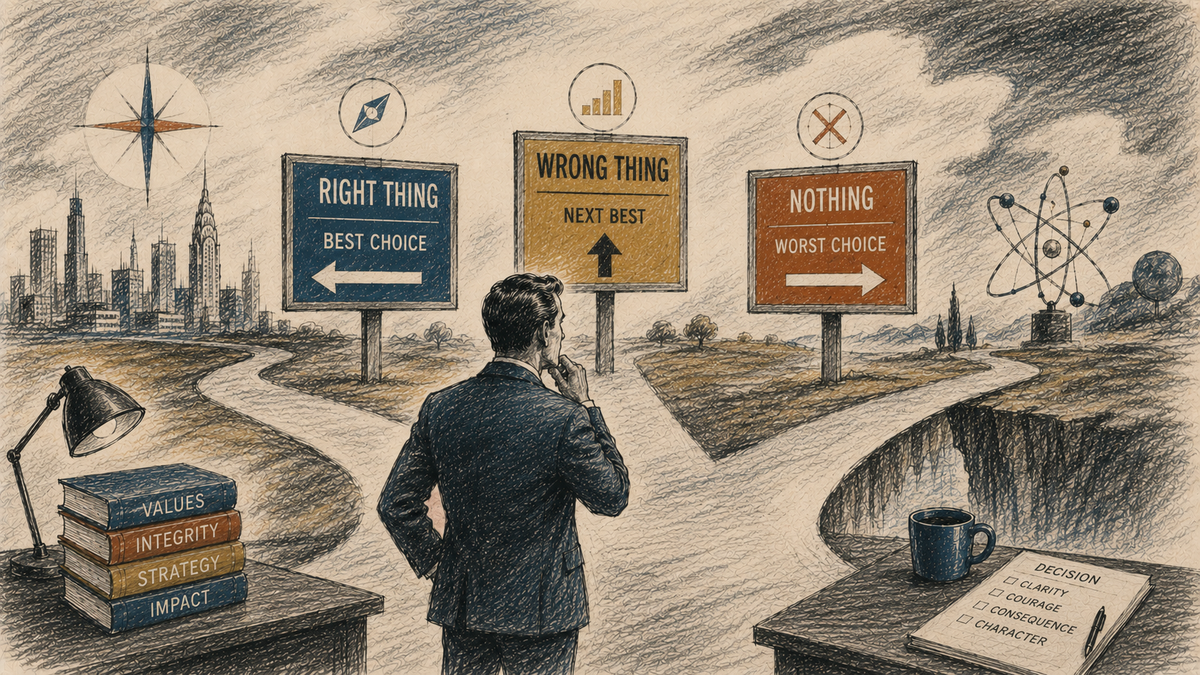
"In any moment of decision, the best thing you can do is the right thing, the next best thing is the wrong thing, and the worst thing you can do is nothing." — Theodore Roosevelt
Executive's Dilemma
Imagine you are sitting in your corner office, reviewing quarterly reports that show steady, if unspectacular, growth. Your company has weathered multiple economic storms, adapted to digital transformation, and maintained market position through careful, measured decisions. The temptation to view AI as just another technology trend—something to monitor but not urgently act upon—feels reasonable, even prudent.
This perspective, while understandable, represents one of the most dangerous strategic miscalculations a leader can make in the modern business era.
The harsh reality is that organizational inaction on AI isn't just a missed opportunity; it's corporate negligence that can lead to existential business threats. Unlike previous technological shifts that allowed for gradual adoption curves, the AI revolution is compressing the gap between early adopters and laggards at an unprecedented pace. What once might have been a five-year competitive advantage window has shrunk to eighteen months or less.
Consider the fate of Kodak, a company that actually invented the digital camera in 1975 but chose to suppress the technology to protect its lucrative film business. When digital photography finally disrupted the market, Kodak's delay proved fatal. The company that once dominated photography filed for bankruptcy in 2012. And while it managed to survive that bankruptcy filing it is now, yet again, threatening to file for bankruptcy in 2025. Now imagine that same dynamic, but accelerated by AI's exponential improvement curve and playing out across every industry simultaneously.
Myth of "Wait and See"
Many executives justify inaction by labeling AI a "wait and see" technology. They argue that letting others take the risks while they learn from early adopters' mistakes represents sound business judgment. This reasoning would be valid if AI were following traditional technology adoption patterns, but it fundamentally misunderstands the nature of this transformation.
AI differs from previous business technologies in three critical ways that make the "wait and see" strategy not just ineffective, but dangerous:
First, AI is a force multiplier, not just a tool addition. Unlike implementing a new CRM system or upgrading accounting software, AI doesn't simply digitize existing processes—it fundamentally amplifies human capability across every business function. When your competitors begin leveraging AI to enhance their decision-making speed, improve their customer insights, and automate complex workflows, they're not just gaining efficiency; they're operating at a fundamentally different competitive level.
Second, AI learning curves are asymmetric. The gap between AI novices and AI-proficient organizations doesn't grow linearly—it compounds exponentially. Each month of AI experience builds organizational knowledge that accelerates future AI adoption. Meanwhile, organizations without AI experience find themselves not just behind, but increasingly unable to bridge the gap as the complexity and sophistication of AI applications advance.
Third, AI creates network effects and data advantages. Companies using AI generate better data, which improves their AI models, which generates even better data, creating a virtuous cycle that becomes increasingly difficult for competitors to disrupt. The longer you wait to enter this cycle, the more challenging it becomes to achieve competitive parity.
Dr. Michael Porter, in his seminal work on competitive strategy, emphasized that competitive advantage often comes from doing things differently, not just doing them better. AI represents the most significant "different way" of conducting business since the internet revolution, and perhaps more transformational than even that shift.
Fast Followers Become Laggards
Traditionally, business literature celebrated the "fast follower" strategy—letting pioneers absorb the risks and costs of innovation while quickly adopting proven technologies once the market validated them. This approach worked well when technology adoption cycles measured in years provided ample time to catch up.
AI has fundamentally destroyed this model.
The pace of AI advancement means that what seems cutting-edge today becomes standard practice within months, not years. GPT-4 was revolutionary in March 2023; by late 2024, reasoning models like OpenAI's o1 were already making it seem quaint. By 2025 GPT-5 and its rumored trillion plus parameters are massive game changers upending entire industries. Companies that considered themselves fast followers are going to find themselves multiple generations behind the technological curve.
Consider the story of Marcus, a regional insurance company that prided itself on being a fast follower. In early 2023, Marcus leadership watched as some competitors began experimenting with AI for claims processing and customer service. "Let them work out the bugs," the CEO told his board. "We'll implement proven solutions in 2024."
By mid-2024, those early adopters weren't just processing claims faster—they were using AI to detect fraud patterns Marcus couldn't see, offering personalized policy recommendations Marcus couldn't match, and automating underwriting decisions with accuracy Marcus couldn't achieve. More dangerously, they were using AI to identify and target Marcus's most profitable customers with precision Marcus didn't possess.
When Marcus finally began their AI initiative in late 2024, they discovered that the "simple implementation" they had envisioned required fundamental changes to their data architecture, significant workforce retraining, and cultural shifts they weren't prepared for. Worse, their competitors had already moved beyond the basic applications Marcus was struggling to implement, leveraging advanced AI agents and reasoning models for strategic planning and market analysis.
By early 2025, Marcus faced a choice between massive investment to catch up or accepting permanent competitive disadvantage. The "fast follower" strategy had become a pathway to irrelevance.
Barriers are collapsing.
Established companies rely on certain competitive moats to protect their market positions: massive codebases, complex regulatory knowledge, established customer relationships, and significant capital requirements. AI is systematically eroding each of these traditional barriers to entry.
Massive Codebases
Legacy software systems that once represented significant competitive advantages are becoming liabilities in the AI era. AI-powered development tools can now generate functional applications in hours or days, while traditional companies struggle with technical debt accumulated over decades.
GitHub Copilot, Cursor, Aider, Claude and similar AI coding assistants have fundamentally changed software development economics. A startup with three skilled developers using AI tools can now build applications that would have required teams of dozens just five years ago. Meanwhile, established companies find their massive codebases actually slow AI adoption because of complexity and integration challenges.
Consider how Replit, an AI-powered development platform, enables users to build complete applications through natural language prompts. What previously required extensive programming knowledge and weeks of development time can now be accomplished in hours by domain experts with no traditional coding experience.
Regulatory Knowledge Democratized by AI
Complex regulatory environments once protected established players who had invested years in building compliance expertise. AI is democratizing this knowledge. Legal AI systems can now analyze regulatory frameworks, identify compliance requirements, and even generate necessary documentation faster than traditional legal teams. Fine-tuned LLMs built on custom knowledge can dramatically drop the cost and time of creating legal documents.
Startups entering heavily regulated industries like healthcare and finance can now leverage AI to navigate regulatory complexity without the massive compliance departments their established competitors maintain. This isn't theoretical. Companies have used AI-enhanced regulatory navigation to compete directly with incumbents who previously relied on regulatory complexity as a protective barrier. Regulatory walls that have been built up over decades with deep institutional knowledge.
Hyper-personalization at Scale
Companies often assumed their existing customer relationships provided competitive protection, but AI has changed this dynamic by enabling hyper-personalized customer experiences at scale. New entrants can use AI to understand customer preferences, predict needs, and deliver individualized service that feels more personal than relationships built over years of traditional interaction.
All communications including e-mails, videos and other content that is personalized uniquely for every customer. No longer are companies sending out mass generic emails that all say the same thing. Now a company based on any previous interactions with the client can create a message in real-time that is enticing and attention grabbing. Imagine having a personalized chatbot that ‘tuned’ to make sure you feel satisfied by your interaction. Tone and depth of voice, language that is aligned with your personality, and even an avatar that looks and acts like a real person. This is not the stuff of fantasy - this is what is here today.
Startups Eat Incumbents' Lunch
The most significant threat to established companies comes not from traditional competitors adopting AI, but from AI-native startups that build their entire business models around artificial intelligence capabilities. These companies don't face the burden of integrating AI into existing systems and processes—they design everything from the ground up to leverage AI's full potential.
Case Study: The Insurance Disruptor
Lemonade, an AI-powered insurance company, illustrates this dynamic perfectly. Founded in 2015, Lemonade built its entire business model around AI and behavioral economics. Rather than trying to retrofit AI into traditional insurance processes, they designed everything—from underwriting to claims processing to customer interaction—to leverage AI capabilities.
The results speak for themselves. Lemonade can issue policies in seconds, process claims in minutes, and operate with dramatically lower overhead than traditional insurers. Their AI handles routine customer interactions, detects fraudulent claims, and personalizes policies in ways that traditional insurers struggle to match even after massive AI investments.
Traditional insurance companies found themselves in an impossible position: maintain legacy systems and processes while trying to compete with a company designed from the ground up for the AI era. The gap wasn't just technological—it was architectural, cultural, and strategic.
The Retail Revolution
Amazon provides perhaps the most famous example of AI-native advantage, but consider newer entrants like Stitch Fix, which uses AI to revolutionize personal styling. Rather than competing with traditional retailers on their terms, Stitch Fix built an entirely AI-driven business model that delivers personalized fashion recommendations and inventory management.
Traditional retailers faced a choice: invest billions in AI transformation while maintaining existing operations, or accept that a startup with a fraction of their resources could deliver superior customer experiences through AI-first design.
Compounding Nature of AI Advantage
AI advantages compound in ways that make late adoption increasingly difficult. Organizations that begin AI adoption early enter a virtuous cycle where each implementation generates data and insights that improve future AI applications. This creates an accelerating advantage that becomes harder for competitors to overcome with each passing month.
Data Network Effects
Every AI interaction generates data that can improve future AI performance. Companies using AI for customer service collect conversation data that enhances their natural language processing capabilities. Organizations using AI for supply chain optimization gather operational data that improves their predictive models. This data advantage compounds over time, creating moats that become increasingly difficult for competitors to cross.
Amazon's recommendation engine illustrates this dynamic perfectly. Every purchase, every click, every search on Amazon's platform improves their recommendation algorithms. After decades of data collection and AI refinement, Amazon's recommendation accuracy has become a competitive advantage that no new entrant can quickly replicate.
Organizational Learning Curves
Adoption isn't just about technology—it requires developing organizational capabilities in data management, AI literacy, change management, and ethical AI governance. These capabilities take time to develop and become increasingly sophisticated with experience.
Organizations that begin building these capabilities early develop institutional knowledge that accelerates future AI adoption. They understand how to identify appropriate use cases, manage projects, measure success, and avoid common implementation pitfalls. This organizational learning creates competitive advantages that pure technology investment cannot quickly overcome.
Cultural and Process Adaptation
Perhaps most importantly, successful adoption requires cultural changes that cannot be purchased or rapidly implemented. Organizations must develop comfort with AI collaboration, trust in algorithmic decision-making, and processes that leverage insights effectively.
Companies that begin this cultural evolution early develop adaptive capabilities that position them to leverage each new AI advancement. Organizations that delay face not just technological catch-up challenges, but fundamental cultural and process transformations that can take years to complete.
It is not hyperbole to stress the importance of starting the adoption process early. There are profound cultural changes that will be brought about by implementing AI systems - especially those that are ‘deeply’ embedded. And what we mean by this is not using AI on the periphery embedded in commercial applications. It is using AI to dramatically rethink core operational processes and procedures. Don’t fall prey to the usual change of just making a process faster by tweaking it with AI. Rethink the process from the ground up - that is deep AI.
The Hidden Costs of Delay
While the direct costs of AI implementation are visible and measurable, the hidden costs of delay are often more significant and harder to quantify. These hidden costs compound over time, making eventual AI adoption more expensive and challenging than early implementation would have been.
Technical Debt Accumulation
Every month an organization delays AI adoption, they accumulate technical debt that makes future implementation more complex and expensive. Legacy systems become increasingly incompatible with modern AI tools. Data silos become more entrenched. Manual processes become more deeply embedded in organizational workflows.
When organizations finally begin AI adoption, they often discover that their technical infrastructure requires fundamental overhauls before AI implementation can begin. What could have been gradual evolution becomes expensive revolution.
Talent Market Dynamics
The AI talent market is highly competitive, with demand far exceeding supply. Organizations that delay AI adoption find themselves competing for talent in an increasingly expensive market. Worse, the best AI talent often prefers working for organizations already committed to AI transformation, creating a talent acquisition disadvantage for late adopters.
Companies beginning AI adoption early can develop internal talent and build reputations as AI-forward organizations, giving them significant advantages in recruiting and retaining AI expertise.
Customer Expectation Evolution
Customer expectations around AI-enhanced experiences are evolving rapidly. Customers interacting with AI-powered customer service, personalized recommendations, and intelligent interfaces begin expecting these capabilities from all their business relationships.
Organizations that delay AI adoption find themselves not just technologically behind, but failing to meet evolved customer expectations shaped by AI-forward competitors.
Building Learning Organizations
The most successful approach to AI adoption recognizes that perfection is the enemy of progress. Rather than waiting for complete understanding or perfect solutions, organizations must begin controlled experimentation and learning immediately.
The Power of Small Starts
AI adoption doesn't require massive initial investments or comprehensive transformation plans. Some of the most successful AI implementations begin with small, focused pilots that generate learning and build organizational confidence.
A mid-sized manufacturing company began their AI journey by using AI to optimize one production line's scheduling. The pilot required minimal investment and posed little risk, but generated significant insights about AI implementation challenges and opportunities. Those insights informed their next AI project, which was more ambitious and successful because of lessons learned from the initial pilot.
Within two years, this manufacturer had AI applications across multiple business functions and had developed internal AI expertise that gave them competitive advantages in their industry. Their "small start" approach proved more effective than competitors' comprehensive AI strategies that remained in planning phases for years.
Failing Forward and The Learning Advantage
Organizations that begin experimentation early inevitably encounter failures and setbacks. Rather than representing wasted investment, these failures provide invaluable learning that improves future AI initiatives.
A financial services firm's first AI project—an automated loan approval system—failed to meet accuracy requirements and was eventually abandoned. However, the project taught them crucial lessons about data quality, model validation, and regulatory considerations that made their next AI project—a fraud detection system—highly successful.
The organization's willingness to "fail forward" gave them competitive advantages over firms that waited for proven solutions. By the time competitors began implementing similar AI applications, this firm had already moved on to more sophisticated AI implementations informed by years of learning.
Building AI Literacy Across the Organization
Perhaps the most important early investment organizations can make is developing AI literacy across their workforce. This doesn't mean teaching everyone to code, but rather building understanding of AI capabilities, limitations, and appropriate applications.
Organizations with high AI literacy identify more opportunities for AI application, implement AI solutions more effectively, and adapt more quickly to new AI developments. This literacy advantage compounds over time, making these organizations increasingly adept at leveraging each new AI advancement.
The Board's Responsibility: When Prudence Becomes Negligence
Board members and senior executives have fiduciary responsibilities that extend far beyond traditional risk management. In the AI era, failing to act aggressively on AI adoption doesn't represent prudent caution—it represents a fundamental breach of fiduciary duty that exposes organizations to existential threats.
The Fiduciary Failure of AI Inaction
Let's be explicitly clear: executives who delay AI adoption while competitors gain insurmountable advantages are failing in their most basic professional responsibilities. When boards discover that management chose comfort over competitive survival, the inevitable question becomes whether these executives are competent to lead in the modern business environment.
This isn't a theoretical concern. Boards are already replacing executives whose risk aversion on AI has exposed their organizations to competitive disadvantage. The executive who spent eighteen months "studying" AI while competitors implemented game-changing applications will find themselves explaining to shareholders why they chose ignorance over action.
The Cognitive Trap: When Risk Aversion Becomes Reckless
Here's the uncomfortable truth that many executives refuse to acknowledge: your traditional risk aversion is no longer prudent—it's reckless negligence that exposes your organization to existential risk. The very qualities that made you successful in stable environments—careful analysis, measured decision-making, preference for proven solutions—have become liabilities in the AI era.
This represents a fundamental cognitive trap. Executives pride themselves on being cautious stewards of shareholder value, but they're applying yesterday's risk frameworks to tomorrow's competitive realities. The result is a dangerous delusion where inaction feels safe while actually guaranteeing competitive irrelevance.
Questions Every Executive Must Answer (But Can't)
If you're still advocating for "prudent waiting" on AI adoption, answer these questions honestly—both to your board and to yourself:
What specific milestone are you waiting for that will signal it's "safe" to begin AI implementation? What market conditions need to change before you'll act? How many competitors need to gain AI advantages before you consider your position untenable?
How will you explain to your board and shareholders that you chose personal comfort over competitive survival? When your organization loses market share to AI-enhanced competitors, what defense will you offer for your inaction?
What's your plan when customers start asking why your service feels antiquated compared to AI-enabled alternatives? How will you justify charging premium prices for inferior experiences?
If AI provides competitive advantages (which it demonstrably does), how do you reconcile delaying adoption with your fiduciary responsibility to maximize shareholder value?
These aren't rhetorical questions—they're professional challenges that demand answers. If you can't provide compelling responses, you're not demonstrating prudent leadership; you're exposing your professional inadequacy.
The 90-Day Reality Check: While You've Been "Studying"
Still believe you have time to wait and see? Consider what happened in just the last 90 days while you've been analyzing and deliberating:
OpenAI released their o1 reasoning models, fundamentally changing AI's problem-solving capabilities. Google launched Gemini 2.0 with agentic capabilities and multimodal reasoning. Anthropic introduced computer use functionality, enabling AI to interact directly with software interfaces. Meta released Llama 3.3, democratizing advanced AI capabilities for smaller organizations.
Microsoft announced Copilot integration across their entire business suite. Salesforce embedded AI agents throughout their platform. Amazon Web Services launched dozens of new AI services. Every major cloud provider reduced AI inference costs while increasing model capabilities.
Meanwhile, AI-native startups secured billions in funding specifically to disrupt incumbent industries. Traditional companies across every sector announced AI transformations. Regulatory bodies issued AI governance frameworks that your organization isn't prepared to meet.
This happened in ninety days. While you've been scheduling meetings to discuss AI strategy, the competitive landscape has fundamentally shifted. How many more 90-day cycles of advancement can your organization afford to miss?
Professional Competence in the AI Era
Here's the blunt assessment many executives need to hear: if you're not driving AI adoption in your organization, you may simply be unqualified for modern executive leadership. The business environment has changed, and leaders who can't adapt should step aside for those who can.
Modern executive competence requires understanding AI's strategic implications, building organizational AI capabilities, and making decisions under technological uncertainty. These aren't optional skills—they're fundamental requirements for leadership in an AI-driven economy.
Boards have a responsibility to evaluate whether their executive teams possess the capabilities necessary for success in the current environment. An executive who consistently delays AI adoption due to personal discomfort or risk aversion is demonstrating fundamental incompetence that threatens organizational survival.
The Executive Replacement Reality: Not If, But When
Let's be explicitly clear about what's coming: boards WILL replace AI-resistant executives. This isn't a theoretical possibility—it's an inevitable consequence of competitive dynamics that will unfold over the next twelve months. If it hasn't happened already in your industry, it's only because boards haven't yet connected organizational AI lag to executive leadership failure. That connection is coming, and when it arrives, the executives who spent years resisting AI transformation will find themselves unemployed.
You can't have someone in charge who has been actively pushing back against the very changes necessary for competitive survival. Playing catch-up is exponentially harder than leading transformation, and boards are beginning to understand that executives who created the AI gap cannot be trusted to close it.
The executive who spent two years advocating for "prudent waiting" while competitors gained insurmountable advantages will not suddenly become the visionary leader capable of aggressive AI implementation when crisis forces action. By then, the organization needs leadership with AI experience, AI credibility, and the track record of successful technology adoption under uncertainty.
The Generational Leadership Crisis
Here's an uncomfortable truth that many senior executives refuse to acknowledge: your age and career stage may disqualify you from leading AI transformation. The older you get, the less likely you are to embrace profound, risky change. This isn't a character flaw—it's a rational response to personal incentives that makes you fundamentally unsuited for the current business environment.
Consider your personal situation honestly: Your wealth is tied up in company stock, making short-term price stability more important than long-term transformation. Your career timeline doesn't provide enough runway to recover from major strategic mistakes. Your professional reputation was built in a stable environment where measured decisions and risk aversion were virtues.
These incentives made sense in previous business cycles, but they're now liabilities that prevent the aggressive action AI transformation requires. If your primary concern is protecting existing value rather than creating new competitive advantages, you're not the right leader for an AI-driven future.
The Consensus-Builder's Trap: When Core Competencies Become Fatal Flaws
Here's the harsh reality most executives refuse to acknowledge: the very skills that got you promoted are now disqualifying you from effective leadership. You rose through the ranks by building consensus, avoiding controversy, and making decisions based on proven precedents. These abilities served you well in stable environments, but they're now professional liabilities that threaten your organization's survival.
Most executives are consensus builders, not decision makers, though this sounds counterintuitive given their titles. You've spent decades learning not to rock the boat, understanding that bold decisions or controversial pronouncements rarely lead to promotion. The corporate system rewarded your ability to find middle ground, build stakeholder alignment, and make incremental progress through careful consultation.
This approach worked because business environments provided time for consensus building and precedents for guidance. You could study how similar companies handled similar challenges, consult with industry peers, and craft strategies based on proven approaches. Risk came from deviating too far from accepted practice, not from failing to innovate quickly enough.
AI has fundamentally broken this operating model. There are no relevant precedents for the transformation speed AI demands. Industry peers are as confused as you are, making consensus building an exercise in shared ignorance. The proven approaches you rely on were developed for technological changes that unfolded over years, not months.
The Decision-Making Crisis
Your instinct to base decisions on past experiences and established precedents has become a cognitive trap. AI represents a discontinuous change that makes historical analysis irrelevant and traditional risk frameworks obsolete. When you apply yesterday's decision-making approaches to today's AI challenges, you're not being prudent—you're being incompetent.
Consider how you typically evaluate new initiatives: extensive analysis, stakeholder consultation, pilot programs, gradual rollout based on proven success metrics. This methodical approach feels responsible, but it assumes you have the luxury of extended evaluation periods that no longer exist.
While you're building consensus around AI strategy, your competitors are implementing AI solutions. While you're studying precedents that don't exist, AI-native startups are defining new competitive realities. While you're managing stakeholder concerns about AI risks, you're creating the existential risk of competitive irrelevance.
The Promotion Paradox
The corporate promotion system systematically selected against the leadership qualities AI transformation requires. Executives who made bold technological bets were often punished for rocking the boat, while those who managed steady incremental progress were rewarded with advancement. The result is a generation of senior leaders psychologically conditioned to avoid exactly the kind of aggressive action AI adoption demands.
You learned that controversial decisions threaten career advancement, so you developed expertise in finding safe middle ground. You discovered that bold pronouncements without stakeholder buy-in led to organizational resistance, so you mastered the art of gradual consensus building. You understood that deviating too far from industry norms invited scrutiny, so you became skilled at following rather than leading.
These lessons served you well in environments where conformity represented safety and innovation carried career risk. But AI has inverted this dynamic. Conformity now represents existential risk, while innovation offers the only path to survival. The very instincts that advanced your career are now threatening your organization's future.
Rethinking Leadership for Discontinuous Change
AI requires a fundamentally different leadership approach that contradicts everything the corporate promotion system taught you. Instead of building consensus, you need to make decisions with incomplete information. Instead of following proven precedents, you need to create new approaches without guarantees of success. Instead of managing stakeholder comfort, you need to drive organizational transformation despite resistance.
This isn't about learning new skills—it's about overriding psychological conditioning developed over decades of corporate advancement. The question isn't whether you can intellectually understand different approaches; it's whether you can emotionally embrace decision-making styles that feel professionally dangerous.
Most executives cannot make this psychological shift because it requires abandoning the very behaviors that defined their professional success. The consensus-building, precedent-following, boat-steadying approach isn't just what you do—it's who you are as a leader. Asking you to suddenly become a bold, precedent-breaking, transformation-driving executive is asking you to become someone fundamentally different.
The Historical Precedent Fallacy: When "Lessons Learned" Become Lessons in Failure
Your reliance on historical precedents has become particularly dangerous in the AI era because there are no relevant precedents for the current transformation. When you look for guidance from previous technological changes, you're studying fundamentally different phenomena that offer misleading lessons about AI adoption timelines and competitive dynamics.
Consider the devastating logic trap many executives fall into. A Fortune 500 CEO recently told his board, "We learned from the dot-com bubble to be cautious with new technology. We won't repeat those mistakes by rushing into AI without proper due diligence." This statement reveals profound misunderstanding of both historical context and current reality. The dot-com bubble was driven by speculation about future business models that didn't exist yet. AI represents deployment of capabilities that demonstrably exist today and are already generating competitive advantages for early adopters.
Another insurance executive justified his company's AI delay by explaining, "We watched companies waste millions on failed ERP implementations in the 2000s. We're taking a measured approach to avoid similar AI implementation disasters." This comparison exposes fundamental ignorance about the nature of AI versus traditional enterprise software. ERP implementations required massive upfront commitments with binary success outcomes. AI adoption can begin with small pilots that generate immediate learning and incremental value, making the risk profiles completely different.
The internet revolution unfolded over decades, providing ample time for careful analysis and gradual adoption. Mobile computing followed predictable adoption curves that allowed for measured responses. Cloud computing offered clear cost-benefit calculations that supported traditional decision-making frameworks. AI is different. The technology improves exponentially rather than linearly. Competitive advantages compound rather than erode gradually. Market disruption happens in months rather than years.
When you apply lessons from previous technology adoptions to AI, you're not being analytically rigorous—you're being intellectually lazy. The precedents you're studying are irrelevant to current circumstances, making your analysis worse than useless because it provides false confidence in inappropriate strategies.
The Change Imperative: Leadership from the Top
The uncomfortable truth is that you cannot change your stripes overnight, but organizational survival demands exactly that kind of rapid transformation. This creates an impossible situation for consensus-building executives who built careers on gradual change management and stakeholder comfort.
AI transformation requires aggressive leadership from the top that fundamentally contradicts traditional corporate change management. The CEO must get completely out of their comfort zone and fully embrace AI adoption, driving organizational commitment through decisive action rather than careful consensus building. This isn't about managing change—it's about forcing change despite organizational resistance.
This means making examples of people who resist AI transformation. When senior executives or department heads try to slow down or derail AI initiatives, they cannot be managed or convinced—they must be removed. The organization needs to understand that AI resistance is not just career limiting; it's career ending.
The traditional approach of bringing skeptics along through education and gradual buy-in becomes a luxury that organizations cannot afford. Time spent convincing resistors is time competitors use to build insurmountable advantages. The message must be clear: embrace AI transformation or find employment elsewhere.
The AI Leadership Audit: Surgical Assessment of Executive Fitness
Boards with the right composition should immediately implement AI leadership audits of their executive teams. This isn't about general management competence—it's about specific psychological and cognitive capabilities required for AI transformation leadership. Most boards lack the expertise to conduct these assessments internally, making external specialists essential.
These audits require consultants specializing in AI implementation and data transformation who understand the specific leadership qualities successful AI adoption demands. Traditional executive assessment tools are inadequate because they evaluate skills optimized for stable environments, not the rapid experimentation and decisive action AI transformation requires.
Psychological evaluation becomes particularly crucial because AI leadership demands cognitive flexibility that contradicts decades of corporate conditioning. Industrial psychologists can assess whether executives possess the psychological profiles capable of abandoning consensus-building for decisive action, embracing uncertainty over precedent-following, and driving organizational change despite resistance.
The audit should specifically evaluate each executive's demonstrated ability to make decisions with incomplete information, comfort with technological uncertainty, willingness to challenge organizational inertia, and capacity for rapid learning in unfamiliar domains. These capabilities cannot be assumed based on traditional executive success metrics.
The External Leadership Solution
Rather than attempting to transform existing consensus-building executives into AI transformation leaders, boards should consider bringing in external AI-native leadership. This approach recognizes that asking career-long consensus builders to suddenly become bold technological decision-makers represents wishful thinking, not realistic change management.
AI-native leaders bring fundamentally different psychological profiles developed outside traditional corporate advancement systems. They're comfortable with technological uncertainty because they've succeeded in environments where uncertainty was constant. They make decisions with incomplete information because they've operated in industries where waiting for complete data meant missing market opportunities entirely.
These leaders understand that AI transformation requires speed over consensus, experimentation over analysis, and decisive action over stakeholder management. They don't need to overcome decades of corporate conditioning because they never developed it in the first place.
The board's responsibility extends to recognizing when existing leadership psychology represents an insurmountable barrier to necessary transformation. Attempting to force psychological change in executives optimized for different environments wastes precious time and virtually guarantees transformation failure.
The Board's Fiduciary Failure
Boards that are not actively evaluating their organization's AI readiness and leadership capabilities are failing in their fundamental fiduciary responsibilities. This isn't a matter of technological preference or strategic timing—it's a basic governance requirement in an era where AI capabilities determine competitive survival.
Here's the governance challenge most boards refuse to acknowledge: if board members themselves lack AI literacy, they cannot effectively evaluate executive AI competence. Boards populated with directors whose own careers predate the AI era are poorly positioned to assess whether their executives possess capabilities for AI leadership. This creates a dangerous cycle where AI-illiterate boards cannot identify AI-incompetent executives, leading to organizational leadership that is fundamentally unprepared for competitive challenges they don't understand.
The fiduciary implications are stark. When boards discover that their organization lost competitive position because they failed to evaluate leadership AI capabilities, shareholders will reasonably question whether directors fulfilled their oversight responsibilities. The "we didn't understand the technology" defense will not protect board members from liability when AI incompetence leads to measurable organizational harm.
Board AI education becomes as critical as executive AI education, but boards must recognize that their traditional governance approaches may be inadequate for AI oversight. The questions boards should ask, the metrics they should monitor, and the strategic decisions they should oversee all require AI-specific knowledge that most current directors don't possess.
Cognitive Flexibility Versus Corporate Conditioning: The Leadership Incompatibility Crisis
The fundamental challenge in AI leadership assessment lies in evaluating cognitive flexibility against decades of corporate conditioning that systematically eliminated flexible thinking. Traditional corporate advancement rewarded executives who could reliably execute established processes, follow proven frameworks, and make decisions within accepted parameters. These capabilities represent cognitive rigidity masquerading as professional competence.
AI transformation demands exactly the opposite psychological profile. Leaders must demonstrate comfort with ambiguous outcomes, willingness to experiment without guarantees, and ability to make consequential decisions based on incomplete information. These requirements directly contradict the cognitive patterns that corporate promotion systems cultivated in current executive leadership.
The conditioning runs deeper than conscious decision-making preferences. Decades of corporate advancement created neural pathways optimized for consensus-building, risk minimization, and precedent-following. Asking these executives to suddenly embrace uncertainty, make bold technological bets, and drive rapid organizational change is requesting fundamental personality reconstruction, not skill development.
Consider how this manifests in practical AI decision-making. When presented with AI implementation opportunities, cognitively flexible leaders ask: "How quickly can we test this, what will we learn, and how do we scale success?" Corporate-conditioned executives ask: "What are the risks, who else has done this successfully, and how do we build stakeholder buy-in?" The difference in questioning reveals incompatible cognitive approaches to technological uncertainty.
Essential Questions for AI-Era Executive Assessment
When hiring executives whose roles will require AI implementation and transformation leadership, boards should evaluate candidates against three fundamental questions that reveal cognitive flexibility and decision-making capabilities:
First, describe a situation where you had to make a consequential business decision without industry precedents or stakeholder consensus. How did you approach the decision-making process, and what was the outcome? This question reveals whether candidates can operate effectively in the uncertainty that defines AI transformation, or whether they require the comfort of proven approaches and group agreement.
Second, tell us about a time when you had to drive organizational change that encountered significant internal resistance. How did you overcome that resistance, and how quickly were you able to implement the change? This assessment exposes whether candidates possess the psychological fortitude to push through the inevitable organizational resistance that AI transformation creates, or whether they retreat to consensus-building when facing opposition.
Third, how do you approach learning about technologies or business domains where you have no prior expertise? What's your process for becoming competent enough to make strategic decisions in unfamiliar areas? This question determines whether candidates can rapidly develop AI literacy and make informed AI strategy decisions, or whether they become paralyzed when operating outside their established expertise areas.
These questions focus on demonstrated capabilities rather than theoretical knowledge because AI leadership requires proven ability to operate effectively under the specific conditions that AI transformation creates. Candidates who cannot provide compelling examples of precedent-free decision-making, resistance-overcoming change leadership, and rapid domain learning are psychologically unsuited for AI transformation roles regardless of their traditional qualifications.
The Industry-Dependent Urgency Matrix
While AI transformation represents an urgent issue for all companies, the timeline pressure and implementation depth vary significantly by industry domain. Technology companies face immediate existential pressure because their competitive environments change monthly, while manufacturing organizations may have slightly longer adaptation windows due to slower industry transformation cycles.
Financial services and fintech companies operate under extreme urgency because AI-native competitors are already redefining customer expectations around personalization, response time, and service quality. Insurance companies face particular vulnerability because their traditional resistance to change has become a competitive liability when AI enables rapid underwriting, claims processing, and risk assessment improvements.
Healthcare organizations must balance AI adoption urgency with regulatory complexity, but this complexity cannot justify inaction when AI applications demonstrably improve patient outcomes and operational efficiency. Retail companies face direct consumer pressure as AI-enhanced shopping experiences become standard expectations rather than competitive differentiators.
The urgency assessment should focus on competitive dynamics rather than internal comfort levels. Industries where AI applications are already generating measurable competitive advantages cannot afford extended evaluation periods, regardless of organizational readiness concerns.
The 12-Month Deadline: Your Window is Closing
If your company doesn't have a comprehensive AI and data strategy within the next twelve to eighteen months, you're not just lagging—you're demonstrating leadership incompetence that threatens organizational survival. This isn't a gradual decline you can manage; it's a binary shift where organizations either adapt or become irrelevant.
Twelve months. That's the window boards will give AI-resistant executives before questioning their fitness for leadership. Eighteen months is the outside limit before replacement becomes inevitable. These aren't arbitrary timelines—they're the natural rhythm of competitive dynamics in rapidly evolving markets.
Industry-Specific Accountability
The pace of AI disruption varies by industry, making some executives more vulnerable to immediate replacement than others. Technology and fintech companies have already experienced rapid AI transformation, making AI resistance in these sectors grounds for immediate leadership change.
Insurance executives face particular scrutiny because their industry's traditional resistance to change has become a competitive liability in the AI era. Insurance companies that continue delaying AI adoption while AI-native competitors revolutionize customer experience and operational efficiency are not being prudent—they're being negligent.
If you're leading an insurance company and still advocating for cautious AI adoption, you're demonstrating exactly the kind of institutional thinking that makes your industry vulnerable to disruption. Your board should be asking whether your conservative approach represents wisdom or simply an inability to adapt to changed circumstances.
The Practical Path Forward: From Analysis to Action
Recognizing the cost of inaction is only valuable if it leads to appropriate action. Organizations ready to begin their AI journey should focus on building foundational capabilities while pursuing targeted pilot projects that generate learning and demonstrate value.
Assess Your Current State
Before beginning AI implementation, organizations must honestly assess their current capabilities and readiness. This assessment should examine data quality and accessibility, technical infrastructure, organizational AI literacy, and cultural readiness for change.
This assessment isn't about achieving perfection before beginning—it's about understanding current limitations and building improvement plans. Most organizations discover they're more ready for AI adoption than they initially believed, while also identifying specific areas requiring attention.
Start with High-Value, Low-Risk Pilots
The most effective AI adoption strategies begin with pilot projects that offer high potential value while posing minimal risk to core business operations. These pilots should focus on problems causing genuine business pain and should be measurable enough to demonstrate clear success or failure.
Successful pilot selection balances ambition with pragmatism. Projects should be challenging enough to generate meaningful learning but achievable enough to build confidence and momentum for future AI initiatives.
Build Learning and Adaptation Capabilities
Perhaps most importantly, organizations beginning AI adoption must develop capabilities for continuous learning and adaptation. AI technology evolves rapidly, and successful organizations must evolve with it.
This requires building processes for monitoring AI developments, evaluating new opportunities, and adapting existing AI applications to leverage new capabilities. Organizations that view AI adoption as a one-time project rather than an ongoing journey significantly limit their potential success.
The Final Choice: Action or Obsolescence
The window for gaining competitive advantage through AI adoption may have closed, but the window for avoiding competitive irrelevance remains open—barely. Each day of continued delay makes eventual AI transformation more expensive, more complex, and less likely to provide meaningful competitive positioning.
The Analysis Paralysis Trap
If your immediate response to this chapter is to commission additional studies, form committees to evaluate AI readiness, or develop comprehensive analysis frameworks for AI strategy development, you're demonstrating exactly the kind of decision-making incompetence this chapter describes. The time for analysis has passed. The information needed for AI adoption decisions already exists, and additional research serves only to delay inevitable action while competitors advance.
Analysis paralysis in the AI era represents a particularly insidious form of executive incompetence because it masquerades as diligent leadership while actually enabling organizational decline. When executives request more data, additional case studies, or extended evaluation periods, they're not demonstrating prudent stewardship—they're revealing psychological inability to operate under uncertainty.
The harsh reality is that continued deliberation about whether to begin AI transformation looks exactly like what it is: delaying the inevitable while hoping circumstances will somehow change to make difficult decisions easier. They won't. The competitive pressures driving AI adoption will only intensify, making eventual transformation more urgent and more difficult with each passing month.
The Reckoning
Every month you delay AI adoption, your competitors gain advantages that become progressively harder to overcome. Every quarter you spend building consensus around AI strategy, AI-native companies advance their capabilities and market positions. Every year you wait for perfect clarity about AI's future, you guarantee your organization's increasing irrelevance in that future.
The executives who continue advocating for "measured approaches" and "careful analysis" are not protecting their organizations—they're systematically destroying competitive viability through sophisticated-sounding procrastination. The boards that enable this inaction by accepting delay justifications are failing in their most basic governance responsibilities.
The choice facing leaders today is binary: begin aggressive AI transformation immediately or accept accelerating competitive disadvantage. There is no middle ground where additional analysis creates better options or more favorable circumstances. The luxury of extended deliberation about AI adoption has disappeared, replaced by the necessity of rapid implementation under uncertainty.
Your competitors are not waiting. Your customers' expectations are not pausing. The technology is not slowing down. The only question remaining is whether you will lead your organization into the AI future or preside over its gradual decline into irrelevance.
The cost of inaction compounds daily. The time for action is not next quarter, next budget cycle, or when you feel more prepared. The time for action is now. The question is not whether your organization can afford to invest in AI—it's whether you can afford not to, and whether you personally can afford to be the executive who chose comfort over competitive survival.
The window is closing. Step through it or watch others define the competitive landscape of tomorrow while you manage the decline of yesterday's approach. The choice, and its consequences, are entirely yours.