Chapter 5: AI Strategy IS Your Business Strategy
The era of IT acting as a supporting player is dead. AI is not an add-on; it is the very DNA of your organization's future.
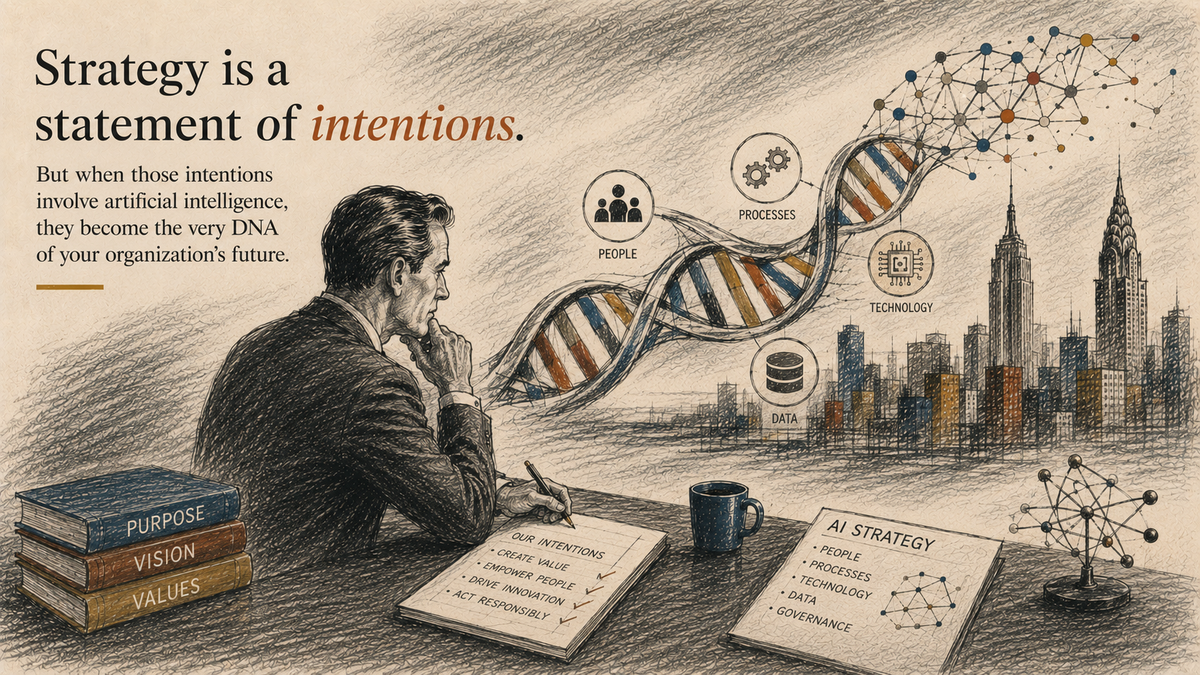
"Strategy is a statement of intentions." — But when those intentions involve artificial intelligence, they become the very DNA of your organization's future.
The Death of Technology as a Supporting Actor
For decades, the relationship between business strategy and technology strategy was clear-cut, hierarchical, and predictable. Business leaders would craft their strategic vision, then hand it down to the technology department with instructions to "make it happen." Technology was the reliable supporting actor—never the star, always in service to the "real" business decisions made by the "real" business leaders. In forward looking organizations where technology was a key differentiator technology was a business partner, but even then usually reported at least a level down from the CEO.
That era is over.
This isn't a subtle evolution—it's a fundamental inversion of how business strategy gets created. Artificial intelligence isn't just supporting business strategy; it will become inseparable from it. AI strategy isn't a subset of business strategy, nor is it a parallel track running alongside it. AI strategy IS the business strategy, period.
This Time Is Different
Every few years, technology vendors proclaim that their latest innovation will "transform business." Most of the time, they're wrong. Technology typically automates existing processes, makes operations more efficient, or enables modest improvements in how work gets done. The fundamental nature of the business—its value proposition, competitive advantages, and strategic differentiation—remains largely unchanged.
AI shatters this pattern.
Consider what will happen at a theoretical mid-sized financial services firm. Their competitive advantage rested on their experienced analysts' ability to spot market trends faster than competitors. It was a people-driven advantage, protected by years of experience and institutional knowledge. Then they deployed domain trained AI reasoning models that could analyze vast quantities of unstructured market trends, news sentiment, and economic indicators in real-time, generating insights that were not just faster than their human analysts, but often more accurate. AI becomes a force multiplier. It augments the firm in a way that typical analysts just cannot. AI’s ability to identify subtle signals that a human either cannot see or ignore as signal noise will radically transform finance.
Seemingly overnight, their core competitive advantage shifted from human experience to AI-augmented intelligence. Their business strategy had to evolve from "hire the best analysts" to "create the most effective human-AI analytical teams." The technology didn't just support their existing strategy—it forced them to reimagine what their strategy could be.
This is why AI demands a different approach to strategy development. Unlike previous technologies that automated the "how" of business operations, AI is reshaping the "what" and the "why" of business itself.
A CEO's Non-Negotiable Role
You cannot outsource your AI strategy to your IT department, your chief technology officer, or even a dedicated AI team. This ultimate responsibility lands squarely on the CEO's desk, and there's no delegation that will substitute for direct, personal engagement with this challenge.
CEOs are busy—they're always busy—but this is a wave of change that's going to disrupt their business if they are not on top of it. It's best to be educated. You don't have to be an expert, but you need to understand the parameters and the capabilities of what's changing and how you can integrate it into the business.
This isn't about becoming a technical expert or understanding the mathematical foundations of machine learning. It's about developing sufficient fluency to make informed strategic decisions about capabilities that will reshape every aspect of your organization.
A CEO can learn the hard way when the technical team optimizes for interesting technological problems rather than critical business outcomes. Engineering is typically too far removed from business problems. Outsourcing and other management structures have decoupled technology and engineers from having a deep understanding of how the business operates.
The CEO asked the wrong questions and asked 'what can AI do for us? They should have been asking 'How does AI change what's possible for our business?'
That's a strategic question, not a technical one.
Strategy to Intentional Evolution
The word "strategy" intimidates many leaders. It conjures images of lengthy planning processes, elaborate frameworks, and rigid long-term commitments. In the context of AI, this traditional approach to strategy development becomes not just ineffective, but counterproductive.
AI capabilities are evolving so rapidly that any strategy locked in stone will be obsolete before the ink dries. New models emerge monthly, capabilities expand weekly, and competitive dynamics shift in real-time. The traditional strategic planning cycle—annual or even quarterly strategic reviews—simply cannot keep pace with the rate of change in AI.
Instead of capital-S Strategy, think of AI strategy as intentional evolution. You need a clear statement of intentions that can adapt as you learn, as the technology advances, and as competitive dynamics shift. This approach requires three fundamental elements:
First, clarity about direction without rigidity about tactics. Your AI strategy should articulate where you want AI to take your organization—enhanced customer experiences, accelerated innovation cycles, more efficient operations—without prescribing exactly how you'll get there. The "how" will evolve as you learn what works and what doesn't.
Second, commitment to continuous learning and adaptation. Unlike traditional business strategies that might remain stable for years, your AI strategy should evolve constantly based on new information, pilot project results, and changing market conditions. This requires building organizational capabilities for rapid experimentation and learning, not just for implementing predetermined plans.
Third, deep integration with core business objectives. Your AI strategy cannot be an appendix to your business strategy—it must be woven into the fabric of how you think about market opportunities, competitive advantages, and value creation.
The Digital Workforce: When Strategy Becomes Inseparable
The reason AI strategy and business strategy cannot be separated becomes crystal clear when you recognize that AI is fundamentally about workforce transformation. For decades, business leaders have understood that people drive strategy, develop strategy, refine it, and implement it. Human capital decisions have always been strategic decisions because your workforce determines what your organization can accomplish.
Now consider this reality: when a software developer becomes two to three times more productive using AI code generation tools, you haven't just improved efficiency. You've effectively gained two to three additional developers without hiring anyone. When physicians working with AI diagnostic models make more accurate diagnoses faster than they could alone, you've enhanced your medical capacity without expanding your staff. When legal professionals leverage AI for document analysis and brief writing, they can handle case loads that previously required entire teams.
This capacity multiplication effect means that AI deployment decisions are workforce decisions, and workforce decisions are inherently strategic decisions. You're not just implementing technology; you're fundamentally reshaping your organization's capabilities and competitive position.
The implications extend far beyond individual productivity gains. A software company in Austin discovered this when they deployed AI coding assistants across their engineering team. Initially, they expected faster development cycles. What they actually achieved was transformation of their entire development model. Senior developers freed from routine coding could focus on architectural innovation. Junior developers working alongside AI could tackle projects previously reserved for senior team members. The company could pursue product opportunities that were previously impossible due to development resource constraints.
The digital workforce doesn't complain, doesn't get sick, doesn't take vacations, and operates around the clock. When performance issues arise, you don't fire digital workers—you refine their training, improve their capabilities, or reallocate their responsibilities. As AI models advance, these digital workers learn and improve in real-time through experience, not just through formal training cycles.
This creates a compound effect where your organizational capabilities grow continuously rather than being constrained by traditional human capital limitations. Your institutional knowledge doesn't just preserve expertise—it multiplies and improves it systematically.
Psychology of Professional Resistance
The most challenging aspect of AI strategic integration isn't technological or financial—it's psychological. In professions where expertise defines identity, AI capabilities create what can only be described as an existential crisis. Understanding this dynamic is crucial for any leader attempting to navigate AI transformation, because traditional change management approaches are completely inadequate when people face genuine threats to their professional meaning and worth.
Consider what happens when a radiologist with twenty years of experience discovers that an AI system can detect cancers in medical imaging more accurately than they can. This isn't learning about a new tool that improves efficiency. This is confronting the possibility that a machine can literally save more lives using the skills they've spent decades developing. The emotional impact strikes at the foundation of their professional identity: "I became a doctor to save lives. I specialized in radiology because I was exceptional at pattern recognition. And now a machine outperforms me at the core competency that defines my career. What does that make me?"
This existential challenge explains why law firms, medical practices, and accounting firms often resist AI integration so strongly. The resistance isn't just about risk aversion or conservative cultures. These professions attract individuals whose sense of worth is built around being the smartest person in the room regarding their domain expertise. AI doesn't just threaten their efficiency or market position—it threatens their fundamental sense of professional value.
A senior partner at a prestigious law firm described this psychological barrier perfectly: "I've spent thirty years building a reputation for legal insight that clients trust above all others. When I see AI systems drafting legal briefs that are more comprehensive and legally sound than what my team produces, I don't just see competition. I see the potential irrelevance of everything I've built my identity around."
This creates a fascinating strategic paradox. The organizations in these resistant industries that overcome psychological barriers first will gain enormous competitive advantages precisely because their competitors remain paralyzed by professional ego. But the internal transformation challenge requires managing organizational-scale psychological trauma, not just technological adoption.
The legal profession illustrates this dynamic particularly clearly. Legal work creates perfect training data for AI systems—documented analysis, decision-making patterns, and argumentation structures that AI can learn from comprehensively. Add multimodal capabilities that capture not just text but vocal intonations, facial expressions, and persuasion techniques, and you're approaching digital replication of legal expertise that operates at superhuman scale and availability.
The first law firms to master this digital replication won't just compete on having better lawyers—they'll compete on having lawyer-AI combinations that handle complex legal work around the clock, across multiple jurisdictions simultaneously. But getting there requires law partners to collaborate with systems that might genuinely outperform them at tasks they've spent lifetimes mastering.
The strategic implications cascade through entire industries. In healthcare, physicians who overcome both legitimate clinical caution and professional pride will provide demonstrably better patient outcomes. In accounting, firms that integrate AI will offer services at accuracy levels and price points that traditional competitors cannot match. The resistance creates opportunity for early adopters, but only for organizations capable of managing the psychological transformation required.
Managing the Hybrid Workforce
The shift toward digital workforce integration creates management challenges that have no precedent in business history. Traditional workforce management involves succession planning, skills development, performance evaluation, and cultural alignment. When your workforce includes both human and digital workers, every aspect of organizational management must be reconsidered.
The question of who owns digital workforce development is particularly complex. Unlike traditional technology implementations that fall under IT purview, digital worker training and refinement requires deep understanding of business processes, domain expertise, and human-AI collaboration dynamics. Many organizations are discovering that HR departments, designed around human psychology and interpersonal dynamics, lack the conceptual framework for managing digital workers that learn, adapt, and improve through experience.
This is leading to emergence of entirely new organizational functions dedicated to hybrid workforce management. These roles require understanding both human psychology and AI capability development, designing human-AI collaboration workflows, measuring combined human-digital performance, and managing cultural adaptation as employees work increasingly closely with their digital counterparts.
Consider the succession planning challenge in this new environment. When senior professionals work alongside digital systems that capture their decision-making patterns, communication styles, and expertise applications, organizational knowledge preservation becomes active rather than passive. Instead of knowledge walking out the door when experts retire, their expertise continues operating through digital workers that have learned from their patterns and approaches.
But this creates new strategic questions: How do you develop leadership pipelines when junior professionals learn from both human mentors and digital representations of organizational expertise? How do you maintain organizational culture and values when significant portions of work happen through human-AI collaboration? How do you ensure that digital workers align with strategic objectives as they learn and evolve?
The cultural implications extend beyond management structure. As human-computer interaction evolves toward voice, video, and natural language interfaces, interactions with digital workers will increasingly resemble interactions with human colleagues. This presents both opportunities and risks for organizational culture.
The risk lies in the possibility that employees might develop negative interaction patterns with AI systems that carry over to human relationships. If people become accustomed to treating digital workers as disposable tools rather than collaborative partners, those patterns could degrade interpersonal workplace dynamics. Organizations need proactive strategies for teaching constructive human-AI interaction patterns that preserve healthy human workplace culture.
The opportunity lies in the potential for digital workers to model consistent, professional communication and problem-solving approaches that could actually improve overall workplace interactions. When digital workers demonstrate patience, thoroughness, and systematic thinking, they can reinforce positive professional behaviors throughout the organization.
Competitive Dynamics in the Age of Resistance
The professional resistance patterns we've identified create unique competitive dynamics that smart executives can exploit strategically. When entire industries resist AI integration due to psychological barriers, the organizations that overcome these barriers first don't just gain typical first-mover advantages—they gain sustained competitive positions that may be difficult for followers to challenge.
This resistance-driven competitive protection works differently than traditional market dynamics. In most technology adoptions, competitive pressure forces rapid industry-wide adoption once early benefits become apparent. But when resistance is psychological rather than financial or technical, the adoption barriers remain high even after competitive advantages become obvious.
Consider the legal industry, where the first firms to successfully integrate AI capabilities will be able to offer legal services at quality levels and price points that traditional firms simply cannot match. But because legal professionals' resistance stems from threats to professional identity rather than concerns about technology effectiveness, competitive pressure alone may not force rapid adoption by resistant firms.
This creates an unusual strategic window where early adopters can establish market positions and refine their capabilities while competitors remain paralyzed by psychological barriers. The legal firms that master human-AI collaboration will have time to develop superior hybrid capabilities, build client relationships around AI-enhanced services, and establish operational advantages before their competitors overcome their psychological resistance.
The healthcare industry presents an even more pronounced version of this dynamic. Physicians who successfully integrate AI diagnostic and treatment assistance will provide demonstrably better patient outcomes than their peers. The evidence will be measurable in terms of diagnostic accuracy, treatment effectiveness, and patient satisfaction. Yet the combination of legitimate clinical caution and professional pride creates double barriers to adoption that may persist despite clear evidence of superior outcomes.
This means that healthcare organizations that successfully navigate the psychological transformation will gain competitive advantages that compound over time. They won't just be more efficient—they'll be demonstrably better at the fundamental mission of healthcare. These advantages become self-reinforcing as better outcomes attract better patients, more qualified staff, and increased resources for further AI integration.
The accounting profession may see the most dramatic competitive reshuffling. So much traditional accounting work involves pattern recognition, rule application, and data analysis—exactly what AI systems excel at. The firms that overcome professional resistance will be able to serve clients at scales and price points that traditional firms cannot approach. This could accelerate industry consolidation as AI-enabled firms capture market share from traditional competitors who remain constrained by psychological barriers to adoption.
This resistance-driven competitive advantage window won't remain open indefinitely but it does create a window of opportunity. Eventually, competitive pressure will force even the most resistant professionals to adapt or exit their industries. The question for strategic leaders is whether they'll position their organizations to exploit this window while it exists, or whether they'll wait until competitive pressure forces industry-wide adoption and eliminates the early-mover advantages.
Building AI Strategy Into Business Strategy
Creating an integrated AI and business strategy requires rethinking traditional strategic planning processes. Instead of developing business strategy first and then figuring out how technology can support it, successful organizations are exploring what becomes possible when AI capabilities are available, and then crafting business strategies around those expanded possibilities.
This approach starts with understanding AI capabilities deeply enough to envision new business models, not just improved versions of existing ones. It requires imagining how customer experiences could be fundamentally different when AI can provide personalized, real-time interactions at scale. It means considering how operations could be restructured when AI can handle complex decision-making tasks that currently require human intervention.
A professional services firm in New York exemplifies this approach. Instead of asking how AI could make their existing consulting model more efficient, they asked what kinds of consulting services would become possible if AI could handle research, analysis, and even initial recommendation development. This led them to create new service offerings that combine human strategic insight with AI-powered analysis and modeling. They're not just doing consulting faster—they're doing consulting that wasn't previously possible.
The Communication Challenge
One of the most underestimated aspects of AI strategy is the communication challenge. Unlike traditional technology implementations that primarily affect specific departments or processes, AI transformation touches every aspect of the organization. This creates unprecedented communication and change management requirements.
Your AI strategy isn't just a plan for technology implementation—it's a blueprint for organizational transformation. Every employee needs to understand not just what's changing, but why it's changing and how it affects their role, their career development, and their relationship with the organization.
This communication must be ongoing, transparent, and bidirectional. Employees need to understand the strategic vision, but leadership also needs to understand employee concerns, resistance points, and insights about where AI can create the most value.
The CEO of a logistics company discovered this when their initial AI communication focused entirely on the business benefits of automation. Employee resistance was significant because workers assumed AI meant job elimination. When they shifted to communicating how AI would handle routine tasks and allow employees to focus on problem-solving and customer relationship work, resistance decreased and employee engagement with AI initiatives increased dramatically.
Integration, Not Addition
The fundamental insight driving this chapter is simple but profound: AI isn't something you add to your business strategy. It's something you integrate into your business strategy so thoroughly that the two become indistinguishable.
This integration requires courage, curiosity, and commitment from leadership. Courage to acknowledge that AI will change fundamental assumptions about how your business operates. Curiosity to explore possibilities that extend beyond traditional improvement initiatives. Commitment to invest the time and resources necessary to develop genuine organizational AI capabilities, not just implement AI tools.
The organizations that will thrive in an AI-driven future are those that recognize this integration imperative early and act on it decisively. They won't wait for AI technology to mature further, for competitive threats to become obvious, or for industry best practices to emerge. They'll start building integrated AI and business strategies now, learning and adapting as both the technology and their understanding evolve.
Your AI strategy is your business strategy. The question isn't whether this is true—the question is whether you'll recognize it and act on it before your competitors do.
Making It Real: The Strategic Action Framework
Understanding that AI strategy and business strategy must be integrated is one thing. Actually creating and implementing that integration is another challenge entirely. The most successful organizations we've observed follow a systematic approach that combines strategic thinking with practical experimentation.
Start with business problems, not AI solutions. The most impactful AI strategies begin by identifying the most significant challenges or opportunities facing your business, then exploring how AI capabilities might address them in novel ways. This prevents the common trap of implementing impressive AI technology that doesn't create meaningful business value.
Build cross-functional strategy teams. Traditional strategic planning that separates business strategy from technology strategy simply cannot work in an AI context. You need teams that include business leaders, technology experts, domain specialists, and often external AI expertise working together to explore what becomes possible.
Embrace experimental strategy development. Unlike traditional business strategies that can be largely planned in advance, AI strategy must be developed through experimentation. You discover what's possible by testing AI capabilities against real business challenges, not by theoretical analysis alone.
Plan for organizational transformation, not just technology implementation. AI strategy that focuses only on technology deployment will fail. You must simultaneously plan for changes in job roles, skill requirements, decision-making processes, and organizational culture.
The integration of AI strategy and business strategy isn't just a strategic imperative—it's a competitive necessity. The organizations that master this integration will define the future of their industries. Those that don't will find themselves competing against organizations that operate according to fundamentally different rules.
The choice is yours, but the window for making it is narrowing as companies embrace AI. Your AI strategy is your business strategy and the time to act on that reality is now.