Chapter 19: The Rise of Composable, Agent-Driven Solutions
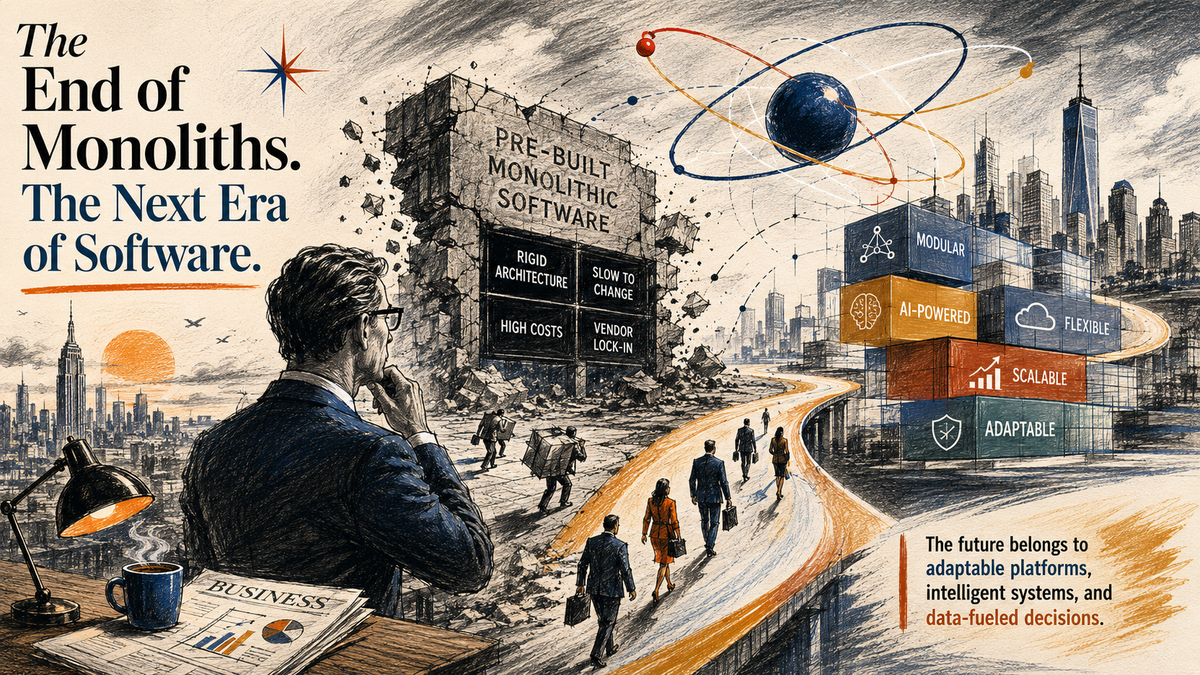
Traditional SaaS applications are becoming digital straightjackets. Prepare your enterprise for a future of flexible, composable, agent-driven architectures.
"The best way to predict the future is to invent it." — Alan Kay
The multi-billion-dollar Software-as-a-Service industry is facing an existential threat that most executives haven't yet recognized. It's not coming from a competitor offering better features or lower prices. It's not emerging from a new business model or superior customer service. The threat is far more fundamental: it's the very concept of pre-built, monolithic software applications becoming obsolete.
We are witnessing the dawn of composable, agent-driven solutions that promise to render traditional SaaS architectures as quaint as file cabinets in a digital office. This isn't hyperbole—it's the logical evolution of software architecture in an AI-first world. The question isn't whether this transformation will happen, but how quickly your organization will adapt to survive it.
The SaaS Straightjacket
For the past two decades, Software-as-a-Service has dominated enterprise technology adoption. The value proposition was compelling: instead of buying expensive software licenses and managing complex installations, businesses could simply subscribe to cloud-based applications that were ready to use out of the box. Salesforce revolutionized customer relationship management, Workday transformed human resources, and hundreds of other SaaS providers carved out niches across every business function imaginable.
But success bred complacency, and complacency bred rigidity. Today's SaaS ecosystem resembles a digital feudal system where businesses are locked into vendor-specific workflows, forced to adapt their processes to fit software constraints rather than having software that adapts to their needs. Consider the familiar frustrations: endless configuration screens that never quite capture your unique business logic, integration projects that take months to connect systems that should naturally work together, and the constant tension between standardization and customization.
David Chen, CTO of a Fortune 500 manufacturing company, captures this dilemma perfectly: "We've spent millions implementing our ERP system, and it handles about 80% of what we need brilliantly. But that other 20%—the stuff that actually differentiates us in the market—requires expensive customizations that break every time the vendor updates their platform. We're paying them to limit our competitive advantage."
This isn't an isolated complaint. It's the defining characteristic of mature SaaS markets: powerful platforms that excel at common use cases but struggle with the edge cases where real business value often lies. The result is a landscape of expensive point solutions, each addressing specific gaps left by primary systems, creating integration complexity that often exceeds the problems the original software was meant to solve.
Rise of Agentic Computing
While traditional software vendors were optimizing their existing architectures, a fundamentally different approach was quietly emerging from AI research labs. Instead of building applications that perform predefined functions through rigid user interfaces, researchers began developing autonomous agents—software entities capable of understanding goals, formulating plans, and executing complex multi-step tasks without explicit programming for each scenario.
The breakthrough came when these agents gained the ability to dynamically discover and utilize tools. Unlike traditional software that requires developers to anticipate every possible integration and hard-code connections, agentic systems can evaluate available resources in real-time and orchestrate them to achieve desired outcomes.
Think of the difference between a traditional assembly line, where each worker performs a predetermined task in a fixed sequence, and a highly skilled project team that can assess a challenge, identify the right expertise and resources, and dynamically organize themselves to deliver results. Traditional software is the assembly line; agentic computing is the adaptive team.
This shift from procedural to declarative computing represents more than a technical evolution—it's a fundamental reimagining of how humans and software interact. Instead of learning complex interfaces and adapting workflows to software constraints, users can simply describe what they want to accomplish and let intelligent agents determine the best path forward.
Model Context Protocol
The catalyst that's accelerating this transformation is the emergence of standardized protocols for agent interaction, most notably the Model Context Protocol (MCP) championed by Anthropic and rapidly adopted by industry leaders including Google and OpenAI. MCP solves a critical challenge that has historically limited agent capabilities: how can autonomous software discover and interact with services it has never encountered before?
Traditional software integration requires extensive advance planning. Developers must research APIs, understand data formats, handle authentication, and write custom code for each connection. This front-loaded complexity makes integration projects expensive and time-consuming, often taking months to connect systems that should logically work together seamlessly.
MCP fundamentally changes this dynamic by enabling agents to discover tools dynamically and learn how to use them through self-describing interfaces. When an agent encounters a new service, it can query that service's MCP endpoint to understand what functions are available, what inputs are required, and what outputs to expect. It's like arriving in a foreign country and discovering that every service provider speaks your language and can explain exactly how to work with them.
The implications are staggering. Instead of requiring months of integration work to connect a customer service system with inventory management, billing, and logistics platforms, an agentic solution can discover these capabilities at runtime and orchestrate them as needed. When new services become available, agents can automatically incorporate them into their problem-solving toolkit without requiring any reprogramming.
Composable Enterprise
This technological foundation enables something unprecedented in enterprise software: true composability at scale. Instead of selecting large, monolithic applications that attempt to address broad functional areas with varying degrees of success, organizations can begin assembling specialized agents that excel at specific tasks and coordinate seamlessly to deliver complex business outcomes.
Consider a customer service scenario in today's SaaS world. When a premium customer calls with a complex issue involving a defective product, service representatives typically navigate between multiple systems: customer relationship management to view account history, inventory management to check product details and availability, warranty systems to determine coverage, billing systems to process credits or refunds, and logistics systems to arrange returns or replacements. Each system has its own interface, data model, and business logic, requiring extensive training and often resulting in frustrated customers who are asked to repeat information multiple times.
In an agentic paradigm, this same scenario might be handled by a customer service agent that receives the goal of "resolve this customer's issue completely and ensure their satisfaction." The agent would automatically coordinate with specialized sub-agents: a customer intelligence agent that understands the customer's history and preferences, a product knowledge agent that can diagnose technical issues, an inventory agent that identifies optimal replacement options, a financial agent that determines appropriate compensation, and a logistics agent that arranges for seamless resolution.
The customer interacts with a single, intelligent interface that understands context and maintains conversation continuity, while behind the scenes, multiple specialized systems coordinate to deliver a seamless experience. Most importantly, when the organization introduces new capabilities—perhaps a new returns processing system or enhanced product diagnostic tools—these automatically become available to the customer service agent without requiring retraining or system reconfiguration.
Real-World Disruption in Motion
This isn't theoretical speculation. Organizations are already beginning to experience the disruptive potential of agentic approaches. Victor Tabaac, a technology executive, recently shared a telling anecdote about reconsidering a SaaS development project: "We were working with some SaaS products trying to figure out should we go to market with this tool, and I said, listen, I don't even know if it makes sense anymore. The millions of dollars in product engineering and development that have gone into building some of these SaaS tools—I feel like I can almost do out of the box right now with just some simple integrations. I can set up an agent and do the same thing probably in a matter of a week that took six months to a year to build."
This observation captures a crucial inflection point. When individual practitioners can replicate the functionality of million-dollar software platforms in days rather than months, the fundamental economics of software development shift dramatically. The moats that have protected established SaaS providers—primarily the time and expertise required to build complex software—are rapidly eroding.
Early adopters are already demonstrating this potential across various domains. Data engineering teams that once relied on expensive ETL platforms are building agent-based data pipelines that can automatically discover data sources, understand schemas, and implement transformations based on business requirements rather than technical specifications. Marketing teams are deploying agent swarms that can coordinate content creation, campaign optimization, and performance analysis across multiple channels without requiring separate tools for each function.
These examples share common characteristics: they solve real business problems more effectively than traditional software, they adapt to changing requirements without extensive reconfiguration, and they leverage existing investments rather than requiring wholesale replacement of established systems.
Economics of Agent-Driven Solutions
The economic implications of this shift extend far beyond technology budgets. Traditional SaaS models depend on predictable subscription revenues generated by large user bases paying for broad functionality, much of which remains unused. This approach works when alternatives are expensive and time-consuming to develop, but breaks down when users can achieve superior results by composing specialized agents.
Consider the typical enterprise resource planning deployment. Organizations spend millions on licensing fees for comprehensive platforms that attempt to address finance, human resources, supply chain, and manufacturing requirements within a single integrated system. Most implementations use a fraction of available functionality, and customizations to address unique business requirements often cost more than the original license fees.
An agentic approach inverts this model. Instead of paying for comprehensive platforms, organizations can invest in specialized agents that excel at specific business functions and coordinate through standard protocols. Financial planning agents can work seamlessly with supply chain optimization agents and human resources agents, each bringing best-in-class capabilities to their domain while maintaining the integration benefits of monolithic platforms.
This shift from "platform-centric" to "capability-centric" procurement fundamentally alters software economics. Instead of large, infrequent platform purchases, organizations can make smaller, more targeted investments in capabilities that directly address business needs. When requirements change, new agents can be introduced without disrupting existing systems. When better capabilities become available, they can be incorporated seamlessly.
The result is higher utilization rates, lower switching costs, and more predictable return on investment. Organizations pay for value delivered rather than features available, and software investments become more aligned with business outcomes.
Challenges and Considerations
This transformation isn't without challenges. Organizations considering agent-driven approaches must navigate several critical considerations that don't exist in traditional SaaS deployments.
Security represents perhaps the most immediate concern. When agents can dynamically discover and interact with services, traditional perimeter-based security models become inadequate. Organizations need robust identity and access management systems that can evaluate agent requests in real-time and ensure appropriate authorization for each interaction. This requires more sophisticated security architectures than most organizations currently maintain.
Similarly, governance becomes more complex when business logic is distributed across multiple autonomous agents rather than centralized within monolithic applications. Organizations need clear frameworks for defining agent responsibilities, monitoring agent behavior, and ensuring compliance with regulatory requirements. When an agent makes a decision that impacts customer billing or regulatory reporting, the organization needs confidence that the decision was appropriate and auditable.
Integration complexity, while reduced in many ways, shifts rather than disappears. Instead of managing point-to-point integrations between known systems, organizations must manage dynamic interactions between agents that may discover new capabilities at runtime. This requires more sophisticated monitoring and debugging capabilities than traditional integration approaches.
Perhaps most significantly, this transition requires new skills and mindsets from technology organizations. Instead of configuring predefined software packages, teams must learn to design agent ecosystems, define appropriate boundaries between autonomous systems, and monitor emergent behaviors that arise from agent interactions.
Strategic Implications for Leadership
For business leaders, the rise of agentic computing presents both unprecedented opportunities and existential risks. Organizations that successfully navigate this transition can achieve operational efficiency and customer experience advantages that were previously impossible. Those that ignore or delay adaptation risk being displaced by more agile competitors who leverage agent-driven approaches to deliver superior value propositions.
The strategic imperative is clear: begin experimenting with agentic approaches now, while the technology is still emerging and competitive advantages are available to early adopters. This doesn't require wholesale replacement of existing systems—indeed, such an approach would be unnecessarily risky and expensive. Instead, organizations should identify specific use cases where agent-driven solutions can deliver measurable improvements over current approaches and use these as learning laboratories.
Customer service represents an ideal starting point for many organizations. The integration challenges that plague traditional customer service—multiple systems with inconsistent data and interfaces—are precisely the problems that agentic approaches solve most effectively. Organizations can deploy customer service agents that coordinate existing systems while learning about agent capabilities and building internal expertise.
Similarly, data analysis and reporting functions offer excellent opportunities for agentic experimentation. Instead of requiring business users to learn complex business intelligence tools, organizations can deploy analysis agents that understand natural language requests and coordinate with appropriate data sources to deliver insights. These implementations provide immediate value while building organizational confidence in agent-driven approaches.
The Path Forward
The transition from traditional SaaS to agent-driven solutions won't happen overnight, but it will happen faster than most organizations expect. The combination of rapidly improving AI capabilities, standardized interaction protocols, and growing awareness of traditional software limitations creates a perfect storm for accelerated adoption.
Organizations that begin this journey now have the opportunity to shape the transition rather than simply react to it. They can influence agent development roadmaps, establish partnerships with emerging technology providers, and build internal capabilities that will become increasingly valuable as agentic computing matures.
The alternative—waiting for the technology to fully mature before engaging—carries significant risks. By the time agent-driven solutions become mainstream, competitive advantages will be limited to execution efficiency rather than strategic positioning. Organizations that have invested years building agent expertise and partnerships will be difficult to displace.
More fundamentally, the skills required for successful agent deployment—systems thinking, outcome-focused design, and dynamic integration management—take time to develop. Organizations that begin building these capabilities now will be better positioned to capitalize on future opportunities than those that wait for certainty.
Beyond Software
The implications of agent-driven solutions extend far beyond technology architecture. When software becomes truly adaptive and responsive to business needs rather than constraining business processes to fit predetermined workflows, organizations can fundamentally reconsider how they operate.
Traditional organizational design has been heavily influenced by software limitations. Business processes are often structured around system capabilities rather than optimal customer experiences or operational efficiency. When these constraints disappear, organizations have opportunities to redesign processes from first principles.
Customer journey design becomes truly customer-centric when software can adapt to customer needs rather than forcing customers to adapt to system limitations. Supply chain optimization can consider real-time variables and constraints without requiring weeks of analysis and configuration changes. Product development can respond to market feedback dynamically rather than waiting for quarterly software updates.
These organizational capabilities compound over time. Organizations that learn to leverage agent-driven solutions effectively develop institutional knowledge and cultural practices that accelerate future innovations. They become more responsive to market changes, more efficient in their operations, and more attractive to customers who value personalized experiences.
The Imperative
The rise of composable, agent-driven solutions represents more than a technology trend—it's a fundamental shift in how software creates value. Organizations that recognize this transition early and invest in building relevant capabilities will have sustainable competitive advantages. Those that continue investing in traditional SaaS models risk being disrupted by more agile competitors who leverage agent-driven approaches to deliver superior customer experiences and operational efficiency.
The question every executive must answer is not whether this transformation will occur, but how quickly their organization will adapt to benefit from it. The technology exists today. The standards are emerging. The early adopters are demonstrating measurable results.
The age of rigid, monolithic software applications is ending. The age of intelligent, composable solutions is beginning. Your move.