Chapter 20: Continuous Adaptation and the Ongoing Journey
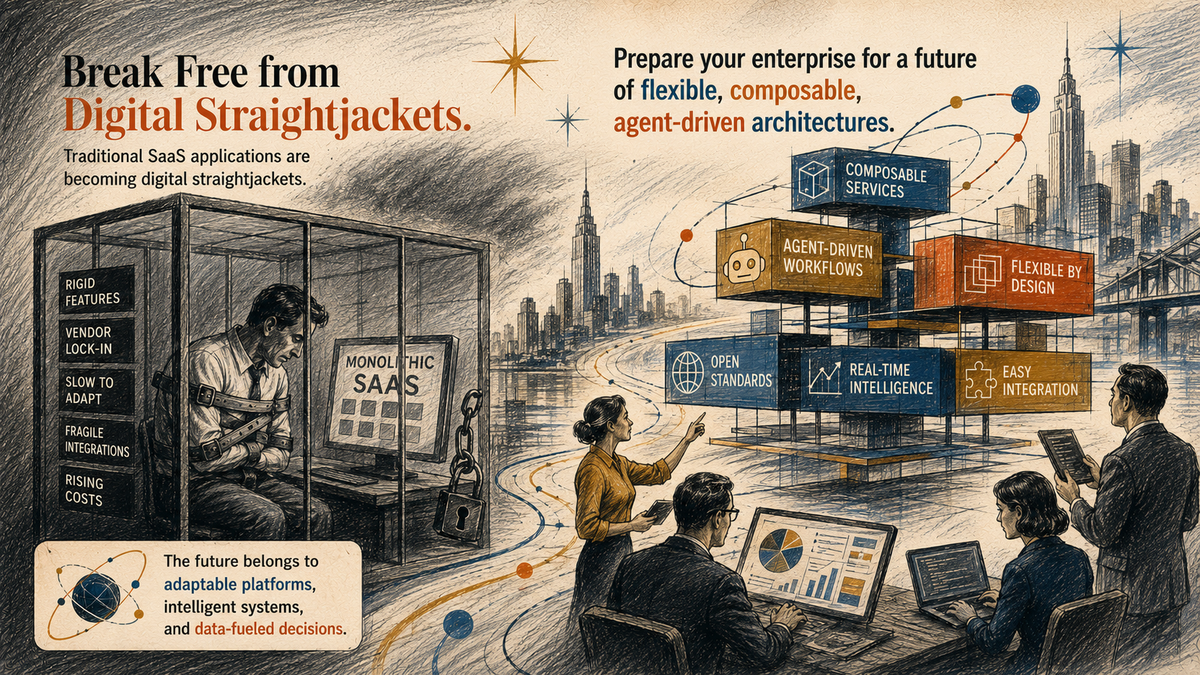
Traditional SaaS applications are becoming digital straightjackets. Prepare your enterprise for a future of flexible, composable, agent-driven architectures.
"The most dangerous phrase in the language is, 'We've always done it this way.'" - Grace Hopper
Myth of the Set-and-Forget AI Solution
In the gleaming boardrooms of Silicon Valley and the corner offices of Fortune 500 companies, a dangerous myth persists: that artificial intelligence solutions are like traditional software deployments—build once, deploy, and enjoy the benefits indefinitely. This fiction has led countless organizations down a path of disappointment, where promising AI pilots become production nightmares, and transformative technologies become expensive shelf-ware.
The uncomfortable truth is that AI systems are more akin to living organisms than static software. They require continuous feeding, monitoring, pruning, and adaptation to remain effective. Unlike the predictable behavior of traditional software, AI models exist in a constant state of flux, responding to evolving data patterns, shifting user behaviors, and changing business contexts. To succeed with AI, organizations must embrace this reality and build capabilities for continuous adaptation.
The root of this myth lies in organizational immaturity around analytics and AI. As AI grows exponentially, most organizations simply lack the experience of managing these types of applications. They don't understand that AI models require close monitoring for phenomena like model drift—it's an education they must undergo, often through painful trial and error. This represents a fundamental cultural issue combined with skills gaps that permeate even sophisticated organizations.
This chapter explores the critical discipline of AI Operations (AIOps), the phenomenon of model drift, and the organizational mindset required to treat AI as an ongoing journey rather than a destination. We'll examine why the most successful AI implementations are those that build feedback loops into their DNA, creating systems that learn, adapt, and improve over time.
Rise of AI Operations
Traditional IT operations, often called DevOps, revolutionized software development by creating systematic approaches to build, deploy, and maintain applications. However, the unique characteristics of AI systems demand a new operational paradigm. AI Operations, or AIOps, represents this evolution—a discipline that combines traditional operational rigor with the specialized requirements of machine learning systems.
Consider the difference between deploying a traditional web application and an AI-powered recommendation engine. The web application, once deployed, will behave predictably given the same inputs. Its performance metrics are straightforward: response time, uptime, error rates. The recommendation engine, however, operates in a world of probability and inference. Its effectiveness depends not just on technical performance but on the quality of its recommendations, the freshness of its training data, and its ability to adapt to changing user preferences.
Sarah Chen, the Chief Technology Officer at a major e-commerce platform, learned this lesson the hard way. Her team had successfully deployed an AI-powered product recommendation system that showed impressive results during initial testing. However, within six months, customer engagement with recommendations had dropped by 40%, and conversion rates were declining. The technical metrics looked fine—the system was responding quickly and without errors—but the business value was eroding.
The culprit was model drift. The AI system had been trained on historical customer data, but customer preferences had evolved, new products had been introduced, and seasonal patterns had shifted. The model was technically functioning but practically obsolete. This experience forced Sarah's organization to build a comprehensive AIOps capability, transforming how they approached AI system management.
The Silent Killer of AI Performance
Model drift is perhaps the most insidious challenge in AI operations. It occurs when the statistical properties of the data an AI model encounters in production differ from the data it was trained on. This divergence can happen gradually or suddenly, and its effects can be subtle or catastrophic.
The fundamental reality is that no model is ever truly stable, even when it appears to be performing well. This is because models are predictive by nature—they attempt to forecast the future based on patterns learned from the past. While this often works remarkably well, the real world is constantly changing, and this creates an inherent instability in any predictive system.
Consider the sobering lessons from the financial industry, where sophisticated hedge funds have experienced catastrophic failures despite years of accurate predictions. Long-Term Capital Management, once hailed as having near-perfect mathematical models, collapsed spectacularly in 1998 when their models failed to predict market behavior during the Russian financial crisis. The models had been extraordinarily accurate for years, but when confronted with a "black swan" event—a rare but highly impactful occurrence—they became not just wrong, but dangerously wrong.
There are several types of model drift that organizations must monitor and address. Data drift occurs when the input data changes over time. For example, a fraud detection model trained on pre-pandemic transaction patterns might struggle with the surge in online shopping and digital payments that emerged during COVID-19. The model's inputs—transaction amounts, merchant categories, geographic patterns—all shifted dramatically.
Concept drift represents a more fundamental challenge: when the relationship between inputs and outputs changes. A classic example is a credit scoring model that correlates homeownership with creditworthiness. During a housing market crash, this relationship might invert, making the model not just inaccurate but actively harmful to decision-making.
Performance drift is the ultimate measure of model effectiveness. Even if data and concept drift are not immediately apparent, declining performance metrics—whether technical or business-focused—signal that intervention is needed. The challenge is that performance drift often manifests gradually, making it difficult to detect without systematic monitoring.
Why Good Practice Isn't Common Practice
Any data scientist with experience understands that machine learning operations must be in place before putting anything into production—this should be considered basic good practice. Yet organizations consistently fail to implement these practices, revealing a deeper challenge around organizational maturity in analytics and AI.
The issue isn't necessarily technical incompetence; it's a fundamental misunderstanding of what managing AI applications requires. Traditional software applications have predictable failure modes. When a web server crashes, you restart it. When there's a bug, you patch it. But AI models can fail silently while appearing to work perfectly from a technical standpoint. They can return responses with perfect uptime and millisecond response times while delivering completely wrong answers.
This represents a fundamentally different type of failure mode that requires a different operational mindset. Organizations that successfully manage AI at scale have dedicated teams to manage ML operations on a continuous basis. These teams understand that models change with time and have the knowledge to interpret results. Critically, they work closely with data scientists or AI developers who have a firm grasp on the business domain.
The emphasis on business understanding cannot be overstated. Since these models are predictive in nature, you must have a sense of what constitutes a correct prediction to gauge accuracy. This requires deep domain expertise, not just statistical knowledge. In a financial services firm, for instance, the MLOps team should include former traders or risk managers who can spot when a model's predictions "feel wrong" even if the statistical measures appear fine.
Organizations often struggle to capture the real cost of putting models into production, particularly when development datasets and environments don't match production realities. Cost modeling is not always obvious, and the hidden expenses can be substantial. These include the specialized talent needed for ongoing model management, the infrastructure required for continuous monitoring and testing, the business disruption when models need to be retrained or replaced, and the opportunity cost of model degradation before it's detected.
However, these operational costs pale in comparison to the potential cost of bad predictions. Poor model performance can drive costs exponentially higher and potentially cause irreparable reputational damage.
The Heart of Adaptive AI
The key to managing model drift and ensuring long-term AI success lies in building robust feedback loops that can detect changes, assess their impact, and trigger appropriate responses. These feedback loops must operate at multiple levels: technical, business, and operational.
At the technical level, organizations must implement comprehensive monitoring systems that track model performance metrics in real-time. This includes traditional metrics like accuracy, precision, and recall, but also domain-specific measures that reflect business value. For a customer service chatbot, this might include resolution rates, customer satisfaction scores, and escalation frequencies. For a supply chain optimization model, it might include cost savings, delivery performance, and inventory turnover rates.
However, technical monitoring alone is insufficient. Organizations must also create business-level feedback loops that connect AI performance to business outcomes. This requires close collaboration between data science teams and business stakeholders to define meaningful success metrics and establish regular review processes.
Lessons from High-Profile Failures
The most sobering examples of model failure come from organizations that discovered the hard way that the public will find edge cases that internal testing never anticipated—and they'll find them quickly. Microsoft experienced serious reputational damage when it released a chatbot into the world without properly testing it for adversarial inputs. Within hours, users had manipulated the system into generating inappropriate and offensive content.
Google faced similar challenges and arguably continues to pay the reputational price. When they released models that generated results that were horrible and disconnected from reality, they were destroyed in the press. Some of this damage was self-inflicted, but it illustrates a fundamental truth: you can never test all cases, and the public will find things your testing didn't cover.
These failures reveal something crucial about AI deployment strategy. The public doesn't just use AI systems as intended—they probe them, test their boundaries, and often try to break them in ways that internal teams would never consider. This creative boundary-testing represents a form of stress testing that no internal QA process can fully replicate.
The lesson is clear: organizations must build their AI deployment strategies around the assumption that public exposure will reveal failures. Rather than trying to prevent all failures, successful organizations plan for controlled failure and rapid response.
The Operational Framework for Continuous AI Adaptation
Building an effective AIOps capability requires more than just monitoring and feedback loops. Organizations must establish operational frameworks that can systematically manage the entire AI lifecycle, from initial development through ongoing maintenance and evolution.
The foundation of this framework is model versioning and experiment management. Just as software development teams use version control systems to manage code changes, AI teams must track model versions, training data, hyperparameters, and performance metrics. This capability enables organizations to quickly rollback to previous model versions when drift is detected, and to systematically experiment with improvements.
Data pipeline management represents another critical component. AI models are only as good as the data they consume, and production data pipelines must be robust, scalable, and monitored. This includes tracking data quality metrics, monitoring for data drift, and ensuring that training and inference data remain consistent.
Model deployment and serving infrastructure must be designed for continuous updates. Unlike traditional software deployments that might occur monthly or quarterly, AI models may need to be retrained and redeployed weekly or even daily. This requires automated deployment pipelines, A/B testing capabilities, and infrastructure that can handle multiple model versions simultaneously.
Building Organizational Checks and Balances
Organizations that can afford separate teams should establish them, as independence is critical for effective AI operations. At minimum, someone other than those who created the models should be testing the output, and this testing should be automated with results reviewed continuously.
This principle mirrors the independence requirements in financial auditing—you need someone who wasn't involved in creating the books to review them. The people who built the model obviously have the deepest technical understanding of how it works, but they may also have blind spots or unconscious biases about its limitations.
This creates interesting organizational dynamics. The ideal structure balances the need for independence with the need for technical expertise. Some organizations create dedicated QA functions for AI systems, while others establish separate data science teams for validation. The key is ensuring that model testing includes both technical validation and business context evaluation.
The challenge lies in maintaining continuous attention. Human focus tends to drift when systems are working well, but that's exactly when vigilance becomes most critical. Organizations must develop systematic approaches for maintaining this attention over time, potentially drawing lessons from other high-reliability industries like aviation or nuclear power.
Bridging AI and Business Context
While technical capabilities are essential for effective AIOps, the human element remains crucial for long-term success. AI systems, no matter how sophisticated, lack the business context and intuitive understanding that human experts bring to complex problems. The most effective AI implementations are those that seamlessly integrate human expertise with machine capabilities.
This integration must occur at multiple levels. During model development, business experts must work closely with data scientists to ensure that models capture relevant business logic and constraints. During deployment, subject matter experts must monitor model behavior and flag anomalies that might not be apparent from technical metrics alone. During ongoing operations, business stakeholders must regularly review model performance and provide feedback on changing business requirements.
Consider the experience of a major insurance company implementing AI-powered claims processing. The initial model showed excellent technical performance, accurately classifying claims and reducing processing time. However, claims adjusters began noticing that the model was missing certain types of fraud that were obvious to human experts. The model was technically correct but missing important business context.
The solution was to implement a human-in-the-loop system where experienced adjusters could flag problematic model decisions and provide feedback. This feedback was then used to continuously improve the model, creating a virtuous cycle where human expertise enhanced machine performance, and machine efficiency allowed humans to focus on more complex cases.
From Pilot to Enterprise
As organizations mature in their AI journey, they must scale their AIOps capabilities from managing individual models to orchestrating enterprise-wide AI systems. This scaling presents unique challenges in terms of complexity, governance, and resource management.
At the enterprise level, organizations typically manage dozens or hundreds of AI models across different business units and use cases. Each model may have different data requirements, performance characteristics, and business impact. Managing this complexity requires sophisticated orchestration capabilities that can coordinate model training, deployment, and monitoring across the entire portfolio.
Resource management becomes a critical concern at scale. AI operations, particularly model training and inference, can be computationally intensive and expensive. Organizations must implement sophisticated resource allocation and optimization systems that can balance performance requirements with cost constraints. This includes using cloud auto-scaling capabilities, implementing model caching strategies, and optimizing inference pipelines for efficiency.
Governance and compliance become increasingly complex as AI systems proliferate across the organization. Different models may be subject to different regulatory requirements, risk tolerances, and business constraints. Organizations must implement comprehensive governance frameworks that can ensure compliance while enabling innovation and agility.
When "Stable" Solutions Aren't Stable
A particularly insidious challenge emerges with foundation models from major providers. Many organizations adopt these thinking they're getting a "stable" solution, but foundation models are actually changing frequently, creating a new type of vendor dependency risk that most organizations aren't prepared for.
Even when using a foundation model from a major provider and fine-tuning it for specific applications, organizations can experience drift. The foundation models themselves are continuously updated, and these updates can have unexpected downstream effects on fine-tuned applications. An organization might discover that their carefully tuned customer service chatbot suddenly starts behaving differently after a provider updates their base model.
This reality underscores a crucial point: even when organizations don't control the underlying AI technology, they still need robust testing and monitoring systems. Having some kind of testing in place makes sense regardless of whether you're training models from scratch or using pre-built solutions.
The key insight is that stability in AI is always an illusion. Models try to predict the future based on the past, and while this often works very well, sometimes it works catastrophically badly. The organizations that succeed are those that build their operations around this fundamental uncertainty rather than fighting against it.
Economics of Continuous AI Adaptation
The operational requirements of AI systems have significant economic implications that organizations must consider in their planning and budgeting. Unlike traditional software investments that have predictable maintenance costs, AI systems require ongoing investments in data, compute resources, and skilled personnel.
Model retraining represents one of the most significant ongoing costs. Depending on the complexity of the model and the frequency of retraining, organizations may need to allocate substantial compute resources for this activity. The cost can be particularly high for deep learning models that require extensive training time and specialized hardware.
Data acquisition and maintenance costs are often underestimated in AI projects. As models evolve and business requirements change, organizations may need to acquire new data sources, improve data quality, or expand data collection capabilities. The cost of high-quality, relevant data can be substantial, particularly for specialized domains or real-time applications.
The human resources required for effective AIOps are also significant. Organizations need skilled data scientists, ML engineers, and AI operations specialists who can manage the complex technical and business requirements of production AI systems. The shortage of skilled professionals in these areas has driven compensation levels higher, making the human capital investment substantial.
However, these costs must be weighed against the value that well-operated AI systems can provide. Organizations that invest in robust AIOps capabilities often find that their AI systems deliver greater and more sustained business value than those that treat AI as a one-time implementation project.
Technology Trends Shaping the Future of AI Operations
The field of AI operations is rapidly evolving, driven by advances in both AI technology and operational practices. Several key trends are shaping the future of how organizations will manage AI systems in production.
Automated machine learning (AutoML) is reducing the technical complexity of model development and maintenance. These tools can automatically select appropriate algorithms, tune hyperparameters, and even handle certain aspects of model retraining. While AutoML doesn't eliminate the need for skilled practitioners, it can significantly reduce the operational burden of managing AI systems.
Edge AI is changing the deployment and operational model for many AI applications. By moving AI processing closer to the data source, organizations can reduce latency, improve privacy, and operate more efficiently. However, edge deployment also introduces new operational challenges, including device management, model synchronization, and limited compute resources.
Federated learning represents another emerging trend that has significant operational implications. This approach allows organizations to train models across distributed data sources without centralizing the data. While federated learning can address privacy and regulatory concerns, it also introduces new complexity in terms of model coordination and performance monitoring.
The rise of AI-powered automation is beginning to transform AIOps itself. Organizations are starting to use AI to manage AI, implementing systems that can automatically detect drift, trigger retraining, and even make certain operational decisions without human intervention. While this meta-AI approach is still in its early stages, it represents a promising direction for managing the complexity of large-scale AI operations.
Building a Culture of Continuous Learning
Perhaps the most important aspect of successful AI operations is building an organizational culture that embraces continuous learning and adaptation. This cultural transformation is often more challenging than the technical implementation but is essential for long-term success.
Organizations must move beyond the traditional mindset of "deploying solutions" to embracing "managing capabilities." This means accepting that AI systems will require ongoing attention, investment, and improvement. It also means building organizational processes that can quickly adapt to changing requirements and new opportunities.
The role of leadership is crucial in this transformation. Leaders must set expectations that AI is a journey, not a destination, and must be willing to invest in the capabilities needed for long-term success. This includes not just technical infrastructure but also the organizational processes, skills, and culture needed to manage AI systems effectively.
Training and development become ongoing requirements rather than one-time events. As AI technology evolves and business requirements change, organizations must continuously update their skills and capabilities. This includes not just technical training for data scientists and engineers but also business training for stakeholders who need to understand and work with AI systems.
Embracing the Journey
The organizations that will thrive in the age of AI are those that embrace the reality of continuous adaptation. They understand that AI success is not measured by the sophistication of their initial models but by their ability to evolve, learn, and improve over time. They build robust operational capabilities that can detect and respond to change, and they create organizational cultures that view adaptation as a competitive advantage rather than a burden.
The journey of AI transformation is not for the faint of heart. It requires sustained commitment, significant investment, and the willingness to continuously learn and adapt. However, for organizations that embrace this challenge, the rewards can be transformative. AI systems that are well-operated and continuously improved can provide sustained competitive advantage, drive innovation, and create new sources of value that would be impossible to achieve through traditional approaches.
The key is to start building these capabilities now, even if your AI implementation is still in its early stages. The operational disciplines, feedback loops, and organizational capabilities required for AI success take time to develop and mature. By beginning this journey early, organizations can position themselves to capture the full value of AI as it becomes increasingly central to business success.
The future belongs to organizations that can learn, adapt, and evolve as quickly as the technology itself. In a world where change is the only constant, the ability to continuously adapt may be the most valuable capability of all.