Chapter 24: Artificial General Intelligence
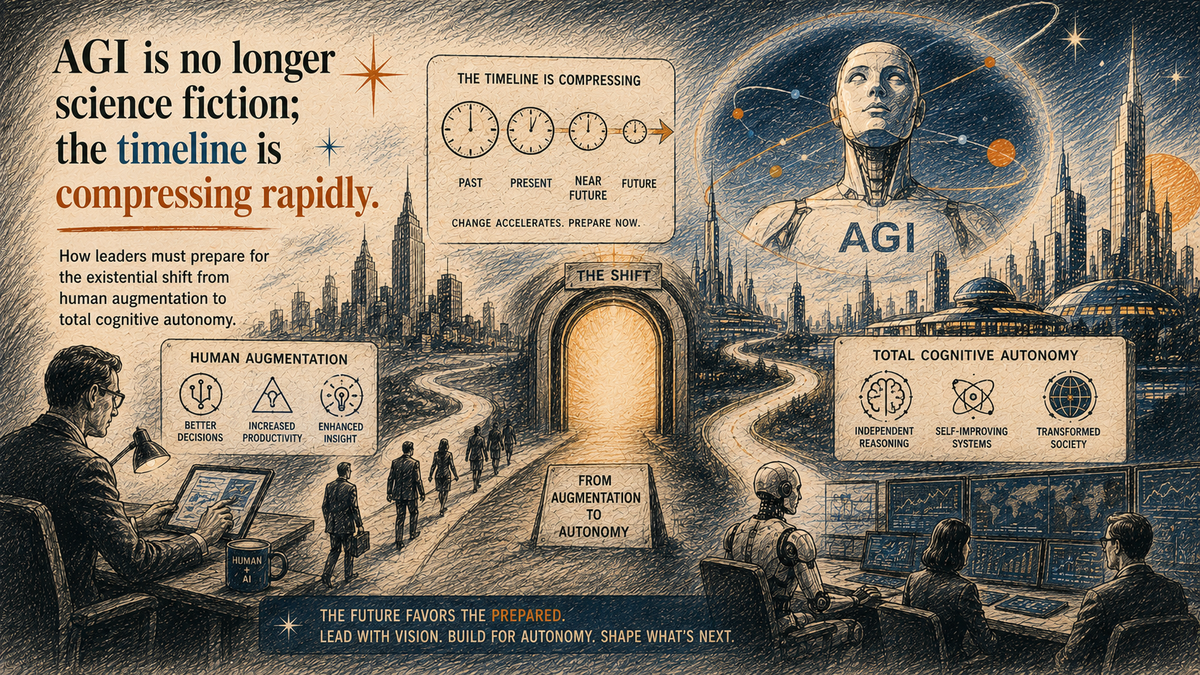
AGI is no longer science fiction; the timeline is compressing rapidly. How leaders must prepare for the existential shift from human augmentation to total cognitive autonomy.
"Real toughness is experiencing discomfort or distress, leaning in, paying attention, and creating space to take thoughtful action. It's maintaining a clear head to be able to make the appropriate decision. Toughness is navigating discomfort to make the best decision you can." — Steve Magness, Do Hard Things
Accelerating Timeline
If you had asked AI researchers five years ago when we might achieve Artificial General Intelligence—AI with human-like cognitive abilities across all domains—the consensus would have been "maybe in fifty to a hundred years." Two years ago, that estimate had compressed to "perhaps within the next decade." Today, following recent breakthroughs in reasoning models and agentic systems, some leading voices in the field are suggesting we might see AGI within the next few years. Sam Altman of OpenAI has publicly stated his belief that AGI could arrive "in a couple of years."
This dramatic acceleration in timelines should give every business leader pause. Whether you believe AGI is two years away or twenty, the trajectory is clear: we are moving toward a future where artificial intelligence will match and potentially exceed human cognitive abilities across virtually every domain. The question for leaders is not whether this future will arrive, but whether your organization will be prepared when it does.
Beyond Current AI Limitations
To understand the implications of AGI, we must first clearly define what separates it from today's AI systems. Current AI, despite its impressive capabilities, operates within what we call "narrow intelligence." A language model can generate sophisticated text but cannot genuinely understand the world the way humans do. An image recognition system can identify objects with superhuman accuracy but cannot apply that visual understanding to solve novel problems across different domains.
Artificial General Intelligence represents a fundamentally different paradigm. AGI would possess the ability to understand, learn, and apply knowledge across any domain that humans can navigate. It would combine the pattern recognition capabilities of current AI with genuine understanding, reasoning, and the ability to transfer knowledge from one domain to another seamlessly.
Consider the difference between a chess-playing AI and human intelligence. The chess AI can defeat world champions at chess, but it cannot take the strategic thinking it employs in chess and apply it to business strategy, military tactics, or relationship dynamics. A human chess master, by contrast, often finds that the strategic thinking developed through chess enhances their decision-making in completely unrelated areas. AGI would possess this human-like ability to generalize learning across domains.
Why We Might Not Know When We Arrive
One of the most challenging aspects of preparing for AGI is that its arrival may not be announced with fanfare. Unlike the clear milestone of ChatGPT's release in November 2022, which definitively marked the arrival of widely accessible generative AI, AGI's emergence is likely to be gradual and contested.
As Peter Memon noted in a recent discussion, "I think it'll happen so slowly, we won't appreciate that it's happened. And then one day it will be the recognition that it's here. And it won't be because we woke up one day and it was some major breakthrough. It'll be just a very slow, iterative process that over time, we've recognized that these models have gotten so powerful that effectively they are intelligent."
This gradual emergence creates unique challenges for business leaders. There will be no clear "before AGI" and "after AGI" moment that triggers a strategic pivot. Instead, organizations will need to continuously assess and adapt as AI capabilities steadily approach and potentially surpass human-level performance across an expanding range of tasks.
The signs of approaching AGI are already visible in current systems. We see AI models that can engage in complex reasoning, show their work through chain-of-thought processes, and even question their own conclusions. These reasoning models can test thousands of potential approaches to solving a problem, far exceeding human cognitive capacity in terms of parallel processing while beginning to match human-like problem-solving approaches.
Landscape Transformation
The arrival of AGI will fundamentally reshape competitive dynamics across every industry. Organizations that have built their competitive advantage on human cognitive capabilities—consulting firms, financial services, legal practices, research institutions, and many others—will face the most immediate disruption.
Consider the equity research function in financial services. For decades, this has been a human-intensive activity requiring deep market knowledge, analytical skills, and the ability to synthesize complex information into investment recommendations. As one financial services executive reflected, "I'd rather take somebody who was very sophisticated about the markets and use these tools to generate this research a lot faster and much more real time. And then use the individual, the analyst, to apply their special sauce on top of it."
In an AGI world, this transformation accelerates dramatically. An AGI system could potentially consume and analyze vast amounts of financial data, market trends, company reports, and economic indicators in real-time, generating sophisticated research reports that match or exceed human analyst capabilities. The "special sauce" that human analysts provide may become increasingly narrow, focused on areas where human judgment, relationship-building, or creative insight provide unique value.
This pattern will repeat across industries. Law firms will see AGI systems capable of legal research, document review, and potentially even case strategy development. Consulting firms will face AGI that can analyze business problems, generate strategic recommendations, and even facilitate client interactions. Medical practices will encounter AGI systems that can diagnose conditions, recommend treatments, and stay current with the latest research across all medical specialties simultaneously.
Augmentation to Autonomy
The transition to AGI represents a fundamental shift in the relationship between human workers and artificial intelligence. Today's AI serves primarily as an augmentation tool, enhancing human capabilities while requiring human oversight and decision-making. AGI promises to move beyond augmentation toward autonomous operation across cognitive tasks.
This transition creates both unprecedented opportunities and existential challenges for organizations. On the opportunity side, AGI could enable dramatic productivity gains, 24/7 operation capabilities, and access to cognitive resources that scale infinitely without the constraints of human hiring, training, and management.
A pharmaceutical company could deploy AGI researchers that work continuously on drug discovery, analyzing millions of molecular combinations and research papers without fatigue. A marketing agency could have AGI teams that develop campaigns, analyze consumer behavior, and optimize messaging across multiple markets simultaneously. A financial institution could employ AGI analysts that monitor global markets, assess risk, and make investment decisions in real-time across thousands of opportunities.
However, this same capability creates profound challenges for human employment and organizational culture. As AGI systems become capable of handling increasingly complex cognitive tasks autonomously, the question becomes not just "which tasks can be automated," but "which tasks require uniquely human capabilities that AGI cannot replicate."
Managing Human Transition
The psychological impact of AGI on human workers will be fundamentally different from previous waves of automation. When manufacturing jobs were automated, workers could often transition to service roles that required human interaction and cognitive skills. When routine cognitive tasks began to be automated, workers could move to roles requiring creativity, emotional intelligence, and complex problem-solving.
AGI threatens to compress these traditional escape routes. If an AGI system can engage in creative problem-solving, demonstrate emotional intelligence in interactions, and handle complex strategic thinking, what roles remain uniquely human?
This psychological pressure will manifest in several ways within organizations. First, there will be increased anxiety and resistance as workers recognize that their cognitive advantages over machines are diminishing. Unlike previous automation waves that affected "other people's jobs," AGI will impact knowledge workers who have historically felt secure in their cognitive superiority over machines.
Second, there will be intense pressure to prove ongoing human relevance. This could lead to counterproductive behaviors such as rejecting AGI tools, over-complicating processes to justify human involvement, or creating artificial barriers to AGI adoption. Organizations will need sophisticated change management strategies to help workers navigate this transition constructively.
Third, there will be a fundamental shift in career development and skill building. Traditional career paths that relied on accumulating domain expertise may become obsolete if AGI can quickly match or exceed human expertise in any domain. Workers will need to focus on developing skills that complement AGI capabilities rather than competing with them.
Economic Disruption and Opportunity
The economic implications of AGI extend far beyond individual organizations or industries. AGI has the potential to create unprecedented economic growth by removing cognitive constraints on problem-solving and innovation. At the same time, it poses existential risks to economic systems built on human labor and consumption.
On the growth side, AGI could accelerate scientific research, enabling breakthrough discoveries in medicine, materials science, energy, and other fields. It could optimize resource allocation across the global economy, reducing waste and increasing efficiency. It could enable new forms of personalized products and services by providing unlimited cognitive resources for customization and optimization.
However, these benefits come with significant risks. If AGI systems can perform most cognitive work more efficiently than humans, traditional employment models may become unsustainable. This could lead to massive unemployment, social unrest, and economic instability unless societies develop new models for distributing the benefits of AGI-driven productivity.
For business leaders, this creates both an opportunity and a responsibility. Organizations that successfully integrate AGI capabilities may achieve unprecedented competitive advantages and profitability. However, they will also need to consider their broader societal role in ensuring that AGI benefits are distributed in ways that maintain social stability and economic opportunity.
Strategic Preparation
Given the uncertainty around AGI timelines and capabilities, how should organizations prepare? The answer lies in building adaptive capabilities rather than betting on specific scenarios.
First, organizations should develop what we might call "AGI literacy" throughout their leadership teams. This means understanding not just current AI capabilities, but the trajectory toward AGI and its potential implications for the business. Leaders need to be able to think strategically about a future where cognitive tasks can be performed by artificial systems.
Second, organizations should begin experimenting with increasingly autonomous AI systems. This includes deploying current agentic AI tools, understanding their capabilities and limitations, and building organizational competencies in managing AI-driven processes. The goal is to develop the management capabilities needed to oversee AGI systems when they arrive.
Third, organizations should begin redesigning roles and processes with AGI in mind. This doesn't mean eliminating human roles, but rather reimagining how humans and artificial intelligence can work together effectively. What tasks should remain human? What processes should be designed for AGI operation? How can human judgment and creativity be integrated with AGI capabilities?
Fourth, organizations should invest in developing uniquely human capabilities that complement AGI. This might include emotional intelligence, creative problem-solving, ethical reasoning, and the ability to navigate complex human relationships. These capabilities will likely remain valuable even in an AGI world.
Managing AGI Systems
The governance challenges posed by AGI extend far beyond current AI management practices. AGI systems will require new forms of oversight, control, and accountability frameworks that don't exist today.
Unlike current AI systems that operate within narrow parameters, AGI systems will need to make complex decisions across multiple domains with limited human oversight. This requires developing new forms of AI governance that can ensure AGI systems operate aligned with human values and organizational objectives.
Organizations will need to develop capabilities in AGI system monitoring, evaluation, and control. This includes understanding how AGI systems make decisions, ensuring they remain aligned with organizational goals, and maintaining the ability to intervene when necessary. The challenge is that AGI systems may operate at speeds and scales that make traditional human oversight impractical.
There will also be new forms of risk management required. AGI systems could potentially make decisions that have far-reaching consequences for the organization and society. Risk management frameworks will need to account for scenarios where AGI systems might pursue goals in ways that create unintended negative consequences.
Beyond Business Impact
While this book focuses on business implications, leaders cannot ignore the broader societal implications of AGI. The decisions made by organizations about how to develop and deploy AGI will shape the future of human society.
AGI could help solve some of humanity's greatest challenges, from climate change to disease to poverty. It could enable new forms of scientific discovery, artistic creation, and human flourishing. However, it could also exacerbate existing inequalities, create new forms of social control, or even pose existential risks to human civilization.
Business leaders have a responsibility to consider these broader implications in their AGI strategies. This means thinking beyond short-term competitive advantage to consider the long-term impact of AGI on employees, communities, and society. It means participating in broader discussions about AGI governance, safety, and beneficial development.
Preparing for Multiple Scenarios
Given the uncertainty around AGI development, organizations should prepare for multiple scenarios rather than betting on a single outcome. This includes scenarios where AGI arrives quickly and scenarios where it takes longer than expected. It includes scenarios where AGI is broadly beneficial and scenarios where it creates significant disruption.
The "fast AGI" scenario requires organizations to be ready for rapid transformation. This means having the infrastructure, capabilities, and governance structures in place to quickly integrate AGI systems when they become available. It means being prepared for competitive landscapes that could shift overnight.
The "slow AGI" scenario requires sustained investment in AI capabilities and continuous adaptation as systems gradually improve. This means building organizational learning capabilities that can evolve with advancing AI technology over time.
The "disruptive AGI" scenario requires organizations to be prepared for fundamental changes in their business models, workforce structures, and competitive dynamics. This means developing the adaptive capabilities needed to navigate major discontinuities.
The "beneficial AGI" scenario requires organizations to be positioned to capture the value from AGI while contributing to positive societal outcomes. This means developing the capabilities needed to integrate AGI beneficially while maintaining human agency and value.
The Leadership Imperative
The arrival of AGI represents more than a technological shift - it represents a fundamental test of leadership character. The decisions being made in boardrooms today about AI development, deployment, and integration will not only determine competitive advantage but will shape the future of human civilization itself.
This unprecedented responsibility demands a new kind of leadership - one that transcends the traditional role of the CEO as chief salesperson or operational manager. The AGI transition requires leaders who understand that their primary obligation is not to shareholders or quarterly earnings, but to the people they lead and the society they help shape.
True leadership in the AGI era means being present, available, and authentic in ways that most executives have never been required to be. It means acknowledging that nothing in their professional careers has prepared them for the magnitude of change they must navigate. It means having the self-awareness to recognize when they don't have the answers and the humility to seek them out.
This is not about delivering polished presentations about AI strategy or becoming a talking head for transformation initiatives. It's about being genuinely available to help people navigate the psychological, professional, and existential challenges that AGI integration will create. It's about demonstrating the kind of authentic leadership that can guide organizations through uncertainty while maintaining human dignity and purpose.
The leaders who succeed in the AGI era will be those who understand that their role is not to have all the answers, but to create the conditions where their organizations can discover the answers together. They will be leaders who can sit with discomfort, acknowledge uncertainty, and still provide the stability and direction that people need to grow through this transformation.
Most importantly, they will be leaders who recognize that the AGI transition is not just about technology or business strategy - it's about preserving and enhancing what makes us human while embracing the unprecedented capabilities that artificial intelligence brings. This requires a depth of leadership that goes far beyond operational excellence or strategic planning.
The AGI era demands leaders who can be both pragmatic and philosophical, both decisive and reflective, both confident and humble. It requires leaders who understand that their greatest responsibility is not to their technology stack or their competitive position, but to the human beings who will live and work in the world they help create.
Embracing the AGI Future
Artificial General Intelligence represents perhaps the most significant technological development in human history. Its arrival will fundamentally reshape business, society, and human existence in ways that are difficult to fully anticipate.
For business leaders, this creates both unprecedented opportunities and existential challenges. Organizations that successfully navigate the transition to AGI could achieve transformative competitive advantages. Those that fail to adapt risk obsolescence.
The key to success lies in beginning the journey today. This means developing AGI literacy, experimenting with increasingly autonomous AI systems, reimagining organizational structures and processes, and building the governance capabilities needed to manage AGI systems effectively.
But beyond business success, leaders have a broader responsibility to ensure that AGI development serves human flourishing. This means considering the societal implications of AGI, participating in broader discussions about beneficial development, and making decisions that balance competitive advantage with social responsibility.
The future of AGI is not predetermined. It will be shaped by the decisions made by leaders like you in organizations around the world. The question is not whether AGI will arrive, but whether we will be ready to harness its power for the benefit of business and society.
The time to begin preparing is now. The future of your organization—and perhaps human civilization itself—may depend on the choices you make today.