Fire Your CFO. (Fine — Keep Him. But Ditch the Token Budget.)
A $200 Claude subscription. About $1,000 spent. Over $1M in software built. So why are companies capping their best engineers at $20 a month? A provocation about token budgets — and who they strangle.
"The gap between what organizations preach and what they do (that is, rewarding predictability) is only going to widen as artificial intelligence proliferates, removing routines and demanding more nuanced, creative problem-solving from humans."
— Jana Werner, Become an Octopus Organization
Werner wrote that about organizational design. She might as well have written it about the expense line your finance team just created for AI. Because right now, inside a great many large companies, the most consequential technology of our working lives is being managed the way organizations manage everything they don't understand: with a budget, a control, and a monthly cap. Predictability is being rewarded. And the bill for that predictability is going to be enormous.
Let us tell you a story with a number in it, because we are, after all, a data firm. One of us — Peter, in this case — has spent the last couple of months building software with a $200-a-month Claude Max subscription. Total spend to date: call it a thousand dollars. The output: well over a million dollars' worth of software development, by any honest estimate of what that work would have cost the traditional way. We'll show our math shortly, because a claim like that deserves math.
But first, the provocation, because it frames everything else: we think you should fire your CFO. And while you're at it, take a long, unsentimental look at your CIO.
The provocation, and what we actually mean by it
Obviously we don't mean it literally. Mostly. What we mean is this: the way big organizations are treating AI is exactly the way they have always treated technology — as a budget item to be allocated, capped, and controlled. And AI is not a technology in that sense. It's a tool. That distinction sounds pedantic until you sit with it.
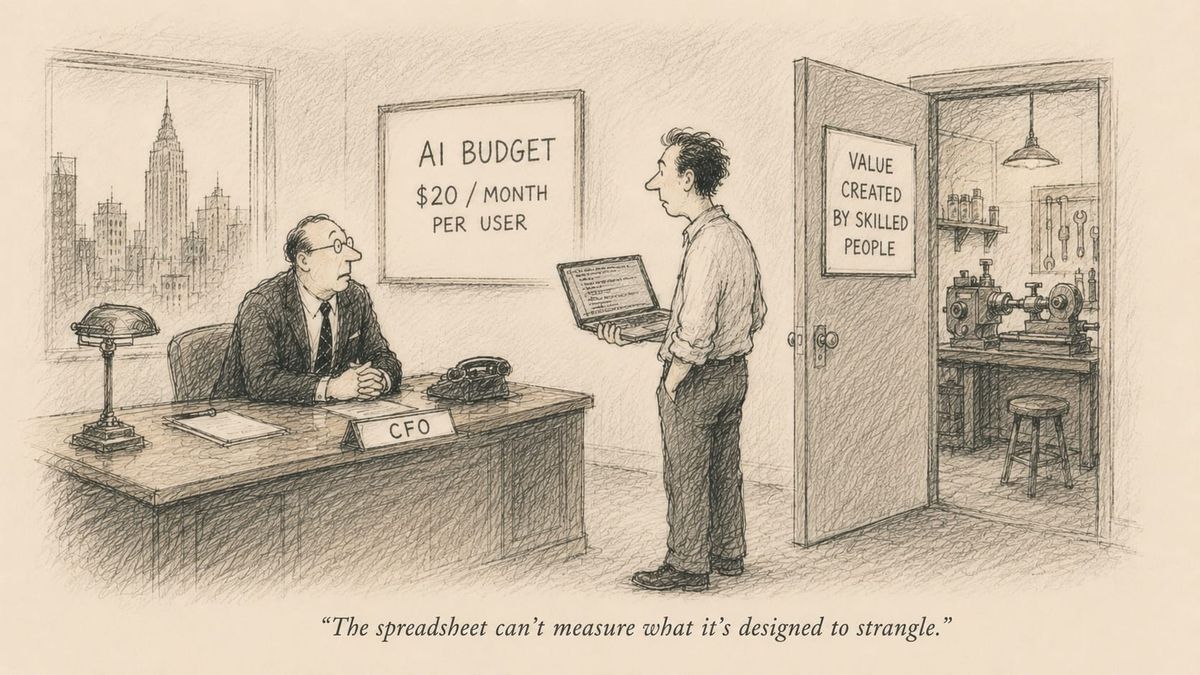
A technology, in the enterprise sense, is something you procure, deploy, secure, and depreciate. It has a project plan and a steering committee. A tool is something a skilled person picks up and uses, and the value it produces depends almost entirely on the skill of the hands holding it. A lathe in the hands of a master machinist and a lathe in the hands of an intern are the same capital expense and utterly different economic events. AI is the most extreme version of this we have ever seen. The variance between a skilled practitioner and a casual user isn't twenty percent. It's a hundredfold. Sometimes more.
The CFO's toolkit — caps, allocations, uniform per-seat budgets — was built for the first kind of thing. Applied to the second, it doesn't control cost. It destroys value, quietly and at scale, while producing very tidy reports about how well-controlled everything is.
And the CIO, with respect, is not built for this either. The modern CIO role is a caretaker role: security, uptime, vendor management, budget discipline. All necessary. None of it is about moving at the speed the business now needs to move. Very often the CIO function, doing exactly what it was designed to do, is the single biggest brake on the organization. That's not a character flaw. It's a design flaw — and it's fixable, which we'll get to.
Putting a meter on intelligence
Here is the practice that prompted this post. In conversation after conversation with people inside large organizations, we keep hearing the same thing: developers are being handed monthly token budgets. Twenty dollars a month. Fifty at the generous shops. That's the allocation. That's the intelligence ration.
Think about what that is. You have hired expensive, capable people — your engineers, your domain experts, the people whose thinking is the actual product — and you have handed them the most powerful amplifier of human capability since the spreadsheet, with a meter on it. Here's your brain; you may use one percent of it. Please file a request if you need more brain.
Fifty dollars a month is not a budget. An effective developer working with a frontier model — and Claude Fable will happily consume serious tokens when you point it at serious work — can burn through fifty dollars before lunch. On a good morning, before coffee. So what happens at 11 a.m.? Does the thinking stop? Do they queue for tokens like it's 1974 and tokens are gasoline? A $20-a-month allocation will get a knowledge worker a few nicely drafted emails. For a developer it is functionally indistinguishable from not providing the tool at all — except worse, because now everyone involved can tell themselves the organization "has AI."
Some of the blame, in fairness, belongs upstream. The frontier vendors spent two years selling a story that amounted to "here's AI, magic occurs, productivity follows" — as if capability transferred by subscription. It doesn't. These are extraordinarily complicated tools, and the gap between owning one and wielding one is the entire story. But executives who bought the magic framing are now budgeting for magic: a flat monthly fee per head, as if every head will conjure the same amount of it. When the magic fails to occur, the conclusion drawn in the budget review will be that AI was overhyped — rather than that the organization handed out amplifiers and never taught anyone to play.
We understand the instinct behind the caps, too. Costs at the frontier are real: heavy use of a top model can run tens of dollars per million tokens, and an intense practitioner can spend a thousand dollars in a month. Finance sees an uncapped, usage-based line item with high variance and does what finance does. But the brute-force cap is the one response guaranteed to fail, because it treats spend as the thing to optimize instead of what the spend produces. Which brings us back to the math we promised.
What a thousand dollars actually bought
The system Peter has been building is not a demo. It's a multi-platform, cloud-based application: a genuinely complex web interface, a genuinely complex AWS backend, processes running across systems that support multiple operating systems, significant code in multiple languages — C and C++ among them — architected to scale to hundreds of millions of events per day on Lambda functions and scalable data stores. A powerful prototype that stands one step from production.
Now price that the old way. You'd need an AWS architect and cloud developers who understand the platform and its security model at depth. UI developers. Systems people for the C and C++ work. A project manager to hold it together. Six, seven, eight specialized people — call it six months if everything went beautifully, a year if it went the way large software projects actually go. Salaries, coordination, management overhead: you clear a million dollars without breathing hard.
And the invoice understates it, because the real cost of team-scale software is the overhead nobody itemizes. The standing meetings. The design sessions about the design sessions. The day lost every time an idea crosses a time zone. The information that simply evaporates between one person's head and another's — every handoff a little lossy, every loss compounding. Anyone who has run a large program knows this tax. It is enormous, and it is invisible on every budget line.
The build happened instead as a single practitioner iterating with a frontier model — a couple of days a week, around everything else. Full-time, the same system ships in about a month. Roughly a thousand dollars of AI spend against a seven-figure traditional cost, in a fraction of the time. We are a data firm; we'll say it plainly: that is a return on investment with three zeros in it, and it's the kind of number a CFO ought to run toward, not cap at fifty dollars.
One honest caveat, because we insist on being honest: this result is not what happens when you hand anyone a Max subscription. It's what happens when deep domain knowledge and decades of engineering judgment meet an amplifier. Which is precisely the point — and precisely what the token budget prevents, because the people capable of this kind of return are exactly the ones a cap kneecaps first.
The part everyone skips: people
If you want returns like that across an organization, there is no shortcut around the unfashionable work: you have to actually educate your people. Not "roll out a video library and declare victory" — we've all watched that movie for twenty years, and it works for the small sliver of the population that was going to teach themselves anyway. Everyone else doesn't do it, doesn't want to do it, and can't find the hours in a day already stuffed with demands.
And we don't mean prompt-writing workshops, either. Prompting matters, but it's table stakes. The real education is teaching people how to think alongside these tools — how to decompose a problem, how to direct an amplifier, how to judge when an output is ready to rely on and when it needs to be pushed back on. That is genuinely hard to teach. It takes real time, away from the inbox, with focus. Organizations that pull people out of their day jobs and give them that time will find it pays for itself embarrassingly fast. Organizations that won't are buying tools for people they've decided not to equip — the gym membership approach to transformation.
It changes recruiting, too. If your interview process for the AI era is "tell me how you'd write an effective prompt," you are screening for the wrong thing with impressive precision. You need people who can think, decompose, and solve — which, incidentally, is why good engineers take to these tools so naturally. They're already analytical. The tool just removes the friction between the thinking and the thing.
Risk-managing the organization to death
Here is where we're supposed to nod respectfully at governance. We do take responsible deployment seriously — it's in our founding documents. But let's be candid about what much of this control actually is. Risk mitigation, risk avoidance, risk management: three names for the same reflex, which is the organization protecting itself from its own tools. Layers of process whose chief output is the justification of the layer. And the accounting is rigged, because the one incident that got prevented makes the slide, while the thousand things that never got built appear nowhere. It is very hard to measure what was not done. We just measured some of it for you: a million dollars of it, sitting in one practitioner's repo.
Meanwhile, somewhere out there is a small company with no token budget, no steering committee, and nothing to lose, pointed at your market. They will take these tools, find the people with real domain depth, train them properly, and let them loose. They will move at the speed of the work itself. Ask the SaaS incumbents how that's going — their lunch is being eaten as we speak, course by course. Your industry is not different. You will not see how fast things are moving around you until it's too late, because you were busy in the risk review.
You might not like fast. Fast might be deeply uncomfortable, because your organization was built to reward predictability — Werner again. But if you won't support fast, someone else will, and in your desire to protect the organization you will have strangled it. That is how incumbents actually die: not from the risk they failed to manage, but from the speed they refused to permit.
What we'd actually do
So: fire the CFO? Keep the CFO — but take AI out of the technology-budget frame entirely, because that frame is the mistake everything else flows from. If you have a chief AI officer, that person reports to the CEO. Not the CFO, not the CIO. This is a business transformation that happens to run on remarkable technology, and it belongs where business transformations belong.
Ditch the uniform token budget. Differentiate instead: your fifty-dollar tier is fine for people drafting emails and decks, and that's not an insult — it's fit-for-purpose. But your high-leverage people, the ones with deep domain knowledge or the capacity to build it, get what the work requires, along with the training to use it well and the accountability that comes with trust. Measure what the spend produces, not the spend.
Then do the harder thing: look at how your organization itself gets in the way. The approval chains, the handoffs, the meetings that exist because the org chart exists. These tools collapse coordination costs — that's half of where the million dollars came from — and an organization designed around expensive coordination will fight that collapse with everything it has. Rethink it anyway, and rethink it hard. Because if you don't, somebody else will do the rethinking, and they'll do it in your market.
None of this is theory. We don't write about this from the conference circuit; one of us just built the evidence, a couple of days a week, for about the price of a nice dinner each month. The tools are sitting right there. The only question is whether your organization is designed to let anyone pick them up.
All In On Data helps leadership teams turn AI ambition into business outcomes — by getting the data, strategy, and people foundations right. If your AI program currently consists of a token budget and a training video, send us a note. We'll tell you honestly what's worth doing and what isn't — and if we're not the right people to help, we'll tell you that too.