The Second Career Hiding Inside Your First
You hear a lot about AI right now, and most of it is noise arguing with other noise. It will take every job; it will take no jobs. It is superintelligence; it is a parlor trick. I have stopped participating in that debate.
You hear a lot about AI right now, and most of it is noise arguing with other noise. It will take every job; it will take no jobs. It is superintelligence; it is a parlor trick. I have stopped participating in that debate, mostly because I'm too busy having a very different experience of it — one that almost nobody is writing about.
I've spent close to forty years in engineering and system design, much of it in finance, in environments where getting it wrong has consequences measured in regulators, headlines, and a great many zeros. And I want to tell you what these tools have actually done for me, because I suspect it applies to a lot of people at my stage of career, and because the people it applies to are precisely the ones most likely to be sitting it out.
Here it is, plainly: AI has given me a second career. Not a metaphorical one. An actual, working, shipping-products second career — at a point in my life when I had quietly assumed the window for that had closed.
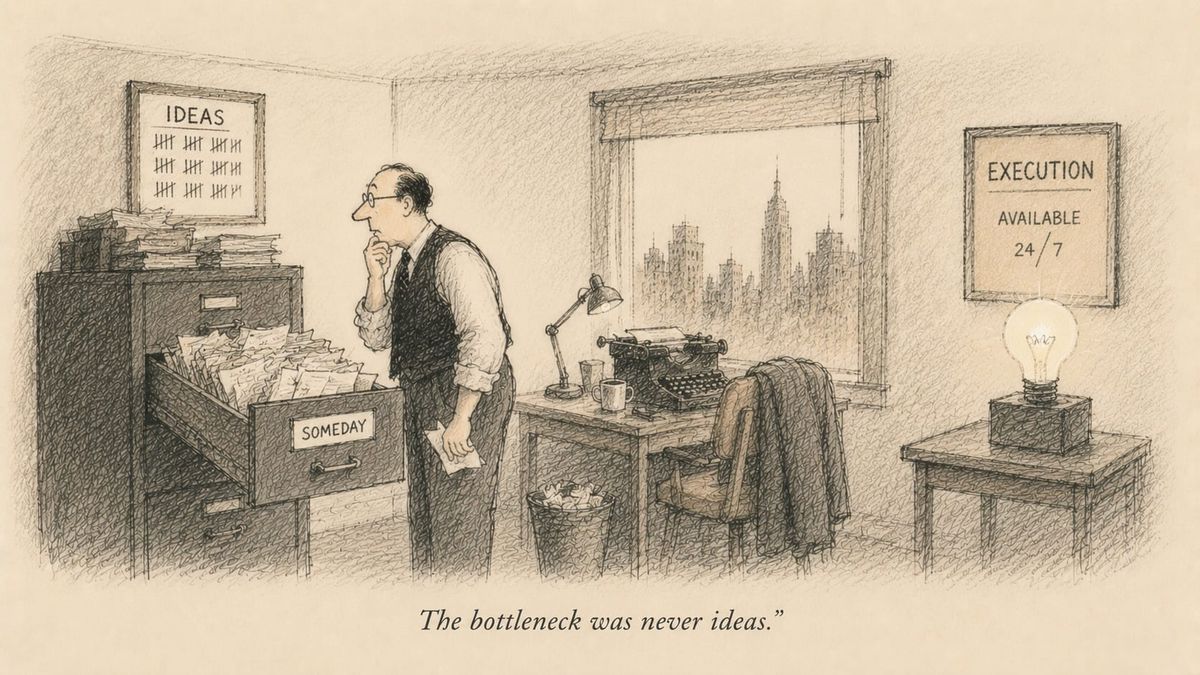
The bottleneck was never ideas
For four decades, I have had more ideas than I could ever execute. I suspect you have too. Products, companies, systems, better ways of doing things that were obvious to me because I'd spent years watching the existing ways fail. Some of those ideas were bad. Plenty were workable. A few, I'd argue, were very good.
Almost none of them ever got built. Not because they weren't worth building, but because of the most boring constraint in the world: there are only so many hours in a day. I was time-constrained, travel-constrained, family-constrained. Executing on a serious idea while holding down a serious job meant either abandoning the job or abandoning sleep, and usually meant abandoning the idea instead. So the ideas piled up in the place where most good ideas go — a mental drawer labeled someday, which everyone over forty knows is a euphemism.
That constraint just disappeared. Not shrank. Disappeared.
For the first time in my life, I can execute on an idea almost as quickly as it arrives. I can take a thought, express it in plain language — typed, spoken, sketched on paper and photographed, whatever is at hand — and have a working artifact in front of me the same day. The distance between what I'm thinking and a thing that exists has collapsed to nearly zero. I've started calling it working at the speed of thought, and I don't mean that as a slogan. I mean that the pacing item in my work is now genuinely how fast I can think, which is a sentence I could not have written at any prior point in my career.
Let me make that concrete. I'm executing on an idea right now that, done the old way, would have taken me the better part of a year, three software developers, and over a million dollars to get to a prototype. Instead: I built a prototype, learned from it, built a more sophisticated one a week later, learned from that, and am now on the road to a real product. Not a demo. Not a proof of concept for a steering committee. A product. The cycle that used to be measured in budget years is now measured in weeks, and the whole thing is running on one person's judgment and a set of tools that translate that judgment into working systems.
The tools didn't make me capable. They made my capability liquid.
I want to be precise about what's happening here, because the lazy version of this story — "AI lets anyone build anything" — is wrong, and the ways it's wrong are the whole point.
These tools are amplifiers. They take whatever you bring to them and they multiply it. And what I bring to them is the only genuinely scarce thing I own: judgment. Decades of shipping systems into production. Decades of watching the same failure patterns recur in new costumes. The accumulated, unglamorous knowledge of what's missing from a design, what will break under load, which edge case will surface eighteen months from now at the worst possible moment, and which "great idea" is a well-known bad idea wearing a new haircut.
When a model produces something, I can look at it and know — quickly, almost pre-verbally — whether it's good. I can say this is right, this is wrong, this is the piece that's missing, this is where the change goes. That evaluation ability is not a nice-to-have in this new world. It is the entire engine. The tools generate; I judge; the loop runs at a speed no team I've ever managed could match. My experience used to be something I could apply only through the narrow aperture of my own typing speed and my own calendar. Now it's liquid. It flows into whatever I'm building, as fast as I can direct it.
And the learning curves that used to guard the borders between domains? Largely gone. If I want to build on a sophisticated edge device, I no longer need two years to become an expert in that platform — I need my systems judgment plus a tool that has the platform fluency. If a project needs serious data analysis, or a domain I've circled but never inhabited, I can pivot into it in days. The domain knowledge I do have transfers further than it ever could, because the mechanical cost of entering a new territory has collapsed.
It reaches past engineering, too. I've spent a career sitting in rooms with lawyers, PR firms, marketing agencies, design shops. I'm not a lawyer or a designer, but forty years of buying and evaluating that work leaves you with something real: you know what good looks like. Recently I needed a fairly complex legal document — the kind I would once have handed to outside counsel with a five-figure invoice and a two-week wait. I knew exactly what I needed, I had examples of what right looked like, and I wrote a long, careful prompt. Twenty minutes later I had the document. I read every word of it, the way forty years teaches you to read things — and it was what I wanted. That review, by the way, is not the optional part. It's the part that made the whole thing work.
An honest word about getting older
Now for the part of this that nobody puts in their keynote.
Your stamina changes as you age. You can fight it, and you should, but pretending otherwise is a strategy with a poor track record. I could work fourteen-hour days at twenty-five and often did. It's not that I can't now — it's that the fourteenth hour was never where my value lived, and these days I decline to pretend it was.
Something else changes too, and this one is better documented and much more interesting: how you think transforms. When I was young, I had raw speed and aggression and very little pattern library. I'd meet a hard problem and simply attack it. I'd get an idea, decide it was good, and go — no second thought, no downstream analysis. That aggression is a real asset, and I'll admit to missing it occasionally.
But what replaces it is worth more. Decades of building, breaking, and fixing things lay down pattern recognition that a younger version of you literally cannot possess, because it's purchased only with time. You look at a design and something in you already knows whether it will survive contact with production. You see the problem from six sides at once. You know the edge cases before you've written a line, because you've been personally mugged by their cousins. We call this wisdom, and we usually say it a little wistfully, as compensation for the speed we lost.
Here's what's changed: the trade is off. The historical bargain of aging in this profession was that you exchanged raw execution speed for judgment, and then spent the back half of your career watching your judgment sit in meetings while other people executed. AI hands the execution speed back. The pattern recognition stays. You get to keep both sides of the trade.
There's a failure mode, and I'll name it because candor is the whole point of this essay: experience misapplied becomes veto power. Give a veteran any product idea and we can produce ten thousand reasons it won't work, several of them even correct. The discipline is using the pattern library to steer — to avoid the known failure, find the edge case early, compress the path — rather than to kill everything that moves. The tools reward the first posture extravagantly. A five-year product timeline, the kind I no longer have the luxury of signing up for, compresses to a couple of months when experienced judgment is steering a tool that never gets tired. That is not an incremental improvement. That is a different career.
A fool with a tool is still a fool
Let me balance the ledger, because I can hear a reasonable objection forming: aren't young people using these same tools? Isn't everyone?
Yes. And here is the uncomfortable, mostly unsaid truth: the tools are not an equalizer. They're a multiplier, and multiplication is unsentimental about what it's multiplying.
I've watched smart young people without real engineering experience use these tools to produce applications — and they do produce applications. What they don't produce is commercial-grade, professional systems, because the tool cannot supply what they don't yet have: the judgment to know whether what came back is any good. They can prompt, sometimes cleverly. They cannot yet prompt like a domain expert, because prompting like a domain expert requires being one. A fool with a tool is still a fool. A powerful tool just helps him arrive at the wrong answer with impressive speed and formatting.
I don't say this to be unkind to people starting out — I was one, I was insufferable, and I turned out fine. I say it because the market narrative right now implies that experience just got devalued, and the opposite is true. When execution is nearly free, judgment is the scarce input. These tools don't mitigate the need for experience; they raise its price. Real, hard-won, production-scarred experience is worth more today than at any point in my career — provided its owners actually pick the tools up.
And the right response from those of us who have that experience is not gatekeeping. It's the opposite. The next generation isn't going to develop judgment by accident; someone has to build the environments and the mentoring that turn tool-speed into actual competence. Which brings me to the alternative version of my life.
The career I was supposed to be having
Let's be honest about what this stage of a technologist's career normally looks like, because I was on that conveyor belt and I know exactly where it goes.
By now, the standard script had me as a senior manager somewhere: spreadsheets, slide decks, budget theater, and serving as an unlicensed therapist for organizational disputes. Four hours a day commuting to do it. Coming home with decades of hard-won expertise that got exercised, on a good week, maybe ten percent of the time. Not because anyone intended the waste — it's simply what the traditional career arc does with experienced people. It promotes them away from the work, hands them administration, and calls it advancement. I would have been well-compensated, roughly miserable, and grossly underutilized. Many of the most capable people I know are living precisely that description right now, and privately they'd tell you so.
Instead, I wake up excited in a way I associate with the beginning of my career, when sitting down to build something for hours was the best part of any day. I get an idea and I can simply go do the idea — often in a day, sometimes in an hour — without assembling fourteen people and a budget line first. This very essay is a small example: I didn't write it hunched over a keyboard. I talked it into my phone while thinking out loud, and shaped it from there. The mechanically taxing parts of knowledge work — the long documents, the design specs, the endless production of artifacts — no longer stand between my thinking and its expression.
And the time that used to disappear into production overhead now goes where I actually wanted it to go all along: building products that make things better, and mentoring younger engineers so they're ready for what's coming. That last part matters to me more than I expected it to. The work is not just faster. It's more fulfilling, because the busywork got amplified away and what's left is the part that was always worth doing.
If you're senior and sitting this out
So here is my message, offered with the candor of someone who has nothing to sell you but the observation itself.
If you are a senior engineer, a senior leader, a domain expert of any kind — if you have twenty or thirty or forty years of pattern recognition banked and you are currently watching the AI conversation from the sidelines with your arms folded — you are making a mistake of career-defining size. Not because the hype is right. Most of the hype is wrong. But underneath the hype, something real happened: the constraint that governed your entire working life — the gap between what you know and what you can personally execute — just came down.
You spent decades becoming the person who knows. The tools that turn knowing into building are here, they're improving monthly, and they work best for exactly the people who bring the most judgment to them. That's you. That was always going to be you.
I'm more optimistic about the next couple of decades of my career than I was about the last three, and I say that as someone constitutionally allergic to breathless futurism. I don't want to stop working. Why would I? For the first time, the job description matches the thing I actually accumulated all these years: not stamina, not typing speed, not tolerance for meetings — judgment, applied at the speed of thought.
The second career is sitting inside the first one. It's been there the whole time, waiting for the bottleneck to move.
It moved.
All In On Data helps leadership teams turn AI ambition into business outcomes — by getting the data, strategy, and people foundations right. If you're a senior leader trying to work out what these tools mean for your organization — or for your own career — send us a note. We'll tell you honestly what's worth doing and what isn't, and if we're not the right people to help, we'll tell you that too.