Chapter 22: Model Context Protocol (MCP) and Inter-Agent Communication
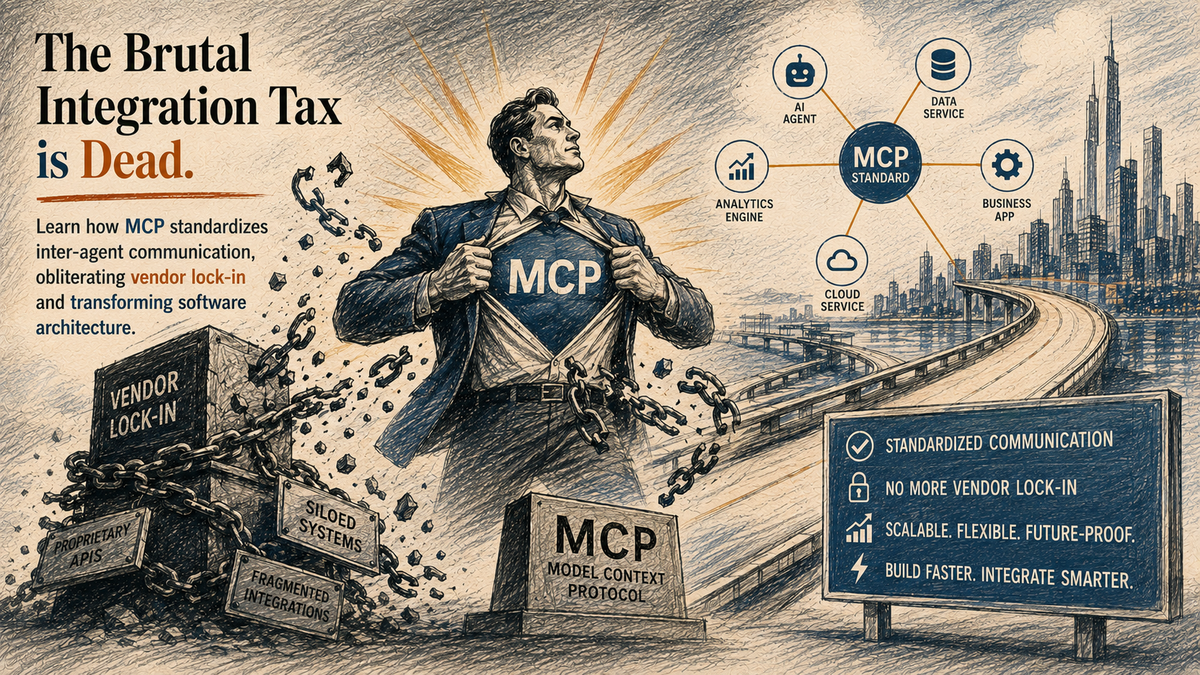
The brutal integration tax is dead. Learn how MCP standardizes inter-agent communication, obliterating vendor lock-in and transforming software architecture.
"The most important thing in communication is hearing what isn't said." Peter Drucker
Standardization That Changes Everything
Picture this: You're in a meeting where five different consultants from different firms need to collaborate on a complex project. Each speaks a different professional language—legal, financial, technical, marketing, and strategic. In the traditional world, you'd need extensive pre-meeting coordination, standardized templates, and rigid protocols just to ensure everyone could understand each other. Now imagine if these consultants could dynamically understand each other's expertise, share context fluidly, and collaborate seamlessly without any of that upfront orchestration.
This is exactly what's happening in the world of AI agents right now, and it's about to fundamentally change how software is built, deployed, and used in your organization.
Welcome to the era of Model Context Protocol (MCP) and inter-agent communication—not a revolutionary technology, but something far more powerful: a standardization that will reshape the entire software industry by making agent communication as simple and universal as email.
Integration Tax
To understand why MCP represents such a significant breakthrough, we need to first acknowledge what I call the "integration tax"—the enormous cost organizations pay every time they want to connect two software systems. This isn't just a technical problem; it's a business-limiting constraint that has throttled innovation for decades.
Organizations embraced open APIs and API platforms as a first step toward better integration, and that was progress. But when you need to integrate with dozens of different applications, each with their own unique interface, the work of integration and information sharing moves into the application level. Every new API requires more integration work, driving code complexity up and consequently increasing both time and cost.
Here's the reality: integration work, depending on the complexity of the API, can take anywhere from days to months of developer time. In an enterprise environment where you might have 200+ different software tools, this creates a mathematical nightmare. Each new tool requires custom integration work with every existing tool it needs to communicate with. The costs compound exponentially.
More insidiously, this approach creates massive vendor lock-in. When you've invested months of developer time building custom integrations with a particular vendor's API, switching becomes prohibitively expensive. Vendors love this dynamic because it protects them from competition, but it strangles organizational agility and innovation.
The current integration model is fundamentally incompatible with how AI agents work. Agents are dynamic, goal-oriented, and adaptive. They can't be constrained by rigid, pre-defined interfaces that require months of custom development for each new connection.
MCP: The USB-C Port for AI Applications
Model Context Protocol isn't revolutionary technology—it's something far more powerful: a standardization that solves a necessary problem and makes it easy for agents to communicate. To understand MCP's significance, think of it as the USB-C port for AI applications. Just as USB-C provides a standardized way to connect your devices to various peripherals and accessories, MCP provides a standardized way to connect AI models to different data sources and tools.
Originally proposed by Anthropic as an open protocol, MCP standardizes how applications provide context to large language models. What makes MCP truly significant isn't its technical innovation, but the fact that it's a standard being embraced by all major vendors. This vendor alignment virtually guarantees its adoption, which is what transforms MCP from an interesting technical specification into a business game-changer.
The power of MCP lies in its simplicity and universality. The protocol follows a straightforward client-server architecture where host applications like Claude Desktop, IDEs, or AI tools can connect to multiple servers. MCP clients maintain one-to-one connections with servers, while MCP servers are lightweight programs that each expose specific capabilities through the standardized protocol. These servers can securely access your local data sources—your computer's files, databases, and services—as well as remote services available over the internet through APIs.
This architecture moves complex integration coding from the application developer level into the standard itself. Problems like sharing results, maintaining context across agent interactions, and coordinating multi-agent workflows—all of these move into the standard and away from custom application development. Instead of writing unique integration code for every system, developers can focus on building intelligent agent behaviors while relying on MCP to handle the communication infrastructure.
End of Vendor Lock-in
Here's where MCP becomes truly transformative for business strategy: it eliminates vendor lock-in by commoditizing agent integration. When every agent can communicate through the same standardized protocol, switching from one vendor to another becomes as simple as changing a configuration setting rather than months of redevelopment work.
This fundamentally changes the competitive dynamics in the software industry. Previously, vendors could rely on integration complexity to create switching costs that protected their market position. With MCP, vendors must compete purely on the quality and value of their offerings rather than on how difficult they are to replace.
This commoditization doesn't favor only the big players—quite the opposite. When you drop integration costs to near zero and eliminate vendor lock-in, anyone can compete, especially smaller vendors who can move faster and focus on specific capabilities. The ability to deliver software rapidly with modern AI tools makes small vendors more competitive than ever, as long as they produce better products.
A specialized AI agent that excels at one specific function can now compete directly with similar functionality buried in a large platform, because organizations can easily swap out individual agents without disrupting their entire technology stack. This creates a highly competitive environment where vendors and new players are constantly competing on merit rather than on switching costs.
Built-in Trust and Control
One of the most compelling business arguments for MCP is how it addresses security through design rather than as an afterthought. MCP uses a capability-based negotiation system where clients and servers explicitly declare their supported features during initialization, ensuring that both parties understand exactly what capabilities are available and how they can be used.
The protocol includes robust security principles that address the real-world concerns of enterprise adoption. For tools that represent arbitrary code execution, MCP requires explicit user consent before invoking any tool, ensuring that users understand what each tool does before authorizing its use. For resources that contain sensitive data, hosts must not transmit resource data elsewhere without user consent, and user data should be protected with appropriate access controls.
Perhaps most importantly, MCP includes LLM sampling controls that give users explicit approval over any LLM sampling requests. Users control whether sampling occurs at all, the actual prompt that will be sent, and what results the server can see. The protocol intentionally limits server visibility into prompts, maintaining privacy and security boundaries.
This security-by-design approach enables organizations to implement a single security control plane that all agents work through. Instead of securing dozens of individual integrations, each with their own authentication mechanisms, data flows, and potential vulnerabilities, MCP enables organizations to implement comprehensive security controls, monitoring, and governance at the protocol level.
This consolidation actually makes systems more secure, not less. When you have one standardized way that all agents communicate, you can implement context-aware security that evaluates agent requests based on factors like data sensitivity, agent trustworthiness, and business context. For risk-averse organizations, this represents a significant advantage over managing security across dozens of different integration patterns.
Technical Foundation
Understanding MCP's technical foundation helps explain why it's gaining such rapid adoption. Rather than inventing entirely new approaches, Anthropic built MCP on proven technologies, adapting concepts from the Language Server Protocol (LSP) that already standardizes how programming languages work across development tools.
MCP uses JSON-RPC 2.0 as its message format, providing stateful connections that focus on context exchange and sampling coordination between clients and servers. This choice ensures reliability and familiarity for developers while enabling the dynamic behavior that makes MCP powerful.
The protocol's capability-based negotiation system ensures that clients and servers can evolve independently while maintaining compatibility. During initialization, both parties explicitly declare their supported features, creating a negotiation process that determines which protocol features and primitives are available during the session. This design prevents the fragmentation that has plagued other integration standards.
What makes MCP particularly "AI-native" is how it refines patterns seen in agent development. While older standards like OpenAPI, GraphQL, or SOAP exist for API interaction, MCP was designed specifically for the needs of modern AI agents. The three primitives—Tools (model-controlled actions), Resources (application-controlled context), and Prompts (user-controlled interactions)—map directly to how AI systems actually work rather than forcing AI behavior into traditional software integration patterns.
This technical foundation explains why major technology companies have embraced MCP so quickly. It builds on familiar technologies while solving the specific challenges that emerge when AI agents need to interact dynamically with external systems and each other.
Why This Matters
The emergence of MCP and inter-agent communication protocols isn't just a technical curiosity—it's a fundamental shift that will impact every aspect of how your organization uses technology. Here's why this matters:
The End of Integration Hell: Today, integrating different software systems is a major source of cost, complexity, and technical debt. MCP promises to make software integration as simple as introducing two people at a networking event. Instead of months of development work, agents can discover and start collaborating with new tools in real-time.
Accelerated Innovation: When software systems can communicate naturally and dynamically, the pace of innovation accelerates dramatically. Instead of waiting for IT to build custom integrations, business users can configure agents to work with new tools immediately. This removes a major bottleneck in organizational innovation.
Cost Reduction: The current cost of maintaining software integrations is staggering. Every API change requires developer time. Every new tool requires integration planning. MCP dramatically reduces these costs by enabling automatic adaptation to changes and instant integration with new tools.
Competitive Advantage: Organizations that can rapidly adapt their software ecosystem to changing business needs will have a significant competitive advantage. MCP enables this adaptability by making software systems more fluid and responsive.
Risk Mitigation: Ironically, while MCP enables more dynamic behavior, it can actually reduce technical risk. Instead of brittle, hard-coded integrations that break when systems change, MCP creates resilient connections that can adapt to changes automatically.
Real-World Applications
Let me share some concrete examples of how organizations are leveraging MCP to solve real business problems, moving beyond theoretical possibilities to demonstrate value.
Financial Services Transformation: Investment firms are implementing MCP-based systems where research agents can dynamically discover and collaborate with market data providers, analysis tools, and reporting systems. When a new data source becomes available, agents can immediately begin incorporating it into their analysis without requiring IT intervention. This has reduced time-to-market for new analytical capabilities from months to days while improving data coverage and analytical depth.
Healthcare Integration: Hospital networks are using MCP to enable communication between diagnostic agents, scheduling systems, and treatment planning tools. When a diagnostic agent identifies a condition requiring specialized treatment, it can automatically coordinate with scheduling agents to find appropriate specialists and coordinate care without human intervention. This has reduced patient wait times and improved care coordination while maintaining strict privacy and security controls.
Development and DevOps: Software development teams are building MCP servers that provide access to Git repositories, issue tracking systems, and deployment pipelines. Developers can create AI assistants that understand their entire development ecosystem, from code repositories to production monitoring, enabling more intelligent debugging, code review, and deployment decisions.
Customer Support Revolution: Technology companies are implementing MCP-enabled customer service systems where support agents can collaborate with product databases, ticketing systems, and escalation tools. When a customer inquiry comes in, the system automatically gathers relevant context from multiple sources and coordinates the appropriate response, reducing resolution times and improving customer satisfaction.
These implementations demonstrate that MCP isn't just a future possibility—it's a current reality that's already transforming how organizations operate. The key insight from these early adopters is that MCP's value comes not just from technical efficiency, but from enabling entirely new workflows that weren't possible with traditional integration approaches.
Building for the Agentic Future
For IT leaders, understanding the technical architecture implications of MCP is crucial. Traditional enterprise architecture is built around the concept of discrete systems with well-defined interfaces. MCP requires a fundamentally different approach.
Microservices Evolution: MCP accelerates the evolution from monolithic applications to microservices, but with a twist. Instead of services that communicate through rigid APIs, you get services that can describe themselves and discover each other dynamically.
Event-Driven Architecture: MCP works particularly well with event-driven architectures where agents can respond to real-world events and coordinate their responses dynamically. This enables more reactive and adaptive systems.
Security Paradigm Shift: Traditional security models are based on controlling access to specific endpoints and data structures. MCP requires a more sophisticated approach based on context, intent, and dynamic risk assessment.
Monitoring and Observability: When agents are discovering and using tools dynamically, traditional monitoring approaches become insufficient. You need new approaches to observability that can track agent behavior and collaboration patterns in real-time.
Breaking Through Risk-Averse Resistance
The biggest barrier to MCP adoption isn't technical—it's cultural. Risk-averse organizations often try to make change impossible, all in the name of protection and fear. This resistance can be intractable, driven by stakeholders who are more afraid of the unknown than they are of the known costs of maintaining the status quo.
Convincing fearful stakeholders requires patience up to a point, but when it becomes obvious they're not going to budge, CEO-level involvement becomes necessary. This is like dealing with someone who has never worked out their entire life and is struggling physically because of it, yet insists they can't lift weights because they're afraid they'll get hurt. Their risk aversion to progress and doing something beneficial will only lead to their decline and deteriorate their position faster.
The breakthrough typically comes when senior executives lay out the business implications of not adopting MCP. When leaders understand that competitors are gaining advantages through faster innovation, lower integration costs, and greater agility, the fear of change often becomes less compelling than the fear of being left behind.
Organizations that embrace MCP early will gain significant advantages in time-to-market, cost efficiency, and competitive positioning. Those that resist will find themselves increasingly disadvantaged as their competitors operate with greater agility and lower technology costs.
Security and Governance
The dynamic nature of MCP creates new security and governance challenges that organizations must address. When agents can discover and use tools dynamically, traditional security models based on predefined access controls become insufficient.
Dynamic Risk Assessment: Security systems need to evaluate the risk of agent actions in real-time, considering factors like the sensitivity of data being accessed, the trustworthiness of the tools being used, and the potential impact of the actions being taken.
Audit and Compliance: When agents are making dynamic decisions about which tools to use and how to use them, creating audit trails becomes more complex. Organizations need new approaches to tracking agent behavior and ensuring compliance with regulations.
Identity and Access Management: Traditional IAM systems are designed around human users and predetermined access patterns. MCP requires IAM systems that can handle dynamic agent identities and context-aware access decisions.
Tool Validation: When agents can discover and use tools dynamically, organizations need processes for validating the security and reliability of those tools before they're used in production environments.
Economics of MCP
From a financial perspective, MCP represents a fundamental shift in the economics of software development and maintenance. Traditional software integration follows a model where costs increase dramatically with complexity. Each new integration requires significant upfront investment and ongoing maintenance.
MCP flips this model. While there's still upfront investment in building MCP-compatible tools and agents, the marginal cost of each new integration approaches zero. Once you have MCP-enabled infrastructure, adding new tools and capabilities becomes dramatically cheaper and faster.
This has profound implications for software budgeting and planning. Instead of large, upfront integration projects, organizations can make smaller, more frequent investments in new capabilities. This enables more agile, responsive technology strategies.
The efficiency gains are equally significant. When agents can discover and use tools dynamically, they can optimize their own performance by selecting the most appropriate tools for each task. This can lead to significant improvements in operational efficiency without human intervention.
Implementation
Organizations need to start planning for MCP adoption now, not later. The window for gaining competitive advantage through early adoption is limited, and the costs of delayed implementation will compound over time.
But what does "planning for MCP" actually look like in practice? It's not just about technology—it's about fundamentally rethinking how your organization approaches software procurement, vendor relationships, and system architecture.
First, start evaluating your current integration landscape. Catalog the time and cost you're currently spending on integration work. Map out your vendor dependencies and identify where lock-in is limiting your flexibility. This assessment becomes your baseline for measuring MCP's impact.
Second, begin incorporating MCP compatibility into your software procurement criteria. When evaluating new tools and platforms, prioritize vendors who support MCP or have clear roadmaps for adoption. This prevents you from adding to your integration debt while the transition is underway.
Third, start pilot projects with MCP-enabled tools in non-critical areas. Focus on use cases where you can experiment with the new paradigm without risking core business operations. These pilots become your learning laboratory for understanding how MCP changes your operational processes.
The timeline for full MCP adoption varies by organization, but the key is starting the transition before you're forced to by competitive pressure. Organizations that begin planning now will be positioned to capture the benefits as MCP becomes standard infrastructure. Those that wait will find themselves playing catch-up with competitors who moved earlier.
Competition Without Lock-in
MCP is creating a fundamental shift in software industry dynamics. We're moving toward a world where software competition becomes more like commodity markets—focused purely on quality, performance, and value rather than on switching costs and integration complexity.
This doesn't mean a race to the bottom on pricing. Instead, it means vendors must compete on the merit of their solutions rather than on how difficult they are to replace. This drives innovation because vendors can't rely on lock-in to maintain their market position—they must continuously improve their offerings to retain customers.
The result is better software, more powerful agents, and a highly competitive environment where vendors and new players are constantly innovating. Small vendors can compete directly with large platforms by building specialized agents that excel at specific functions. Customers can build best-of-breed solutions by combining agents from different vendors without worrying about integration complexity.
This transformation won't happen overnight, but it's already beginning. Organizations that understand and prepare for this shift will be best positioned to benefit from the increased agility, reduced costs, and enhanced capabilities that MCP enables. Those that continue to operate under the old integration paradigm will find themselves at an increasing disadvantage.
Standardization
Model Context Protocol represents a fundamental shift in how we think about software integration, vendor relationships, and business technology. This isn't revolutionary technology—it's something more powerful: a standardization that will reshape the entire software industry by eliminating integration complexity and vendor lock-in.
The implications are profound. When agents can communicate through a single, standardized protocol, software systems become more agile, more competitive, and more valuable. Organizations gain the flexibility to choose best-of-breed solutions without worrying about integration costs or vendor dependencies.
Success with MCP requires more than just technical implementation. It demands a rethinking of vendor relationships, risk management, and competitive strategy. Organizations that embrace this change will gain significant advantages in flexibility, innovation speed, and cost efficiency. Those that resist will find themselves increasingly constrained by integration complexity and vendor lock-in.
The transformation is already underway. The question isn't whether MCP will become standard—it's whether your organization will be ready to benefit from the competitive advantages it creates. The winners will be those who start planning now, not those who wait for the transformation to be complete.
The age of integration complexity is ending. The age of standardized agent communication is beginning. Are you ready?